

Necessary Evil (2025):
Writer: Owen Hammer
Artist: Mariano Navarro and Hernan Cabrera
The Authority (2000):
Writer: Mark Millar
Artist: Frank Quitely
This is a review of a ground-breaking title from the turn of the millennium, contrasted with a recent title from an independent publisher. Despite being 25 years apart, the similarities are striking.
(In an effort to mitigate confusion, this title was renamed from Rogues Gallery to Necessary Evil in March 2026. We found this change added to the confusion. Some of the images used in this review refer to the previous title.)
1. Once upon a time, a quarter of a century ago
In 2000, writer Mark Millar took over writing reins on The Authority, an increasingly popular but solidly second-tier superhero title published by Wildstorm Comics. It was the new millennium and before 9/11, change was in the air. In true fin de siecle fashion, Mr Millar used the title to transform the superhero genre.
The superhero team of The Authority consisted of Jack Hawksmoor (the so-called god of cities), Apollo (a solar-powered stand-in for Superman), his lover Midnighter (a stand-in for Batman), Shen (a flier), The Engineer (a scientist whose blood had been replaced by nanites and who can construct anything from the shell surrounding her body), and The Doctor (a stand-in, of sorts, for the BBC’s Dr Who, but who was described as the planet’s protective shaman rather than as a Timelord).
This paradigm shift came with the sound of smashing glass and burning wires. Mr Millar noted that there were plenty of real-world villains around. The Authority’s interventions were, towards the beginning and again at the end of Mr Millar’s stint as writer, directed against regimes engaged in mass atrocities or covert operations that threatened civilian populations. Mr Millar recognised most significant threats to humanity arise not from eccentric costumed villains but from organised, systemic violence carried out or enabled by governments.
The message was ably assisted by Mr Millar’s fellow Scot, Frank Quitely. Mr Quitely had taken over as artist on The Authority from Bryan Hitch. Mr Hitch had developed a reputation for modern cinematic verisimilitude – action movies on paper, with a big cast of characters in widescreen shots. Mr Quitely continued this style:
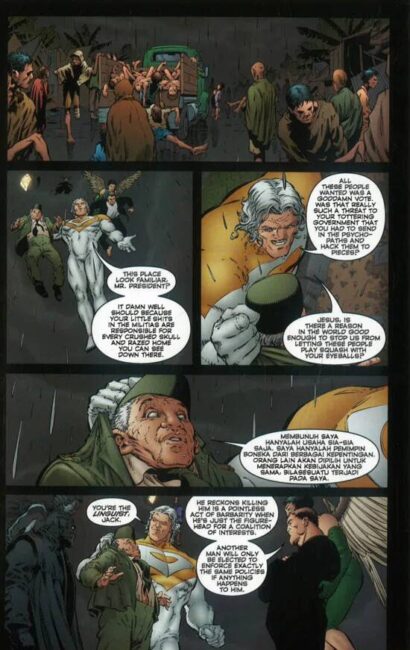
The first issue of Mr Millar’s run on the title coincided with the secession of Timor Leste from Indonesia. Timor Leste had started its existence as a political entity when established by the Portuguese in around 1769. In 1975, Indonesia invaded the Portuguese colony and brutally endeavoured to integrate it. In 1999, Timor Leste was able to declare independence with low-engagement military support from Australia. Indonesia’s response was to allow pro-government militia to run rampage throughout the new country, systemically murdering and burning. The first issue ‘s opening pages directly deals with these atrocities. But Wildstorm Comics did chicken out, a little: the action is described as taking place in “Southeast Asia”, rather than specifically Timor Leste.
Within this first issue, and again throughout the title, Mr Millar pondered would have happened if superheroes were real, not bound by some hypocritical moral code which preventing them from intervening in politics, and decided to act? Mr Millar has The Authority invade a military base in Jakarta, machine-gun down the Indonesian government’s political cabinet, and dump someone who very much resembled then-Indonesian president BJ Habibie into a truck full of bodies to be deal with by Timorese survivors. Jack Hawksmoor is later admonished by Bill Clinton, then President of the United States, for disturbing the geopolitical status quo. Hawksmoor stares Clinton down.
Later still, in one of the run’s most politically explicit moments, The Authority issues demands to the Chinese government regarding its treatment of Tibet, framing the Chinese occupation as a human rights crisis requiring immediate redress. It confronted the comic book cowardice of the invention of countries—Qurac (DC Comics’ version of Iraq), Bialya (DC Comic’s substitution for Libya), and Genosha (Marvel Comics’ version of apartheid South Africa)— by which mainstream comic book publishers gestured toward geopolitics while avoiding direct commentary on real-life oppressive governments.
All of this was overlaid with gallows humour and whip cracking dialogue. The droll comedy stopped the title from being preachy. Here is one example: The Authority barely beat a rival, psychopathic Doctor by waiting for his powers to properly kick in and become one with the universe, a state of enlightenment. The bad Doctor is on his knees, weeping at what he has done. Apollo promptly burns their defeated foe’s skull and, in a moment of pointless anger, Swift kicks his charred head from his neck. The man was no longer a threat, but the characters sought petulant revenge. It was dark and funny stuff.
2. Where is the weather?
One notable omission in Mr Millar’s over-arching plot is the absence of climate change as a systemic threat. By 2000, scientific consensus had already established global warming as a significant and escalating risk (indeed, US presidential candidate Al Gore unsuccessfully ran an election on the issue in 2000). Yet The Authority does not address environmental degradation as part of its critique of state failure.
This omission is striking given the series’ willingness to intervene in geopolitical crises such as Timor Leste and Tibet, and the title’s broader argument that governments are the primary agents of large‑scale harm. Climate change represents precisely the kind of transnational, structural problem that aligns with the comic’s thematic concerns: climate disruption is produced by state and corporate policy, disproportionately affects vulnerable populations, and exposes the limitations of capitalist democracies. As for Mr Quitely and his meticulous artwork, he barely noticed the sky.
3. “Nazi Scientist Foiled By Climate Change!”
In that regard, Necessary Evil, by Owen Hammer, picks up where The Authority left off. Some hapless supervillains called O.V.E.R.L.O.R.D. are foiled in their plot of world domination by a bunch of generic superheroes called the Freedom Council. The acronym – “Omniscient Vanguard Engaged in Radical Liberation Organizing Rightful Dominion” clearly points to a parody. Here is the promotional copy from the Kickstarter website:
For almost a hundred years the colorful heroes of THE FREEDOM COUNCIL have fought the bizarre, sinister, world-domination ambitions of O.V.E.R.L.O.R.D. This has been the status quo—patriotic heroes, mysterious vigilantes, gods and technological marvels fighting the remnants of the Axis Powers—evil geniuses, inhuman monsters, dark magic and walking weapons of mass destruction. With neither side having an advantage, it seems like the never ending battle against evil, might actually be never ending.
Now, O.V.E.R.L.O.R.D. has realized that their doomsday weapon will only work if anthropogenic climate change is reversed, and this becomes their new goal, leaving their heroic counterparts in a moral quandary.
Rogues Gallery is a satire that pokes fun at super-hero tropes but also offers some insight into the nature of the real problems (and real villains) that plague humanity.
The book is written by Owen Hammer with art by Mariano Navarro and Hernán Cabrera—the team that brought you the graphic novel Von Bach (also successfully funded by a Kickstarter campaign).
Mr Hammer’s protagonists are riffs of mainstream American superheroes – a Wonder Woman trope, a Thor trope, a Spider-Man trope and so on. The secondary cast are undeniably villains, and Mr Hammer has gone out of his way to ensure that they are recognised as such. We have a Nazi-era super-scientist leader called Dr Null, some sort of demon lord, an evil assassin, an evil sentient computer called, blandly, Computor which resembles Marvel Comics’ Ultron, and so on.
But what is the difference between O.V.E.R.L.O.R.D and The Authority? Mr Millar’s cast of The Authority could be villains if one squinted hard enough. None of them have compulsion about murder, kidnapping, torture (Midnighter is demonstrated to be very handy with a cattle prod), and general disregard of the rule of law. The overarching proposition is that team are motivated by liberalism, rather than altruism. (After all, what kind of global shaman turns his opponents’ bones into Calvin Klein underwear?) Perhaps the only difference is that The Authority were effective. O.V.E.R.L.O.R.D, by design, are not.
In Necessary Evil, Mr Hammer has one of the heroes of the story, Spook (a thinly veiled version of Spider-Man) decide to quit the team. Spook doesn’t see the point of never-ending battles where the bad guys are foiled but somewhere seem to always get away. Traditional superhero comics often rely on ritualised, non‑lethal combat: heroes and villains engage in repeated confrontations that rarely produce lasting structural change. The Authority disrupts this pattern through decisive interventions, lethal force when necessary, and conflicts framed in geopolitical rather than personal terms. Mr Millar’s critique extends to the formal conventions of superhero storytelling.
This rejection of ritualised combat functions as a critique of the genre’s tendency to avoid engagement with real‑world politics by confining conflict to reversible, individualised confrontations. Hawksmoor’s exchange with Clinton underscores this shift: the Authority refuses to limit itself to symbolic interventions, and the president’s discomfort reflects the threat this poses to established power structures.
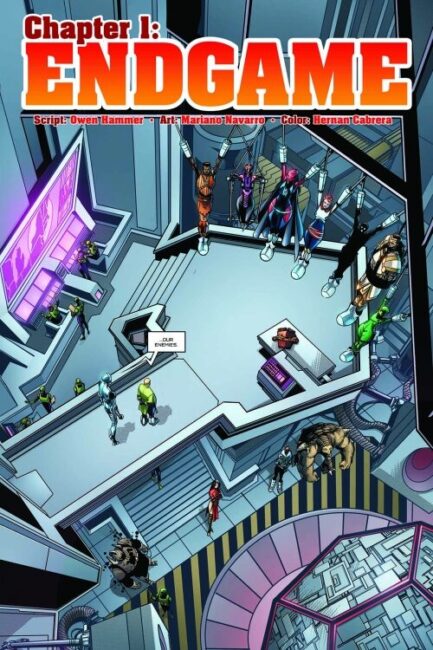
The art in Necessary Evil is delivered by Mariano Navarro and Hernán Cabrera, and is like the rest of the issue satirically cliched. How often have readers of superhero comics seen heroes tied up to walls like hunting trophies to be mocked by their captors? It must be a countless number of times, in titles ranging from 1990s Uncanny X-Men to 2010s Justice League to the 1980s New Teen Titans. As Scott Evil notes in the motion picture Austen Powers, why not just kill them? And, inevitably, the superheroes escape, thanks to melting ice caused by the planet’s overheating.
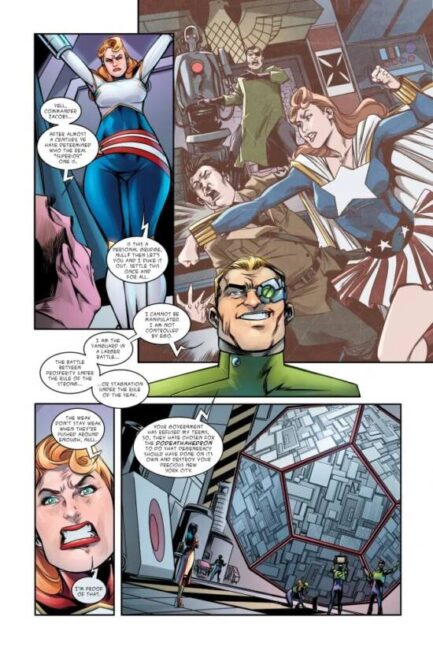
With O.V.E.R.L.O.R.D.’s latest plan stymied by global warming, Dr Null, informed of their cause of their defeat by Computor, decides he must do something about it.
And so who are the bad guys in this series? The supervillains who repeatedly fail, or the people responsible for climate change? We wonder if the Necessary Evil described in the title are actually Chevron, Conoco-Philips, Shell, BP and other oil and gas companies, rather than the costumed supervillains and their ridiculous plots.
Where will Necessary Evil go to from here? Within Mr Millar’s run, the most striking representation of state response to the Authority is the deployment of Seth (often nicknamed “Three‑Willy Seth”), a black‑ops metahuman asset of the U.S. government. Seth, an almost unbeatable, monstrous cyborg, is introduced as an unofficial presidential bodyguard and government assassin, activated when the Authority’s interventions are deemed intolerable.

The threshold for this escalation is notably low: the Authority’s unilateral humanitarian interventions are framed as threats not because they are unjust, but because they bypass state authority. What happens, then, if O.V.E.R.L.O.R.D attack the headquarters of companies who warm the world because they underpin government’s energy security? Will the Freedom Council be compelled to stop them? Are these superheroes lackeys to government and corporate interests? We shall see what Mr Hammer and his collaborators have in store for us.
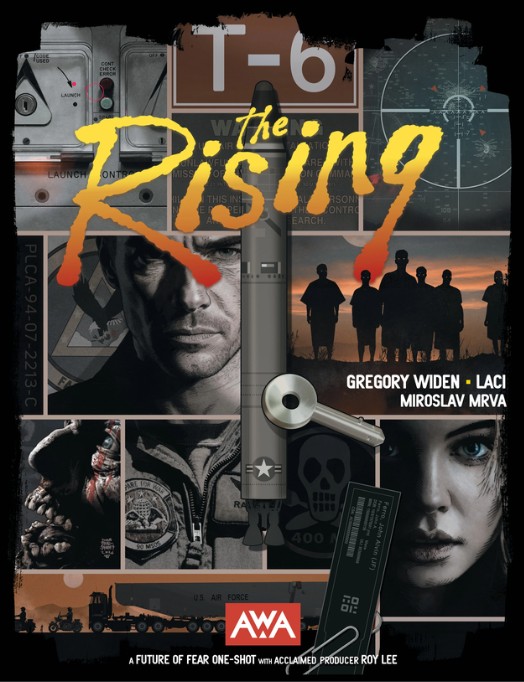
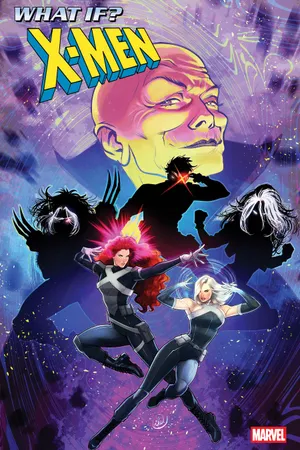
Finally, we have to say how much this alternative cover to Rogues Gallery #1 to issue one amused us. In order to give it full effect, we have placed it below the cover to which it pays homage:
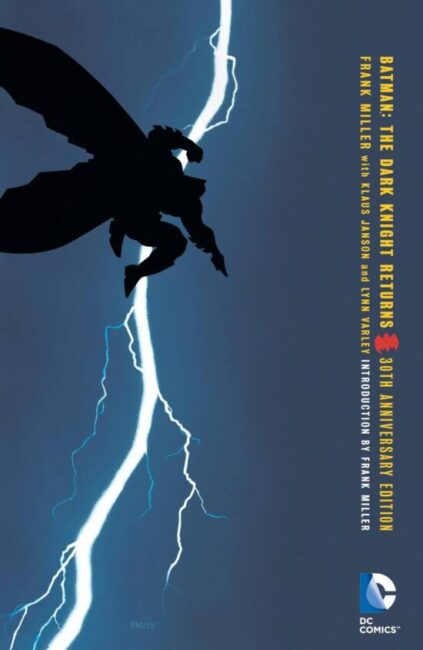
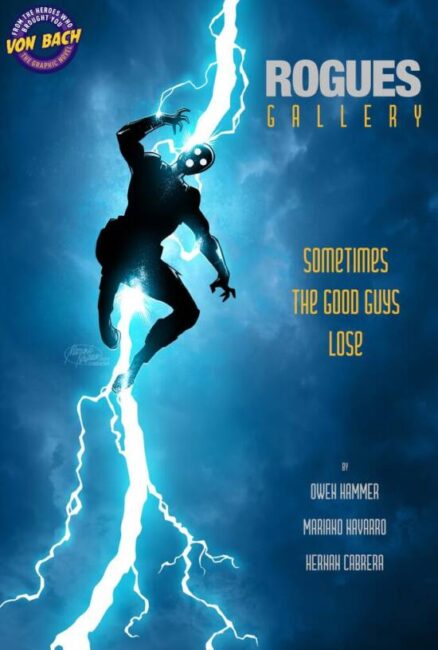
That looks painful.
Necessary Evil #1 is available on Amazon – see .https://www.amazon.com/Necessary-Evil-issue-1-Endgame-ebook/dp/B0G5L7LDXQ/ Issue 2 was successfully funded via Kickstarter in March 2026- see https://www.kickstarter.com/projects/the-hammer/necessary-evil-issue-2 and is yet to be released.