


Creator: Katie Skelly
Fantagraphics, July 2026
Katie Skelly’s Heaven, published by Fantagraphics, is the kind of horror graphic novel that appears poised to employ a familiar trick: adopting a minimalist, almost childlike visual language before gradually revealing something far more sinister beneath the surface. (We saw that concept delivered with startling, horrifying effect in Patrick Horvath’s chilling Beneath the Trees, a title we intend to review soon.)
Heaven however has little misdirection by faux-innocence. The cover alone presents a strip club atmosphere in all its excesses, populated by scantily clad dancers, alcohol, and showering cash. The opening pages are equally direct, introducing readers to an unsettling ritualistic scene involving cloaked women, violence, and murder. Ms Skelly wastes no time establishing that, despite its clean visuals, this is very much a mature horror story.
Here is Fantagraphics’ promotional blurb:
Out past the edge of town, there exists a strip club called Heaven that only some can find. Some say it’s a mirage. Others say you can’t miss the giant neon heels lighting up the desert night skies.
Dolly can’t find a place to belong. After losing her identity as a gymnast and navigating family turbulence, she’s adrift from school and friends. When a mysterious presence beckons her to Heaven, she wonders if she may just have found her place — but just what does it want in return?
Katie Skelly’s first graphic novel since her acclaimed Maids in 2020, Heaven finds out what happens when the artist’s quintessential cool girl characters let their guards down and let the world in. With a supernatural strip club backdrop and an eye-popping sense of color that would make Dario Argento proud, Heaven reinforces Skelly’s place as one of the most distinctive voices working in contemporary comics today.
This promotional copy reminds us of the message in The Eagles’ song Hotel California (with apologies for ear-worming the lyrics into your head for the next hour). The title however is more accessible than that.
The narrative centers on Dolly, who struggles with a problem many teenagers will find familiar: ennui. School offers little satisfaction, her academic performance is unremarkable, and life feels increasingly stagnant. Seeking excitement, Dolly and her friends become fascinated with Heaven, a mysterious strip club that has attained urban legend status. Depending on who you ask, Heaven is either a thriving venue hidden in plain sight or a complete fabrication that cannot be found at all. Online reviews only deepen the mystery, presenting a curious divide between enthusiastic patrons and frustrated seekers convinced the place does not exist.
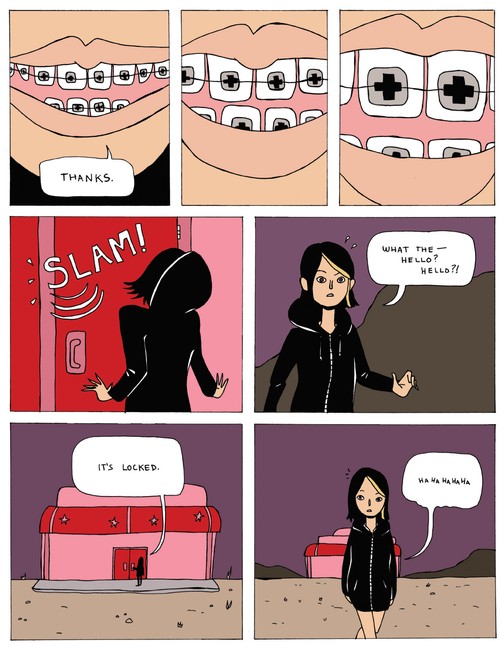
As the only member of her peer group who has turned eighteen, Dolly is the obvious choice to investigate. What begins as a simple attempt to satisfy curiosity quickly becomes something more significant when she impulsively applies for a job at the club. Initially rejected for an unexpected reason, Dolly returns determined to prove herself, eventually attracting the attention of Heaven’s enigmatic owner, Lover. Her acceptance comes under unusual circumstances, hinting early on that Heaven operates according to rules that extend well beyond those of an ordinary business.
From there, Heaven unfolds as an intriguing blend of horror, mystery, and coming-of-age drama. The supernatural elements become increasingly apparent as Dolly learns more about the club and the people who inhabit it, but Ms Skelly resists reducing the story to a straightforward tale of predators and victims. There is an ambiguity to Heaven and its inhabitants. Even as unsettling truths emerge, the book remains interested in questions of belonging, personal agency, and the possibility of choosing one’s own future.
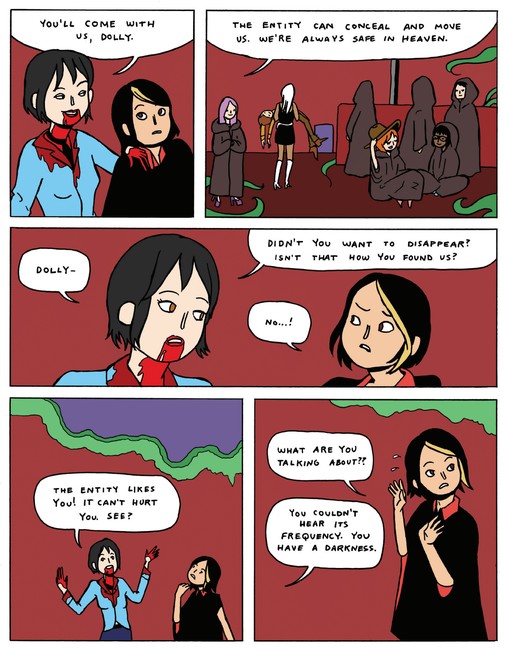
That emotional complexity is what elevates Heaven beyond its horror premise. It is a story populated by monsters, but it is not necessarily a story about malice. Instead, it explores the allure of escape, the excitement of stepping into an unfamiliar world, and the difficult process of deciding what kind of person you wish to become. There are shades of sex positivity woven throughout the narrative, alongside that surprisingly optimistic undercurrent about carving out your own path.
Visually, Ms Skelly employs a clean, minimalist style characterized by flat colors, straightforward compositions, and uncluttered page layouts. The title’s art looks towards character acting, body language, and subtle shifts in perspective. The result is an aesthetic that is highly readable and deceptively expressive.
While it is off-beat, Heaven does not radically reinvent horror. It succeeds however by combining familiar ingredients into a thoroughly engaging package. The title balances horror and youthful uncertainty with confidence, delivering a graphic novel that is accessible and quietly affecting.