Writer: Skye Wallin
Illustrator: Artúr Várai
Independently published, December 2026
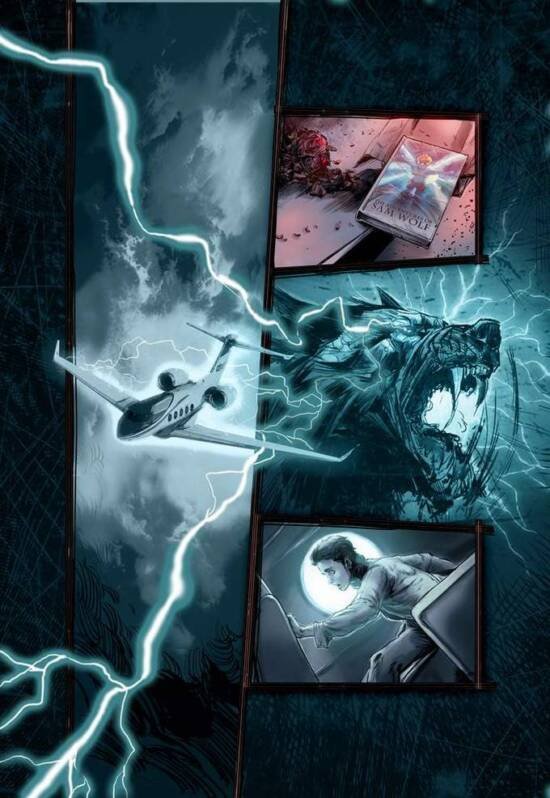
Richard Kilborne has a problem. His bestselling fantasy series, “Sam Wolf,” is running out of steam, and his latest book isn’t receiving the reviews he hoped for. Dream Corp sees an opportunity to turn the property into something bigger, offering Richard a deal that would give the company perpetual rights to his creation. His teenage son Isaac, however, has little interest in watching his father’s fictional hero become an even bigger commercial enterprise. Their disagreement takes a turn for the worse when a storm brings their plane down on a deserted island, leaving Isaac to fend for himself.
In Wolf’s Edge, a 108 page comic book written by Skye Wallin and illustrated by Artúr Várai, the crash sets up two parallel stories. Isaac must learn to hunt, find food, build shelter and deal with the dangers of an environment that offers none of the comforts he has taken for granted. Meanwhile, Richard and Wanda Kinsey, the head of Dream Corp, must fight to survive while Richard’s past begins to catch up with him, including the complicated relationship with his twin brother who originally helped inspire the Sam Wolf stories.
Here is the promotional copy:
Wolf’s Edge is an original, hand-drawn graphic novel. Richard Kilborne, a famed children’s writer, is about to release his latest book in The Adventures of Sam Wolf saga, which his son Isaac, who just turned 18, refuses to read. They unexpectedly board a jet with media mogul Wanda Kinsey, eager to turn Richard’s stories into a global empire.
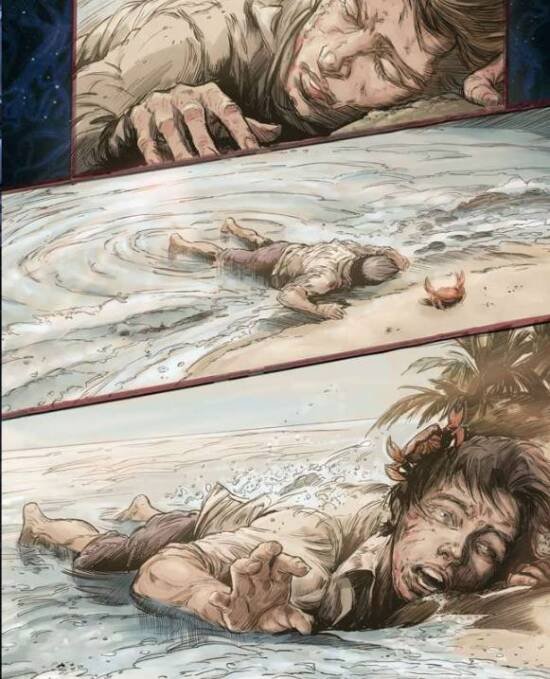
When a storm destroys the plane, Isaac washes up alone on a desolate island. With only a baby boar at his side, Isaac must survive the brutal wilderness. Using his father’s book as a guide, Isaac embarks on a journey of transformation, claiming the island and embracing the character of Sam Wolf.
Mr Wallin’s story has an interesting idea at its core. Sam Wolf began as an imaginary companion for unwanted children in a foster home, a fantasy world offering an escape from an unpleasant reality. But as Richard turns that childhood creation into a commercial success, the character becomes something else entirely. What began as a source of comfort eventually becomes an obsession, a business asset and a burden that Richard struggles to separate from his own identity.
The irony is particularly effective when Isaac, who has spent years resenting the fantasy, finds himself forced into a situation where survival requires him to draw upon the same imaginative instincts that his father spent a lifetime cultivating.
The book also has plenty to say about the relationship between creativity and commerce. Dream Corp’s negotiations are less concerned with preserving the original spirit of Sam Wolf than with exploiting its potential. Richard knows the character has become increasingly difficult to sustain, but he is also reluctant to relinquish control (a scenario reminiscent of George Lucas and his sale of the Star Wars properties).
But Isaac sees the entire enterprise as another example of his father prioritising the fictional world over the people around him. Their arguments feel familiar enough to ground the more fantastical elements of the story, even as the stakes gradually become more extreme.
The pacing occasionally moves a little too quickly, particularly when the narrative jumps between the island and the events surrounding Richard and Wanda. Some developments could have benefited from some extra time in panel. The story’s various threads do not always receive equal attention.
Still, the central conflict remains compelling, and the underlying tension between father and son gives the story a reason to keep moving beyond the immediate dangers of the island.
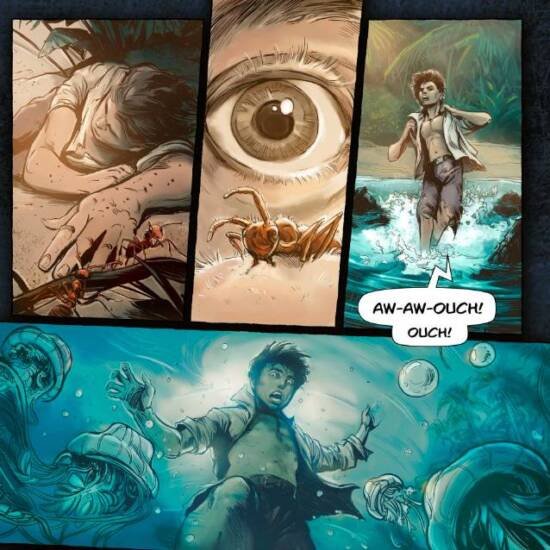
Mr Várai’s artwork is one of the book’s strongest features. His illustrations are textured, expressive and full of movement, with a visual style that gives the story a distinctly uneasy feel. The early scenes of suburban life and corporate negotiations are rendered in muted tones, making the characters’ surroundings feel increasingly confining. Once Isaac reaches the island, the artwork opens up into vivid greens, turquoise waters and dense vegetation, though the apparent beauty of the setting rarely disguises its dangers.
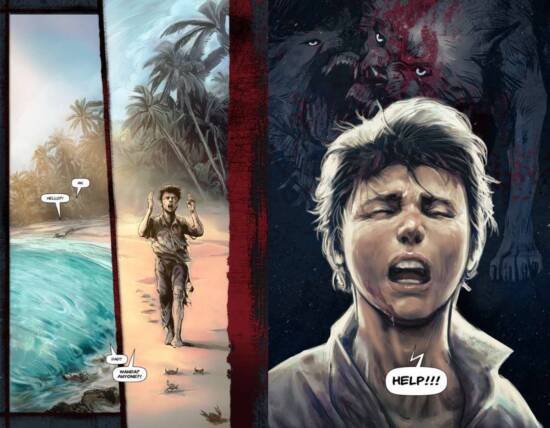
The colour work is particularly effective. Cool blues and teals dominate scenes of isolation, uncertainty and dread, while warmer shades of amber, orange and red accompany moments of panic, violence and anger. The contrast is a visual pendulum, swinging between the different stages of Isaac’s ordeal without relying excessively on dialogue.
Mr Várai also makes excellent use of panel composition. Frames frequently tilt, overlap or break into irregular shapes, reflecting the confusion and instability of the characters’ circumstances. The island sequences are especially effective at conveying physical exhaustion and disorientation, with close-ups of Isaac’s face, bloodied hands and desperate expressions bringing the ordeal down to a personal level. Some pages become visually dense, particularly during the more frantic action scenes, but the artwork generally maintains a clear sense of what is happening.
Wolf’s Edge is an ambitious indie graphic novel that combines family drama, commercial satire and survival horror into an unusual package. Its story occasionally moves faster than its characters can comfortably keep up with, but the premise is strong, the central conflict is compelling and Mr Várai’s artwork gives the book plenty of visual appeal. It is a story about the dangers of living inside someone else’s fantasy, and about what happens when the world you were trying to escape finally disappears beneath your feet.
This title is presently over-subscribed in a Kickstarter campaign: https://www.kickstarter.com/projects/skyewallin/wolfs-edge-a-graphic-novel-survival-thriller