

Writers: Shawn McBee and Maciej Jankowski
Artists: Nicolas Nieto and Matias De Vicenzo
Fandom Limb Media, June 2026.
Fandom Limb Media’s Westron #2, written by Shawn McBee and Maciej Jankowski, with art by Nicolas Nieto and Matias De Vicenzo, is the follow-up issue to the intriguing debut.
The creative team sharpen the series’ identity into something far more emotionally devastating. What initially seemed like a stylish paranormal mystery is quickly revealing itself to be a story about trauma, obsession, and the lifelong scars left behind by unresolved horror. Here is the promotional copy from the website:
“A dead sister. A missing girl. Something waits in the woods. Jan Westron follows a missing-person case into Landri’s Trail, where grief, old violence, and Slavic supernatural lore begin to point at the same impossible answer.”
For those who did not read the first issue, our critique can be found in this link: https://worldcomicbookreview.com/2025/06/18/westron-1-review/ . The series follows Jan Westron, an eccentric private investigator whose deductive abilities border on the supernatural. Comics are visual lines of communication and there are two paths to a comic book story: the art and the text. One of the comic’s most clever artistic flourishes is how Jan’s thought process is visualized through Jan scraps of notebook paper scattered across panels, turning his internal monologue into part of the page design. Jan’s mind is constantly racing ahead of everyone else, and the art makes the reader feel that momentum through these visual cues.
There will inevitably be comparisons between Jan Westron and The X-Files‘ Fox Mulder, and not entirely unfairly. Like the secret-hunting FBI agent Mulder, Jan is defined by a childhood tragedy that became the axis around which his entire adult life spins. Years earlier, his friend Karolina was kidnapped and murdered, while suspicion fell on Jan’s best friend Filip. That unresolved trauma hangs over every page of Westron #2, transforming the investigation from just another case into something deeply personal.
The issue picks up after the horrifying events surrounding sisters Astrid and Natalia, whose encounter with a red-eyed entity in the woods ended in sudden violence and disappearance. Rather than following the mystery forward in a linear way, Westron #2 uses the case as a psychological trigger for Jan, pulling the narrative into parallel timelines that mirror one another in increasingly unsettling ways.
A dual-structure storytelling within the plurality of text and art, then, and it is easily the issue’s greatest strength. On one side, Adult Jan asks key people and follows clues until it leads him to Landri’s Trail, in his attempts to find Natalia before history repeats itself. On the other, Teenage Jan relives the formative catastrophe that transformed him into a supernatural investigator in the first place. The comic essentially asks the reader to solve two mysteries simultaneously: one unfolding in the present, and one buried in the protagonist’s memory.
What makes this structure work so well is how naturally the timelines feed into each other emotionally. The flashbacks are not there merely to dump exposition. Every revelation about Young Jan reframes Adult Jan’s desperation in the present-day storyline. You begin to understand that this is not simply a detective trying to crack another bizarre case. This is someone trying to outrun a failure that has haunted him for years.
The visual storytelling elevates this even further. Having two separate artists handle the past and present gives each timeline its own texture and emotional identity. The contrast helps orient the reader instantly while also reinforcing the feeling that Jan’s memories are almost another world entirely. The present-day sequences feel grimy, immediate, and oppressive, while the flashbacks carry the tragic haze of recollection. It is an ambitious approach for an indie comic, and the creative team pulls it off remarkably well.
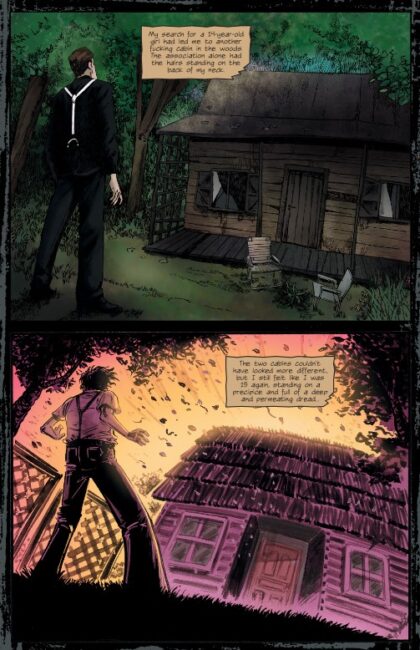
The folklore elements also become far more pronounced here. Westron #2 dives headfirst into Slavic and Nordic mythological horror, firmly establishing that whatever stalks these woods is not merely human evil wearing a monster mask. The comic smartly avoids overexplaining its supernatural elements too early, instead weaponizing atmosphere and implication. The woods themselves begin to feel predatory, ancient, and wrong.
And when the issue finally arrives at its ugliest revelations, it does not pull its punches. The latter portions of the comic veer into genuinely grim territory, culminating in a cliffhanger that feels earned rather than manipulative. Instead of ending on empty shock value, the final pages reinforce the series’ central theme: some wounds never heal, and instead they evolve into obsessions.
What stands out most about Westron #2 is its confidence. Many indie horror comics lean heavily on either lore or gore to maintain momentum. Westron understands that the most effective horror comes from emotional investment. By intertwining supernatural terror with Jan’s unresolved childhood trauma, the series ensures that the monsters matter because the people do.
If the first issue introduced the mystery, issue #2 is the point where the title finds its soul.
You can learn more about this title on its website https://westroncomic.com/. As at the time of this review, the Kickstarter campaign for this second issue begins imminently – see https://www.kickstarter.com/projects/propsmith/westron-2