

Writer: W. Maxwell Prince
Artist: Martin Morazzo
DC Comics, August 2026
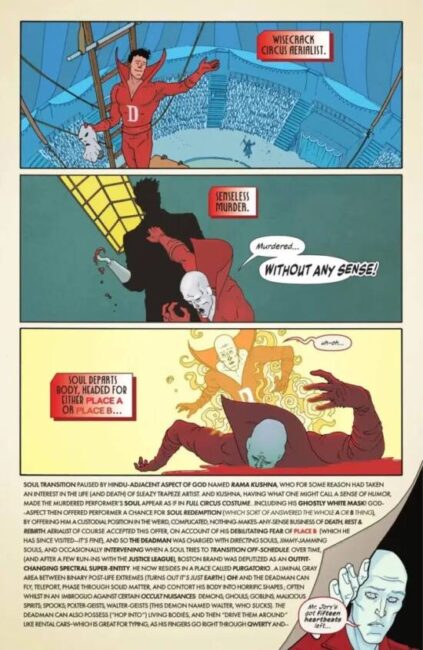
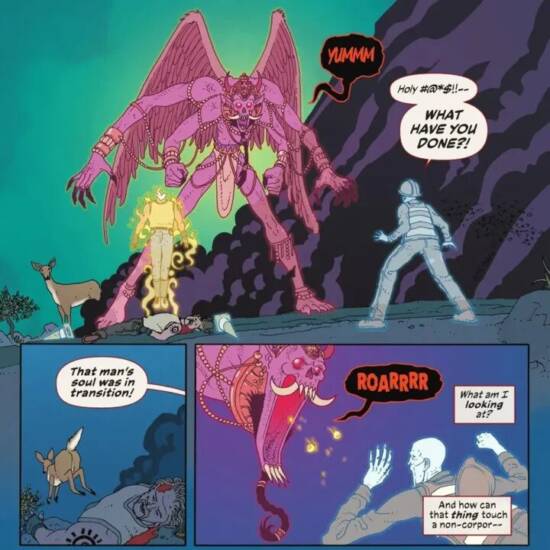
Fresh from their wonderfully chaotic moment on Superman: The Kryptonite Spectrum comes writer W. Maxwell Prince and artist Martin Morazzo with a very fresh take DC Comics’ favourite ghost, Deadman.
Deadman first appeared in Strange Adventures #607 (1967), but which was a prominent addition to Adventure Comics, which by the late 1970s was an anthology series consisting of very short vignettes of the likes of Aquaman, Plastic Man, and other characters which did not have a permanent home. Deadman – a murdered circus acrobat named Boston Brand – was often lost in his quest to find his murderer, sidetracked by various crimes into which he intervened through his power of possession. Deadman, particularly as drawn by Neal Adams, was a gliding figure, sailing through the air like the trapeze artist he once was, his very distinctive rigid collar framing his white skull. Brand was despairing, lost, the horror of his existence balanced against his blue collar sense of humour, and would frequently rail against his beautiful, ethereal omnipotent saviour / patron named Rama Kushna. By the time we get to Mark Waid’s and Alex Ross’ Kingdom Come, Deadman became more of a wise-cracking spiritual guide, his casual humour in contrast to the bundle of bones wrapped in his decaying red costume. Deadman had been transformed into a joking memento mori.
To be fair, it was hard for writers to have Deadman interact with other characters unless they had magical powers and were able to see him. Comics are a visual medium, and Deadman was invisible to his fellow players. Deadman has been gathering dust in DC Comics’ fine cutlery drawer for a little while. But now James Gunn, who controls the DC Universe from his motion picture and television production throne, has announced a Deadman project. And so here we are.
This title takes a different slant on the character. It is called The Deadman. Our hero is now performs quite distinctive functions. In addition to being a voyeur of the anxieties of people on this bus (“don’t mind me” he say as he slides his ghostly skull into a boy’s head), The Deadman now seems to be a lightheaded version of the Greek god Hermes Psychopompus, that version of the messenger god that guided the dead towards the underworld. Perhaps someone should tell Death of the Endless that she has competition in her space. (It occurs to us that Death will probably not show up in this story. DC Comics’ have a gentlemen’s agreement that they would not do anything with Mr Gaiman’s Sandman characters without running it by him first. But Mr Gaiman is now persona non grata, and honouring that agreement would mean that DC Comics would need to ask a favour from a man who is alleged to have assaulted eight women).
Brand describes himself as “Guardian of Spirits, Souls… and other stuff like that!”. In an attitude far removed to his Adventure Comics persona, and armed with a book entitled “Guidebook to Soul Custodianship”, this latest iteration of Brand seems very much at home being dead – although, in a very live-human complaint, at one point he does say that he hates his job.
And, like that other Dead-person (Marvel Comics’ Deadpool), Brand is now addressing the reader directly. “I’m a superhero, you know,” says Brand, waving at us through the fourth wall. It is an intriguing take, a step up from merely being a narrator. Brand’s fellow characters – the living ones, anyway – cannot see him, but we can, and he can see us. It inverts the structure of a story.
We have seen from writer W Maxwell Prince’s work on Kryptonite Spectrum a penchant for oddball whimsy and this book is joyously doused in it.
Here is DC Comics’s promotional blurb:
The Deadman enters the Next Level! In the millisecond following his murder, the soul of shifty circus aerialist Boston Brand was commandeered by the goddess Rama Kushna, who deputized the erstwhile performer’s ghost with a sacred spectral assignment: the Custodian of All Souls! Now Brand floats—begrudgingly—through this bluegreen purgatory we call Earth, upholding the Laws of Spiritual Math and protecting humanity from evil—even if they can’t see or hear him. Open up to this new era of DC’s most lively deceased superhero—the Deadman—in a story about life, death, and everything in between…replete with paranormal activity, possessions, and a profusion of other poignant peculiarities.
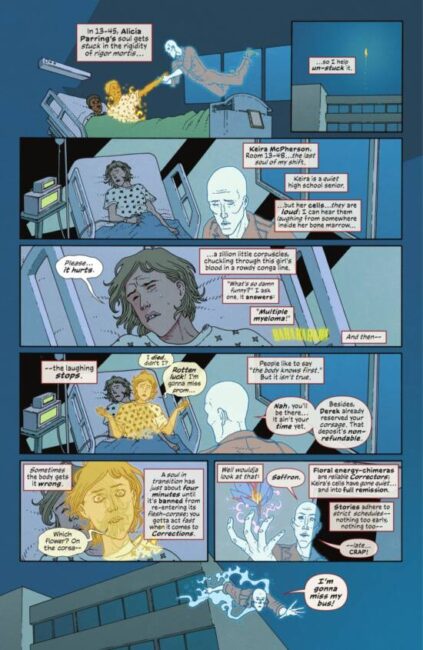
Death is the great leveller. While there is a nascent plot involving very Indonesian-looking devils and their cannibal overlord, Mr Prince’s The Deadman is intriguing because it treats death as an occurrence rather than something to be feared. Perhaps most striking is the death of a billionaire named Ira Jory, described as “the Father of Fracking”. Jory is alone in a cancer hospice, forsaken by family, and dies a completely ordinary death. His attending physician, Dr Barrows, arrives in his room, full of false promises about recovery, a deliberate strategy from the hospice staff to give the patients hope of life rather than fear of death. There is a brief intervention by Brand to help set the dying tycoon on his way to a better next life. The exchange between Jory and Brand is creepy and reminds us of what we are looking at here: “Dr Barrows?” “No. Not for the moment. Someone else looks at you from behind these eyes.” These are a man’s final words, and Brand makes him think he is finally being judged at the edge of his mortality. But Barrows’ reaction to the man’s death is profound in its banality. “You’re going to beat this thing, Ira. I just know – aw crud. Now I gotta call the morgue.”
In-between death and the afterlife is a short period of time during which Brand can address the deceased. “A soul in transition has about four minutes before it is banned from reentering its flesh-corpse; you gotta act fast when it comes to Corrections,” Brand tells us. Pages of backstory come down to those windows where Brand can speak to the recently deceased. These four minutes are accelerants to the plot.
There are other little features of the story which made us smile, more than ably assisted by artist Martin Morazzo. Brand’s presence causes light bulbs to pop, which means Brand now affects his physical surrounds to a very limited degree like a traditional ghost. Mr Morazzo has Brand glance up at the light, with a wry and knowing smirk on his face. When Brand returns to his base of operations, a small town named Robertsville with a greater-than usual number of spirits as residents, he passes by a ghost named Susan who suffered an aneurysm in 1987. Susan is not quite coherent, and seems to have split into five connected forms, a type of spiritual schizophrenia which Brand observes and laments. In death, she is many people. Mr Morazzo’s art is what makes these complex concepts work as well as they do.
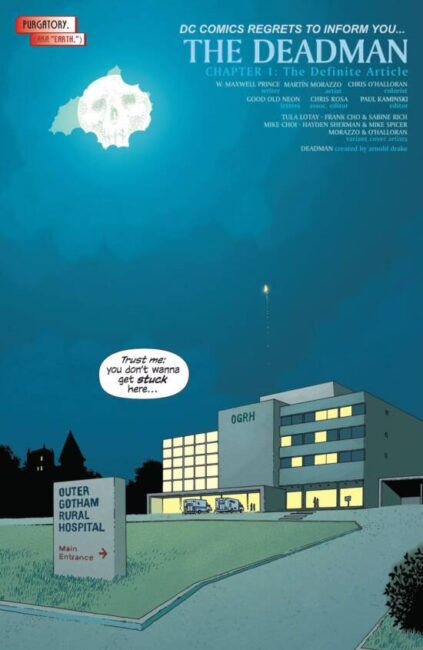
There are so many quirks to unpack in this single issue. Rama Kushna is revealed to be a young girl, not Neil Adams’ sultry goddess of Adventure Comics, who is pleased when Brand gives her a pack of crayons “with every colour”. Brand’s clothing changes depending upon his environment: a janitor’s coveralls, a doctor’s scrubs, a suit and tie, each red-hued. Even the editorial introduction on the first page offers a chuckle: instead of “DC Comics’ proudly presents…” we read “DC Comics regrets to inform you…” lit by a mocking Halloween moon.
This title however is not just about the hoots. A spiritual interaction between Brand and a hospice nurse is wondrous: thirty-six years of mourning for a beloved grandmother manifests as a memory of saffron rice pudding. Those panels make the heart ache. Where Death of the Endless carried out her duties with whimsy and shared comfort, Brand carries out his apparently important role with the stoic humour of a triage nurse, and sees beauty in both life and death. It is a brilliant start to this new series.