



Writer: Mike Carey
Artist: Dean Ormston
Vertigo Comics, February 2001
This critique is the first of a series of reviews of Mike Carey’s epic work Lucifer, which this year celebrates 25 years since inception.
The series was a spin-off from Neil Gaiman’s acclaimed The Sandman comic book series. The Sandman was a kaleidoscopic epic of the personifications of universal constants. But despite his relatively ancillary role, Lucifer is second only to God in the superstructure of creation, described by the series’ protagonist, Morpheus, the Dream King, as far more potent than he.
This is a different creature than the foppish British protagonist of Warner Brothers’ six season Lucifer television series, or the depressed, emo, equally-British Lucifer of the two season Netflix television version of The Sandman. But even within The Sandman comic book, Lucifer initially starts off as deliberately riffing a languid David Bowie, and then in his second appearance comes across as a weary, toga-wearing businessman. Only after Lucifer anticlimactically quits being Lord of Hell, and opens a piano bar in Los Angeles, do we see Lucifer settle into consistency of characterisation. The last time we see Lucifer within the pages of The Sandman is at Morpheus’ funeral.
The Sandman comic series elegantly finished in 1996, and Vertigo Comics (an imprint of American publishing giant DC Comics) then gushed a frothy torrent of Sandman-related titles in an effort to commercialise the success of Neil Gaiman’s series. Mike Carey was slotted to write a Lucifer title. To be fair, it took a little while for Mr Carey to work out what to do. The first story arc of the ongoing series, featuring homophobia and neo-fascism in modern Berlin, was the wrong tune. When Mr Carey starts setting out, step by patient step, Lucifer’s grand plan, the series looks less like a series of story arcs than an elaborate chess game.
John R. Parker, writing for Comics Alliance in 2013, describes the series no better than we can :https://comicsalliance.com/lucifer-book-one-review-mike-carey-vertigo/ :
With talented artists and a plan in mind from the very beginning, Mike Carey sends Lucifer off on a tear through all creation, like a pissed-off teenager with a get out of jail free card. Lucifer’s motivation is the same as it was in Sandman’s “Season of Mists” storyline – to slip from the yoke of predestination and know that his will matters, to do something outside of God’s plans. Free will versus determinism on a universal scale. With his letter of passage, Morningstar fashions a plan, and opens a portal to the void. Over the course of the first year of the series, the immense eschatological repercussions of that act slowly become apparent, and the massive scope and shape of Lucifer’s plan become clear.
The tightropes that Carey walk are impressive, especially with Lucifer’s characterization. As both the hero and the villain of the story, he has a valid point of view, morals, and several qualities about him that make him likeable. Simultaneously, he’s cold, vengeful, manipulative, and self-serving . He only cares for people as far as they can help him, and places nothing above his own need for freedom, but he also has a sense of honor and never breaks his word. And when you watch the character navigate through the other worlds and push them into the shapes he wants, it’s hard not to love him a little.
Whereas The Sandman beautifully meandered about through various plots, scattering concepts about with the poignancy of autumn leaves, Lucifer is as plain as an iron pikestaff. Battle lines are repeatedly drawn between Lucifer and his many enemies. Revenge is played out. Conspiracies are executed upon, and counter-attacks are brutal. The dynamic painted covers, featuring armoured cavalry charges, fiery destruction, and raging angels, capture the imagination.
Lucifer is the manifestation of will, and his will is not easily thwarted. Fabian Bullit, writing for That’s Comics in 2025 https://thatscomics.com/2025/03/28/lucifer-comics-by-mike-carey/, describes at a high level what the eleven-volume story is concerned with:
Unlike other versions, Mike Carey’s Lucifer is neither the incarnation of evil nor a force for good—those notions simply don’t apply to him. For one, he never lies, but he is manipulative and extremely intelligent. The stories are built around this as Lucifer often gets what he wants by outsmarting everyone else, moving forward with his plan while having to deal with betrayals, cosmic politics, supernatural forces, battles with old and new gods (figures from Christian, Norse, and Eastern mythologies are regularly used), and family business.
Our critiques begin with this re-visitation of a particularly insidious vignette appearing early in the series. Issue 9 explains how Lucifer has armed himself with a devastating, perverse weapon. The tale of how he acquired it is grim, compelling, and set the tone for much of the rest of the series.
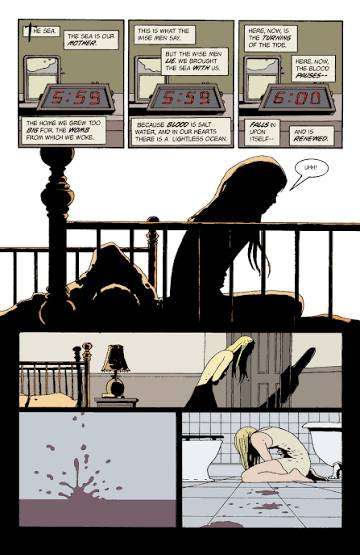
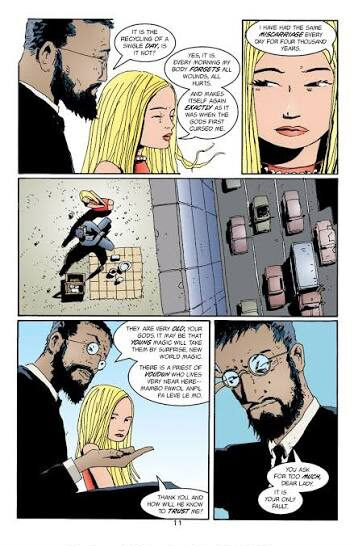
Four thousand years ago, Erishad of Uruk was a priestess, who defiled her temple by falling pregnant. The gods demand her life in penance, but she cannot give it because it would mean also condemning her innocent unborn child. And so the gods, in an act of perverse and bleak humour, granted Erishad immortality, in the form of living every day as she was the day before. That involves every morning having the same miscarriage. If Erishad will not give up her life to appease the gods because of her unborn baby, then she can keep her life, suffering the death of her baby every day.
Uruk was actually a place, a city long fallen into dust to be explored by archeologists. Erishad is a fictional person, but her memories of the scents of the template and the surrounding fields, a description of what must have been amongst the first examples of human agriculture, are vivid. In addition to the gods’ curse of a daily painful miscarriage, Erishad is not enjoying immortality. She is restless, moving from city to city, willing to parasite upon rich men seeking a beautiful and unattainable trophy. Erishad is haunted by her past, and hates her present. Artist Dean Ormston deploys shadow when he can, and presents readers with various chaotic, surreal forms as the series progresses. But Erishad is a bright sunflower from the steppes. Mr Ormiston represents Erishad as a glowing figure amidst dark shadows. She is small, petite, an adolescent, someone too physically fragile to have survived for millennia. The problem for Erishad is the opposite of survival, however. It is that she cannot die.
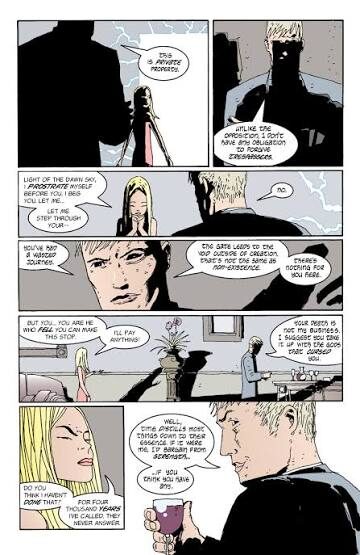
Erishad seeks Lucifer’s gate to a universe outside of God’s creation, thinking it is a short cut to oblivion – “the balm of unbeing” in a nice turn of alliteration – but she has no bargaining position, and Lucifer does not do anyone a good turn out of mercy.
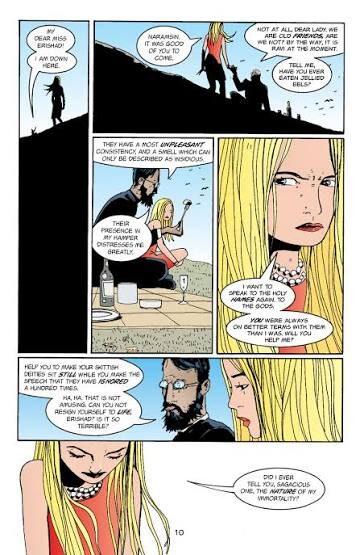
She is not alone in being never-dying. Erishad seeks out Naramsin, an Indian prince (apparently named after the grandson of Sargon the Great) who has eaten a fruit granting him ever-lasting life, last seen in the pages of The Sandman. Naramsim quite enjoys existence, has blended in with mortals, and initially does not understand Erishad’s complaint.
In The Sandman, Mr Gaiman describes the immortal as being like a member of some sort of elite club or secret society. From one of The Sandman’s story arcs, Brief Lives: “There are, for example, less than ten thousand humanoid individuals alive on this planet today who have personal memories of the saber-toothed tiger, the megatherium, the cave bear…. there are roughly seventy people walking the Earth, human to all appearances (and in a few cases, to all medical tests currently available) who were alive before the Earth had begun to congeal from gas and dust.” The club may be exclusive, but it is surprisingly large in Mr Gaiman’s story. Bernie Capax, the 15000-year old lawyer, on his way to work on the bus remembers he dreamt of mammoths… “the rank, high smell of them hung on the air…He hasn’t smelled it since he was a child.” The very strong connection between scent and memory is well documented by neuroscientists. As he dies when a brick wall falls onto him, he screams, “Not yet!” The very-long-lived don’t want to die, and, perhaps, that contributes at least a little to why they are very long-lived.
Only when Erishad describes the nature of her daily horror does Narimsin point her in the direction of a voodoo priest who can help with young magic against old gods. Naramsin’s pause, as he contemplates the significance of Erishad’s 4000 years of torment, speaks volumes. Mr Carey carefully chooses not to sully the panel with dialogue.
The voodoo priest lives in a decrepit slum house but is happy to take financial instruments for payment. At Erishad’s instructions, the priest easily captures the old gods of Uruk in a bottle. The gods pettily tell Erishad to ask again in 1000 years, but then they eventually tell the truth: after 4000 years, they are too feeble to undue what they did at the height of her power. They are now little more than meagre trinkets inside the glass, and speak in the quavering voices of the very elderly. We had seen this in Brief Lives, where the goddess Ishtar’s powers are diminished by an absence of worshippers. For Erishad, the news is sharp: there will be no end to her suffering.
Mr Carey has a penchant for horror, and this is one of his earliest examples of it in the comic book medium. At Erishad’s command, the voodoo priest summons a lurking ghost into existence. It is a creature of horror, the sickly spirit of Erishad’s daily miscarried baby, rendered powerful and hungry by millennia of suffering and death. Rendered as a nightmarish tentacled gangrene horror by Mr Ormston, the monstrous baby readily consumes the faded old gods. They beg for clemency as they are being consumed. Erishad could prove herself better than those who condemned her to 4000 years of pain. But while she is immortal, she is all too human. Erishad withholds her mercy, her chin lifted in proud and delicious vengeance. (And, because Mr Carey knows we are also human and petty, to see these gods die is a source of satisfaction.) The voodoo priest pays for his incantation with his life, and Erishad leaves, taking with her the bottle as a “cold, glass womb” for her baby, with no apparent avenue left for death. Erishad’s membership in the club cannot be revoked.
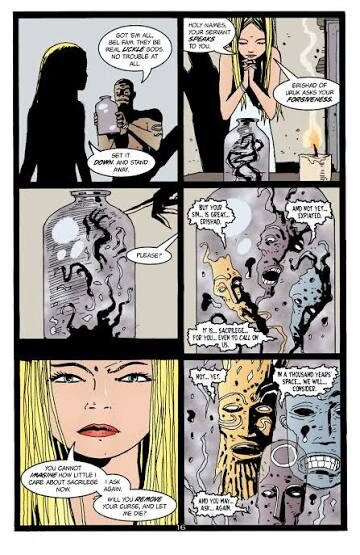
Mr Carey returns to the theme of the corruption of youth later in his epic. We look to the sullied unborn baby as the sting in the Uruk deities’ vile joke. But Erishad herself is perhaps, physically, in her mid-teens, and sleeps with rich men for reasons of lifestyle. Only thousands of years of life have given her an ancient misery, a calculated poise, and now, a thwarted purpose.
Various cities follow, and then while drinking coffee in Paris, Erishad finds herself approached by Lucifer. Erishad now has something Lucifer wants. Erishad’s baby, swirling in his bottle, has become a commodity. “Your death is not my business,” Lucifer said during their first encounter. But now it is – “Today, my stock in trade is death. Assuming you’re still in the market for such a thing” – in a transaction involving the tormented soul of a child which has been spontaneously aborted hundreds of thousands of times. Horrified, Erishad initially refuses, and Mr Carey delivers one of his most Wildean of lines: “Revenge may be a sweet dish, but its not generally found on the children’s menu.”
With death but a touch away, Erishad succumbs and finally is permitted to die. Lucifer walks away, eyes glinting in an additional supernatural touch by Mr Ormston, with the bottle in hand. That final panel is striking, and we have stared at it many times over two and a half decades of re-reading. Lucifer could be a cosmopolitan shopper walking with purpose down the shaded boulevards of Paris, but the eyes are like embers, or perhaps the reflective retina of a big cat. Lucifer’s hunt is done. Erishad has made a deal with the devil, more terrifying in its own way than some grand battle.
As with Bernie Capax’s smell of mammoth hair, Erishad’s demise comes with its own scent: “The smell of briar he took to be the lady’s perfume”. But it was the temple which smelled of briar roses, in Erishad’s memory, and there is no one left to relive it.
We sympathise with Erishad, even as we contemplate the horror of what she has done: first, summon the lifeless, violent spirit of her miscarried infant into material form so as to extract a bitter revenge on the gods who have cursed her, and second, hand over her baby to a malevolent presence who demonstrably has no good intentions towards anyone, least of all this monstrous baby. The baby of course becomes Lucifer’s pawn, a weapon in his fight with a taskforce of well-armed angels.
It is an ending with an act of desperate selfishness by Erishad, and a heartless transaction by the title character. We come, in time, to expect nothing less of him. But at this stage, early in the series, Mr Carey gives the reader a stark message. Lucifer’s blood flows ice-cold, and though he may be almost without peer, there is nothing to admire in him.
This issue is a stand-alone story, a self-described prequel to a major arc. The blog A Reader of Else https://readerofelse.wordpress.com/2016/02/16/lucifer-book-one-mike-carey-et-al/ talking about the first volume of the hardcover collected work, notes that there are many parts to the whole:
Unsurprisingly, the plot feels sort of disparate and disjointed, coming together in slow pieces to a brilliant culmination of “ohhh I see!”. It is very much several stories joined together, but they’re joined together very well – not so that you can’t see the joins, but so that the joins are part of the point.
This particular join is one of the very best in this series.