


Creator: C.E. Massari
Independent, 2026
The title tells you exactly what you’re getting. Inspired by the real-life experiences of author C.E. Massari’s grandfather, The Mafia vs the Klan is a 120-page original graphic novel pitched as “John Wick meets The Godfather.” It promises a story of vengeance, justice, and cultural conflict rooted in a turbulent period of American history, and for the most part, it absolutely delivers. Here is the promotional copy:
THE MAFIA VS. THE KLAN is a 120-page original graphic novel set during the height of the 1920s Prohibition Era, when an Italian immigrant’s quest for a peaceful life is shattered when a botched KKK assassination claims his daughter instead of him. With the law complicit in the crime, Mario must strike a devil’s bargain with the Mafia to wage a bloody war of vengeance.
Set in a small town in southern New Jersey during the mid-1920s, the story unfolds at the height of Prohibition. This was a time when the “Second Klan” was exploding in popularity throughout the Midwest and Northeast, not just the Deep South. This version of the KKK pushed a strict “100% Americanism” agenda, heavily targeting Catholics, immigrants, and ethnic minorities. Italian and Irish communities were constantly viewed with suspicion and accused of putting the Pope ahead of America. The Klan used the enforcement of Prohibition as a handy excuse to raid speakeasies and bootlegging runs, using it to mask a campaign of intimidation and violence against immigrant neighborhoods.
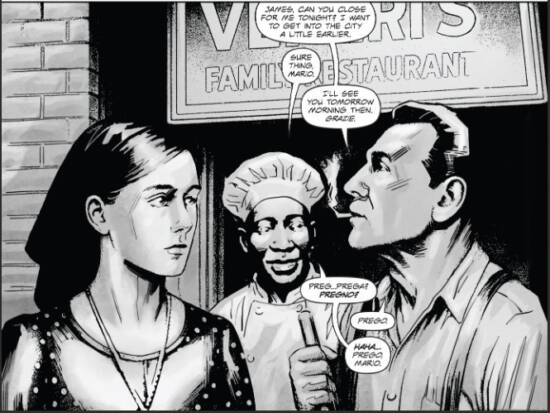
Mr Massari uses this historical backdrop to anchor a deeply personal revenge story. The protagonist is an Italian-American restaurant owner who employs African American staff, which instantly makes him a target for the local Klan chapter. The early pages rely heavily on dialogue, but they never drag. Instead, they do the heavy lifting of building the era’s social tensions while dropping hints about the main character’s past. It quickly becomes clear that he isn’t just a bystander when it comes to organized crime.
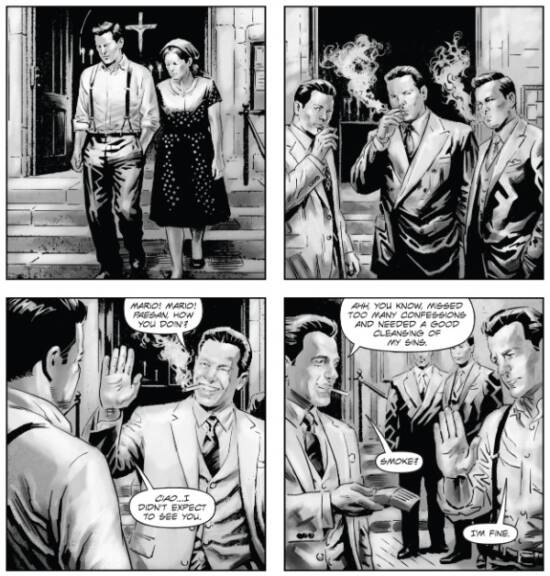
This is where the John Wick comparison becomes apparent. Mr Massari crumbs details of the protagonist’s history before an act of brutality finally pushes him over the edge. Up until that point, he is determined to keep his head down and avoid his old connections. But once the line is crossed, the book shift gears into a direct, fast-paced tale of retribution.
While the book draws on family history, it wisely leans into cinematic flair. In reality, while there were plenty of riots and clashes between Italian immigrants and the KKK in the 1920s, there was never a full-scale, organized war between the Mafia and the Klan. If the comic ends up taking creative liberties to increase the stakes, it will be all the better for it. Instead of a dry historical reenactment, it can spin those real-world tensions into a high-stakes crime drama with a massive emotional payoff.
In terms of writing, Mr Massari knows how to keep you hooked. He has a great grasp on pacing, letting dialogue-driven scenes simmer and build tension before the violence erupts. Even the quiet moments feel intentional, adding to the sense that a major reckoning is coming.
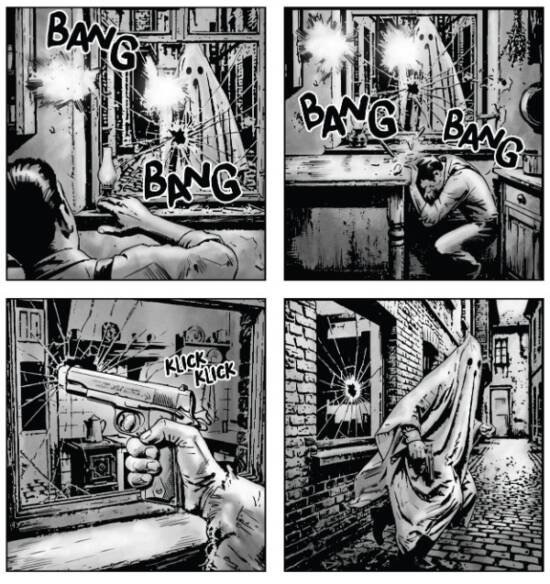
In terms of art, it is easily one of the book’s high points. Done primarily in black and white, it captures the vibe of classic noir and mid-century comics, calling to mind Will Eisner ,or the tenor of EC Comics. Deep shadows dominate the pages, creating a sharp contrast with bright highlights that give the panels a lot of dramatic weight.
At the same time, the artist uses grayscale washes and soft gradients so the pages never feel too stark. The characters have a sculpted, three-dimensional look, and the attention to detail on clothing and architecture is excellent. The anatomy looks natural, and the characters’ emotions come through via subtle facial expressions rather than over-the-top gestures.
The book is incredibly good at establishing mood. Scenes inside churches or family homes have a tangible solemnity to them, thanks to strong directional lighting and detailed backgrounds. Textures like fabric patterns, wooden pews, and worn clothing are drawn with real care, keeping the story grounded. The character acting is just as strong, catching slight shifts in posture that convey exhaustion, grief, and determination without needing pages of dialogue.
The Mafia vs the Klan works because it knows exactly what it wants to be. It doesn’t pretend to be a textbook. Instead, it takes a fascinating, overlooked slice of American history and uses it as the foundation for a gritty revenge story packed with mob drama. By balancing historical reality with cinematic storytelling, Mr Massari delivers a graphic novel that is incredibly entertaining, well-paced, and distinctively noir.
This title is the subject of a forthcoming Kickstarter campaign: https://www.kickstarter.com/projects/cemassari/the-mafia-vs-the-klan