


Writer: James Patrick
Artist: Paul Junquera
Publisher: Mad Cave Studios, August 2026
James Patrick’s and Paul Junquera’s The Omega Book could easily have become an overstuffed blend of conspiracy thriller, cosmic science fiction, and religious allegory. Instead, this first issue keeps a tight grip on its story, introducing its major players quickly while resisting the temptation to explain too much too soon. With moody artwork by Pauli Junquera and a protagonist who is far more abrasive than heroic, the comic establishes itself as a compelling mystery rather than following a more convention path of a straightforward battle between faith and science.
The story centers on the legendary Omega Book, a text rumored to contain all the secrets of the universe. Mr Patrick wastes no time setting the plot in motion. A brilliant but apparently unhinged scientist dies under mysterious circumstances, leaving behind clues connected to the Omega Book and a strange pair of X-ray glasses. These artefacts pass to his estranged son, Father Brady Parsons, while a rival scientist and several powerful clandestine factions begin circling the inheritance.
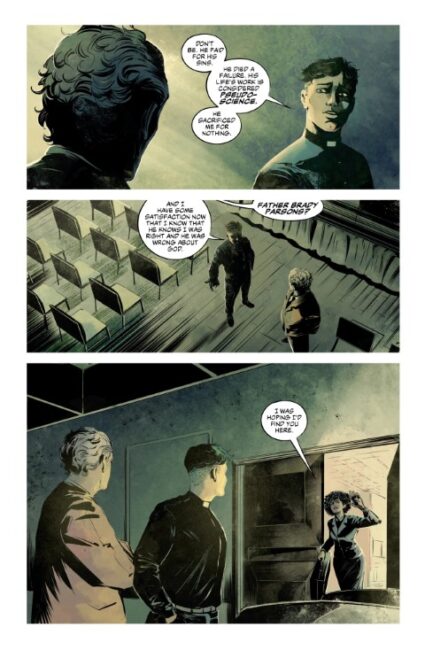
Brady is easily the issue’s strongest element. Comic book priests are often written as compassionate moral anchors, but Patrick goes in a very different direction. Brady is openly bitter toward his father, convinced that the man sacrificed his family in pursuit of scientific obsession. More strikingly, he takes a certain satisfaction in what he sees as his father’s failure, treating his own religious vocation as proof that faith has triumphed over pseudo-scientific arrogance. It is not admirable, let alone Christian behavior, and that is why it works. Brady is a deeply wounded person rather than a forgiving priest.
That tension gives the story its hook. If the protagonist is so resentful, so self-righteous, and so eager to be proven correct, what could possibly push him toward becoming the person who might save the universe? Mr Patrick wisely leaves that question hanging.
The promotional copy suggests a conflict between faith and cold intellect, as we have noted, but the comic is more interesting than a simple debate. Brady does not seem motivated by a desire to destroy his father’s discoveries; he wants to uncover evidence that confirms the existence of an omnipotent creator. That nuance keeps the book from collapsing into caricature. Science, religion, and pseudoscience are all present, but none of them are fully explained or resolved in the opening chapter.
From a storytelling standpoint, the first issue is disciplined. Mr Patrick sets the pieces on the board, introduces the mystery, hints at larger conspiracies, and teases several important characters without dumping pages of exposition on the reader. By the end, we still know very little about the Omega Book itself, yet the sense of hidden significance is strong enough to make the mystery feel intriguing rather than frustrating. This is exactly what a debut issue should do: generate momentum and curiosity.
Mr Junquera’s artwork, in our view, is why the book works as well as it does. The visual style shifts effortlessly between grounded noir and cosmic sci-fi. Conversations in dim rooms and encounters with shadowy antagonists are drenched in heavy blacks, muted blues, and dramatic angles that emphasize paranoia and isolation. The renditions of faces is particularly effective. Brady’s bitterness, skepticism, and growing unease are communicated clearly without excessive dialogue.
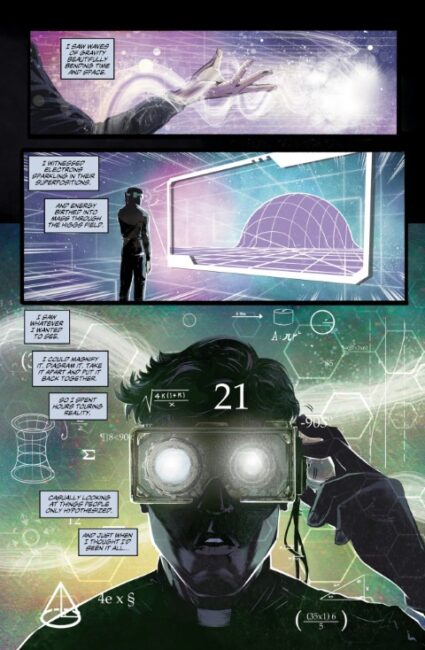
When the science fiction elements emerge, the book becomes visually electric. The moment Brady dons the visor left by his father, the palette explodes into glowing purples, teals, and star-like bursts of light. Mathematical formulas and geometric diagrams layered over the panels create the impression that reality itself is being rewritten in front of him. It is a smart visual shortcut that conveys overwhelming cosmic information without slowing the pacing. The contrast between the gloomy noir sequences and these luminous, mind-bending pages gives the comic a strong visual identity.
If there is a weakness, it is that the first issue is almost entirely a setup. Readers looking for major revelations or decisive action may find it somewhat restrained. The Omega Book remains elusive, the conspiracies are only sketched in, and the larger stakes are still mostly implied. However, this restraint feels intentional rather than incomplete.
Overall, this first issue of The Omega Book is a strong opening chapter. Mr Patrick delivers a well-paced mystery anchored by an unusually flawed protagonist, while Mr Junquera provides atmospheric, expressive artwork that sells both the human drama and the cosmic weirdness. The issue succeeds not because it answers its biggest questions, but because it makes those questions impossible to ignore. We came away wanting to know what the Omega Book really is, why so many factions are willing to kill for it, and whether Father Brady’s certainty about faith can survive whatever truths lie hidden behind his father’s final invention.
This title is for sale here: https://madcavestudios.com/product/the-omega-book-vol-1-series-bundle-1-trade-paperback-5-digital-issues