

Writer: Ashley Allen
Artist: Sumit Kumar
Marvel Comics, October 2026
Back in 2001, Scottish writer Grant Morrison created Cassandra Nova, a mutant telepath with vile tastes in conquest, for American superhero assembly line Marvel Comics. The surprise twist to Nova’s arrival at the time in the X-Men universe is that she is mutant leader Charles Xavier’s sister, killed in utero by Xavier during a pre-birth battle for survival. (Like any good soap opera, X-Men stories are littered with completely unexpected family additions, with the additional impetus of genetic bloodlines explaining the new character’s far-fetched abilities powers.)
This story postulates an alternative dimension where Nova won that fight, and Xavier is dead. This issue is properly characterised as lurking in the horror genre as much as being a mutant superhero adventure ballad.
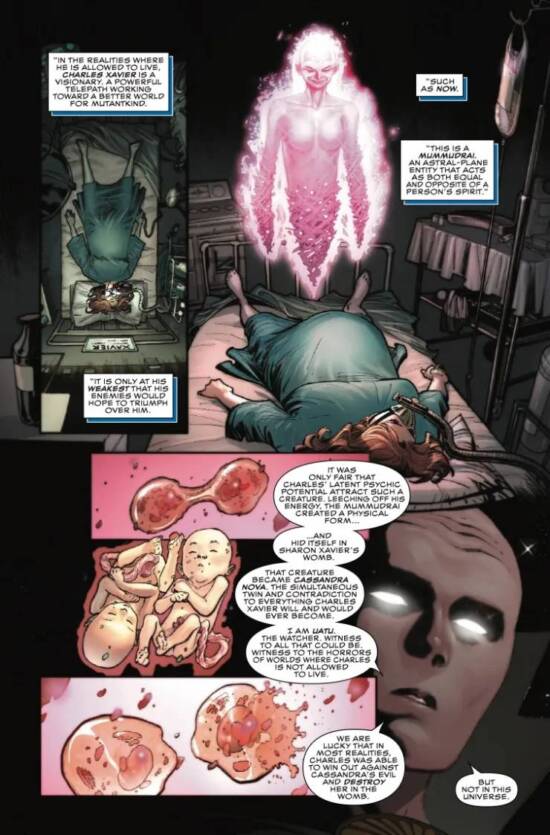
Here is the promotional copy for the title:
In a world where Cassandra Nova killed Charles Xavier in the womb, telepaths are hunted and experimented on – and what she’s making from them is far worse than what she’s taking. But when telepaths Jean Grey and Emma Frost escape, Cassandra Nova will stop at nothing to bring them back! Bring on Cassandra’s X-Men!
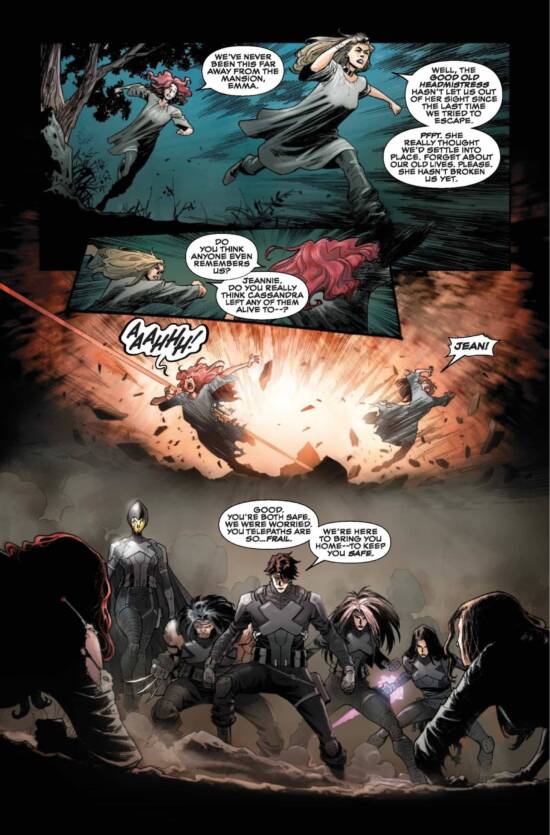
The story begins with a fight scenes, as telepaths Jean Grey and Emma Frost try to escape from Nova’s clutches. The quantity and quality of exposition suggests that editor Emerald Bensadoun was having a little nap. One of the characters, Destiny, who can see the future, says, “Its a good thing you involved Rogue, Psylocke and me. We’re resistant to their telepathy.” Wolverine says, “The headmistress found me at Weapon X and restored my mind!” And the leader Cyclops notes, “I don’t know what I would have done without her after my family was killed in the plane crash.” This is one page. The idea here, for the most part, is to detail the fiction that Nova has installed in each of the character’s heads. But it is more akin to receiving a cream pie in the face. It is sub-standard writing.
The ending deals with the emergence of Phoenix. It is given away very early, slightly before the appearance of the staples which bind the pages, which of themselves are a welcome sign that we are halfway through this half-baked story. Jean has been recaptured and is confronted by Nova. Red thought bubbles appear next to Jean’s temple as an unknown voice tries to console her, while her eyes contain the symbol of Jean’s Phoenix-era costume in regular continuity. This foreshadowing, establishing a foundation for the conclusion of the issue, is executed with neglect. We do not need to think too hard about how this could have been better executed. How about an open, lit fireplace? Or reddish stars in the night sky around Jean’s head? The introduction of fire motifs so as to herald Phoenix’s intervention might have been executed in so many other, more nuanced ways.
The only aspect of this title which was genuinely intriguing was the savagery of Nova in dealing with her students, regarding them all as meat machines that she can fine-tune and completely control. Using her powers to slice open a mutant’s face, skull, and brain so as to remove a stringy, pink bit of inhibition is confronting enough. But then to weld the head back-together with only a small pool of blood to mark the callous surgery is genuinely icky. It reminds us of the live vivisections and other atrocious experiments of Kyushu Imperial University Faculty of Medicine and the Imperial Japanese Army’s Unit 431 during World War II. These pages are searingly graphic. Artist Sumit Kumar, whose metaphorical shoulders must have been aching from carrying the balance of the creative team, spares us no mercy in these sequences.
If the editors at Marvel Comics in the relaunch of this title were counting upon the success of the wonderful animated series broadcast from 2021 to 2024, to bring in new readers, then they forgot two elements to the animated series which spurred its audience. First, the central characters, particularly Captain Carter, were a noble lot. Second, the series was hopeful, not vengeful. Perhaps they could benefit from a binge re-watch.
For our friends at Comic Book Round-up, this issue scores 1/5.