


Creator: Paul Milligan
November 2026
Rock music has always had a rebellious streak, challenging the social conventions and corporate interests that seek to tame it. Paul Milligan’s The God of Rock: Complete Collection is an appropriately chaotic celebration of that spirit.
The series began as part of the 24-Hour Comics Day challenge, a notoriously punishing exercise in which creators must write, draw, ink, and letter an entire comic within a single day. Mr Milligan was involved in five of these, and this collection is the outcome.
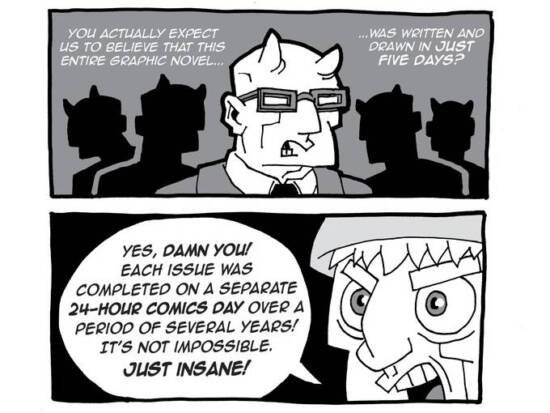
Collecting these stories alongside later additions, the volume serves as both an irreverent fantasy adventure and a record of one creator’s endurance. One can almost feel the sleep deprivation, the frantic corrections over non-reproducible blue lines, and the desperate consumption of cheap energy drinks radiating from the pages.
The collection was the subject of a successful Kickstarter campaign, and was funded within five hours: https://www.kickstarter.com/projects/7631583/god-of-rock-xx-the-20th-anniversary-collection
The premise is gloriously ridiculous. Pan, the diaper-clad, guitar-wielding deity of rock and roll, finds himself dispossessed of his throne, with his girlfriend Michelle kidnapped by his corrupted underling, Scratch. His subsequent struggle to reclaim his kingdom pits him against Anti-Rock, a bureaucratic cabal of grey-suited villains intent on making music safe, orderly, and manageable. The resulting cosmic crusade takes aim at the sort of institutional thinking that would happily drain the life out of rock music, provided the resulting product was sufficiently marketable and unlikely to upset anyone’s parents.
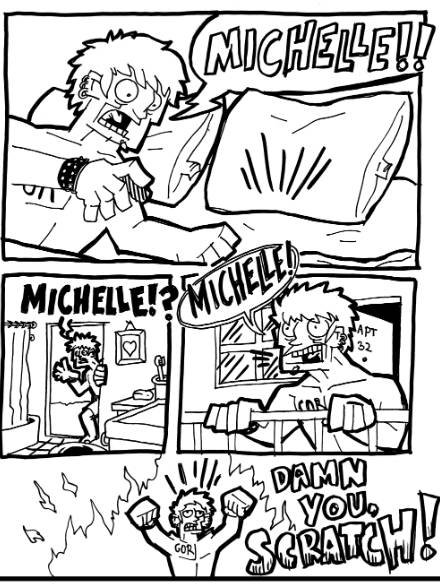
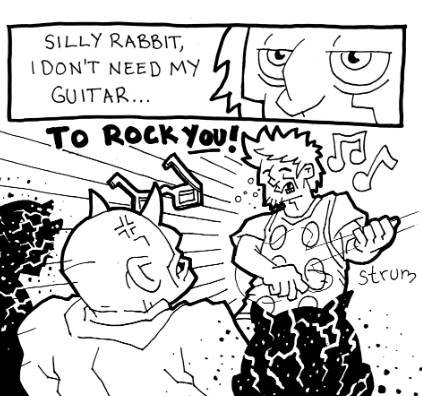
Mr Milligan’s artistic preferences are worn openly on his rolled-up sleeves. His black-and-white artwork is built around heavy ink splashes, frantic linework, and exaggerated caricatures that recall alternative weekly comics and punk fanzines. Anatomy is negotiable, proportions are frequently sacrificed, and individual panels sometimes look as though they were wrestled onto the page moments before the deadline.
This is not polished, meticulously choreographed artwork, but that roughness suits the material. A story celebrating the unruly spirit of youth culture would lose something if rendered with the sterile precision of a corporate design department. The art feels like an extension of the music it celebrates: loud and messy, with little interest in observing the rules.
Although this is a curated collection of works produced over an extended period, it retains a wonderfully unpredictable rhythm. The narrative was plainly not conceived as one carefully plotted epic, with every development accounted for in advance. Instead, readers witness a concept gradually expanding beyond its original boundaries, acquiring new ambitions and increasingly absurd dimensions along the way. This organic development is one of the collection’s more appealing qualities.
The original 2006 story is a relatively compact fable about generational succession and institutional decay within the music industry. Its central conflict establishes the series’ basic antagonism between creative freedom and the forces seeking to control it. In The God of Rock Strikes Back, Mr Milligan broadens the scope of his satire, pushing the narrative toward an audacious metafictional sequence that invokes the bullet that killed John Lennon in 1980. It is a provocative collision of music history and fictional mythology, reflecting the comic’s increasingly unrestrained imagination.
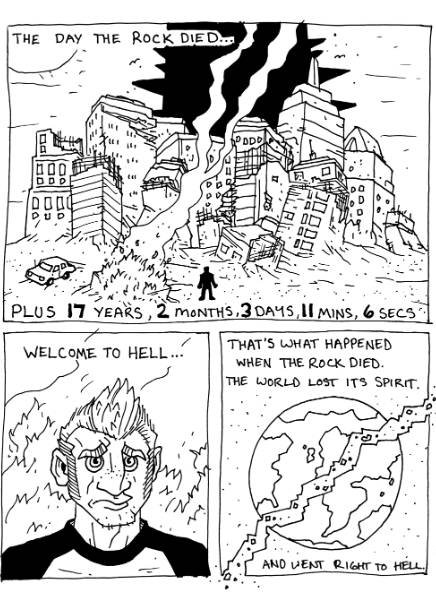
The later material takes the concept into stranger territory still. What begins as a battle over the throne of rock and roll eventually expands into a post-apocalyptic cosmic future, where humanity has abandoned an Earth scorched by its dying sun and searches for music in an increasingly sterile universe. Even the inclusion of opening panels sketched by Mr Milligan’s five-year-old nephew reflects the collection’s willingness to embrace creative spontaneity over conventional polish. The series grows in scope without entirely shedding the scrappy spirit of its origins.
Of course, the 24-hour format leaves its scars. The pacing can be breakneck, transitions occasionally arrive with little warning, and some developments feel more like improvised leaps than carefully constructed plot points. The humour also has a juvenile streak, including recurring jokes about characters refusing to wear trousers. Not every gag lands, and readers expecting a tightly plotted fantasy epic may find the narrative’s frequent detours frustrating. The collection’s unevenness is particularly noticeable when its ambitions expand beyond the relatively straightforward premise of the original story.
Nevertheless, these shortcomings are difficult to separate from the project’s appeal. The rough edges are not automatically virtues, and the time constraints do not excuse every narrative stumble. But the collection’s imperfections also preserve the sense that its creator is following an idea wherever it takes him, rather than sanding away every eccentricity to produce a more commercially palatable product. That distinction matters for a comic whose central conflict concerns the struggle between unrestrained creativity and the institutions that seek to tame it.
The God of Rock: Complete Collection is unlikely to convert readers who demand immaculate artwork or disciplined plotting. Those willing to embrace its punk-rock sensibilities, however, will find an entertaining monument to creative persistence. Its greatest achievement is not the construction of a flawless mythology, but the transformation of a ridiculous premise into a sprawling, increasingly ambitious body of work. Like a garage band that refuses to stop playing despite questionable musicianship and a neighbour threatening to call the police, Mr Milligan’s creation succeeds through sheer force of will.
Rock and roll has never required permission to make noise. This comic certainly doesn’t ask for any.