


Writer: Matt Fraction
Artist: Jorge Jiminez
DC Comics, October 2026
DC Comics’ detective crimefighter par excellence, Batman, is a rich billionaire, of the old school 1930s type. He is served by a live-in butler, English no less, very Gilded Age indicia of refined, aristocratic taste. For as long as anyone can remember, that butler was Alfred Pennyworth. But Pennyworth was murdered by Batman’s longtime-enemy Bane in 2019’s Batman #77.
It was not the first time Pennyworth has died. DC Comics killed Pennyworth off in 1964, a gimmicky death where the servant sacrificed himself to save the master, but was later miraculously brought back to life. Archie Goodwin noted in the forward to the collected works of Manhunter – featuring the famously permanent dead of Paul Kirk, the title character – that when he took over Detective Comics writing chores in 1974, Pennyworth’s death was something which had already been done and was not feasible to replicate. Fans would not believe it at all, even in the context of the American superhero genre where death and rebirth were more likely to occur than eggs at breakfast.
Yet, Pennyworth this time has remained stubbornly deceased. Even Tom King, who penned the story of the murder, is reported in 2026 as being “shocked” that Pennyworth has been dead for seven years and counting: see https://www.thepopverse.com/comics-dc-batman-alfred-dead-death-tom-king-interview .) The void of a major supporting character in the never-ending continuity of Batman has been assisted by an AI hologram, a construct lifted from the pages of William Gibson’s Neuromancer. Pennyworth is now a digital replication of a dead man, just like Neuromancer’s dead master-hacker Dixie Flatline, whose personality and skills were captured in code. But the replicated Dixie Flatline in Neuromancer wanted the erasure of his copied persona, a permanent death, whereas AI Alfred ironically seems quite happy telling Master Bruce off for not reading Pennyworth’s will.
Deploying a AI for Alfred seems a little like cheating to us – but even the story of Manhunter, dead now for over forty years, was perpetuated by the benefit of innumerable clones of Paul Kirk. A clone of Pennyworth would have been a cliche, and a hitherto unknown twin would have been laughable. How then to replace Pennyworth with something other than tutting software? An outsider, some new Jeeves-like figure, would not cut it in the close-knit Bat-family.
The inestimable Matt Fraction, who currently writes Batman, has given us something quite a bit better than a clone. Pennyworth, it seems, had a great niece, named Verity. Because suspicious readers might be caused to think that Verity was some sort of devious sleeper agent planted by a Bat-villain, Verity has passed a DNA test linking her to the deceased loyal butler, and AI Alfred has confirmed she was part of Pennyworth’s succession planning.
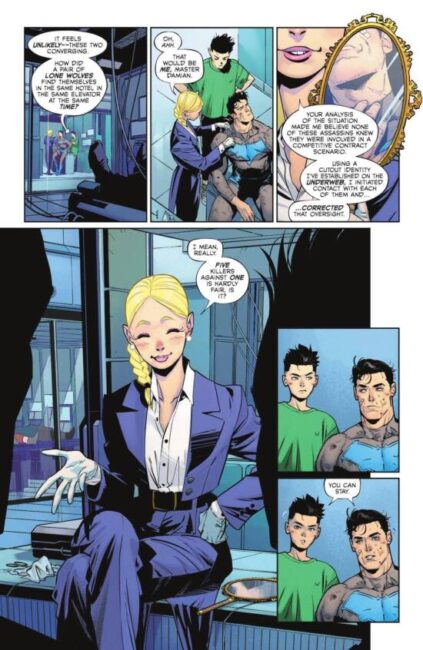
Verity is extremely capable, and the equally capable Jorge Jiminez has chosen to draw her with a very anime style which stands apart from the faces of his other character renditions. Big eyes fold into an arch of eyelashes when she smiles, cheeks slightly flushed, with pouty lips. This is clearly a deliberate choice: something to make Verity cute. The Bat-family has plenty of sex appeal over the years (Jim Lee’s version of the Huntress featured her wearing too-tight shorts) but no character before who is winsome.
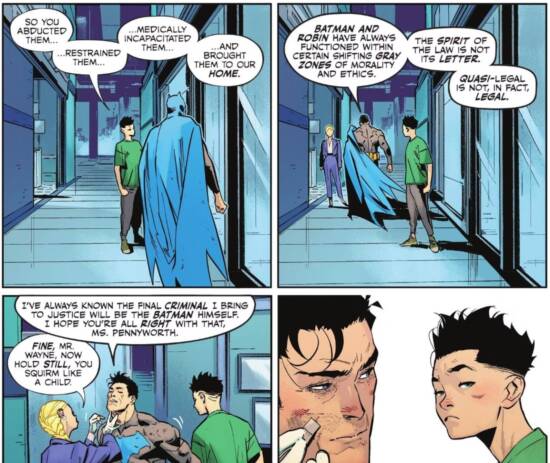
Like Batman, Verity is morally ambiguous. Batman captures two assassins (more on them shortly), and has no way to hand them over to the authorities because the villainous Vandal Savage has stooped in his ambition of world domination to merely be Gotham City’s police commissioner. Pennyworth would have had an issue with Batman’s illegal incarceration of his adversaries. Pennyworth after all often served Batman’s moral compass. Even Batman’s son Damien pauses over the drugging and jailing of the captured hatchet men. But, in contrast, Verity has no compunction with Batman’s imprisonment of the murderers in cells while deliberately placed in medical comas.
And like Batman, Verity is cunning. Batman has captured the two assassins while they were fighting each other in an elevator. Damian questions the probability of this occurring:
Damien: “It feels unlikely – these two converging. How did a pair of lone wolves find themselves in the same hotel in the same elevator at the same time?”
Verity: “Oh, ahh. That would be me, Master Damian. Your analysis of the situation made me believe none of these assassins knew they were involved in a competitive contract scenario. Using a cutout identity I’ve established on the underweb, I initiated contact with each of them and…corrected the oversight. I mean, really. Five killers against one is hardly fair, is it?”
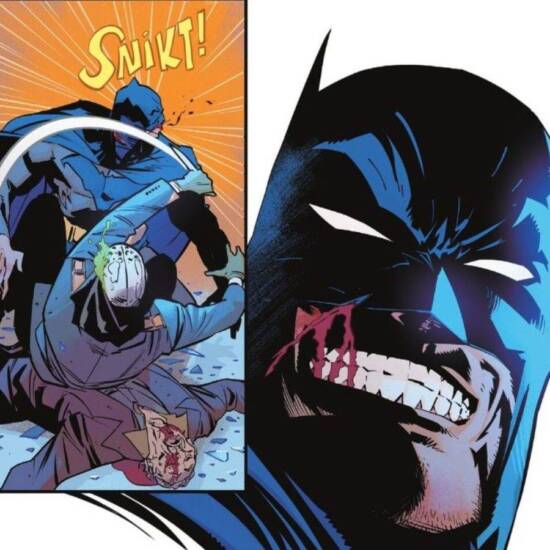
But there are also the little differences between Pennyworth and Verity, too. During the elevator fight with the two assassins, Batman has taken a knife slice to the face, across his cheek. This is very rare to see in Batman stories. The window below his nose is generally sacrosanct in Batman’s adventures. Batman can generally have blackened eyes behind the mask, or gunshot wounds to the body as a consequence of some close-in melee, but never a knocked out tooth. Otherwise, the people of Gotham City might put two and two together. (It is one for the reasons why the retired Bruce Wayne grows a moustache in Frank Miller’s 1986 classic, Dark Knight Returns. Both Batman and Bruce Wayne can never have too much facial hair. And when in Dark Knight Returns, Bruce’s subconscious propels him to take up the mask and cape again, the first thing to go is the mo.) Verity, in addition to fixing up Batman’s wound, also seems to be applying make-up to hide the gash from those who might work out that one is the other. You would never have seen Alfred adept with foundation and a brush.
Verity no doubt will have some sort of shady backstory which will make Batman et al distrust her in time, but unlike Bruce Wayne’s corporate advisor Lucius Fox or Batman’s car builder Jack Edison, we hope that she stays on as a permanent fixture of the cast.
Onto the villains. They are all new. Bat-editors tend to overuse established adversaries of Batman, because many of them are fan-favourites which help sell books. Sometimes, Bat-foes team up (Killer Croc in particular always seems to operate at the behest of some other bad guy). But these assassins, as noted in Verity’s dialogue, all operate alone. Here they are, in order of appearance:
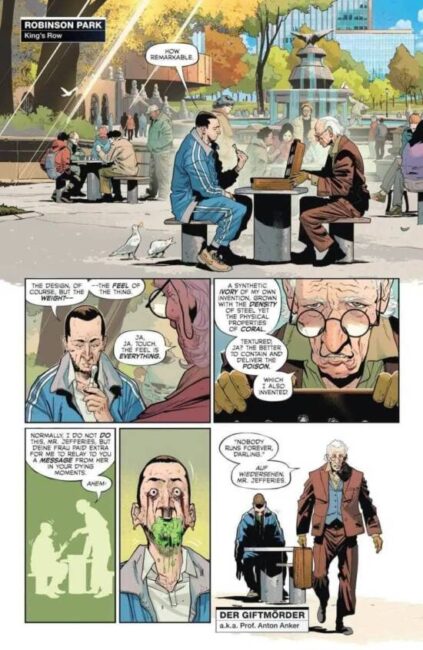
1 Der Giftmorder, the master poisoner, has a victim who seems interested in ivory, and is horribly struck down with some sort of toxin.
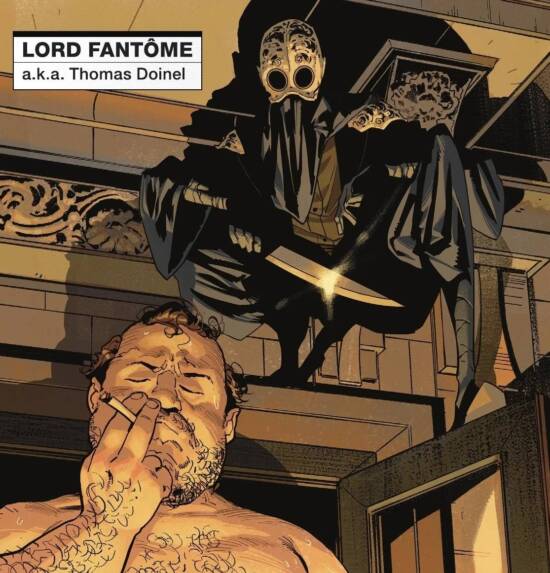
2. Lord Fantôme is a knife-wielding assassin who kills a witness under police protection.
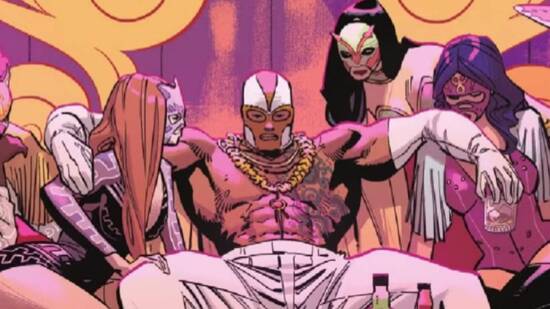
3. Sr Sueno is a hedonistic killer masquerading as a Mexican professional wrestler, surrounded in the last panel of his introduction by a pile of bloodied bodies. Sueno is described in a television by a philanthropic wrestler (King Panther, also Mexican) as a “monster” and a “beast”.
4. Vector is an assassin who uses scorpions hidden in popcorn to murder an overweight man with the same criminal profile as Harvey Weinstein.
5. And Spider Black, having slept with someone with more than a passing resemblance to James Bond for a week, leaves a bomb in his bathroom while travelling on one of the improbable airships so often seen over Gotham City
Each of them gets his or her page of introduction, a little vignette of their most recent hit. It is notable that they all have very different styles of delivering death.
And neither are they easy prey for Batman. In Batman’s fight with Der Giftmorder and Lord Fantôme, the French assassin manages not just to slash Batman’s face but also to spray a sticky green acid over Batman’s glove, forcing the crimefighter to take it off so as to reduce his exposure to chemical burns. Aside from Sueno, all of these villains have a decidedly European flavour to them.
In a twist we rarely see, we learn their target is Bruce Wayne. (This is the price one pays in 2026 for being rich, we suppose. Billionaires are not very popular at the moment.)
This is a very entertaining issue of Batman. We do not expect anything less from Mr Fraction. For our friends at Comic Book Round-up, this issue scores 5/5.