


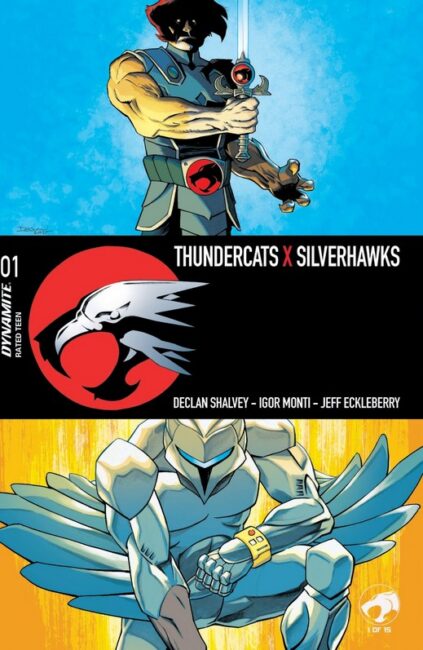
ThunderCats x Silverhawks #1
Dynamite Entertainment
Writer and Artist: Declan Shalvey
ThunderCats x SilverHawks #1 should feel like an event. It brings together two iconic properties with shared 1980s DNA, handled by a single creator in Declan Shalvey, which in theory promises a focused, cohesive vision. Instead, what readers get is a visually strong but narratively disjointed opening chapter that struggles to justify its existence. This seems to be little beyond leverage off brand recognition.
The premise behind both franchises still carries weight. ThunderCats thrives on its blend of mysticism and science fiction, while SilverHawks leans into sleek, cosmic, cybernetic heroics. On paper, combining these worlds should create a compelling clash of tone and ideology. Unfortunately, this first issue barely capitalizes on that potential.
Despite the “#1” on the cover, this is not a true entry point. The story drops readers directly into an already unstable status quo on Third Earth, where ThunderCats mainstay Lion-O has adopted a harsher leadership style that has fractured the team. Some ThunderCats have gone rogue or been exiled, but the comic offers little context or grounding for this shift.
The SilverHawks are introduced mid-mission, investigating an anomaly, but with minimal setup. The result is a narrative that assumes familiarity not just with the original shows, but with publisher Dynamite Entertainment’s cross-title continuity, leaving even moderately informed readers playing confused catch-up.
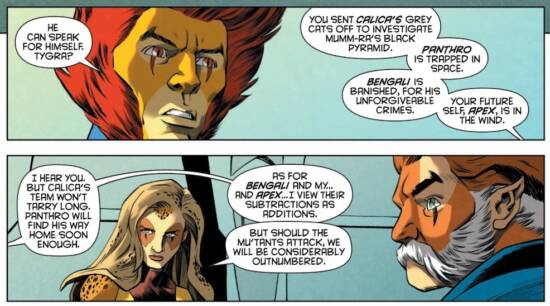
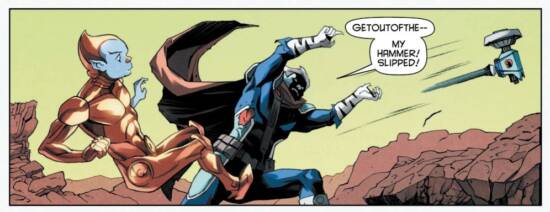
The central interaction between the two teams quickly falls into one of the oldest crossover clichés in superhero comics: misunderstanding leading to combat. Copper Kidd and Chromium’s encounter with Bengali escalates into a fight that feels especially dated. This kind of arbitrary conflict was tired decades ago, and here it is handled without irony or reinvention: the justification for these fights is paper-thin and bordering on unintentionally absurd. A moment where a confrontation halts because one character realizes another is a child, only for violence to resume accidentally, undercuts any sense of serious story-telling.
This pattern repeats throughout the issue, culminating in the expected marquee clash between Lion-O and SilverHawks’ leader Quicksilver. Of course, the fight ends in a draw because one champion cannot be better than the other without upsetting fans, and just as predictably, it is interrupted before any meaningful resolution.
The interruption itself, involving Copper Kidd transforming Lion-O into a child, adds to the sense of narrative chaos rather than intrigue. By the time the cliffhanger arrives, introducing another character with a vague but ominous directive, the story feels less like a deliberate buildup and more like a pileup of disconnected ideas.
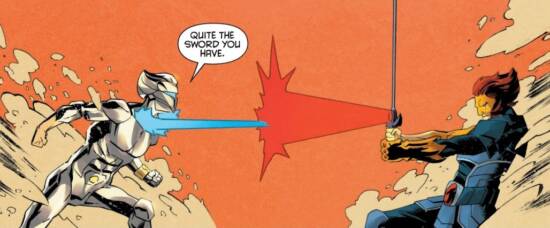
If there is any bright spot, it is the art. Mr Shalvey delivers consistently strong visuals that modernize both franchises without stripping away their 1980s aesthetics. By this we mean the character designs strike a careful balance between nostalgia and contemporary sensibilities, and the action sequences are dynamic and easy to follow. Ironically, the fights that feel narratively hollow are still enjoyable on a purely visual level, which is where the book’s priorities clearly lie.
As a setup issue, this comic underdelivers. As a crossover spectacle, it leans too heavily into outdated tropes. And as a starting point for new readers, it is actively unwelcoming. What remains is a book that looks good but lacks the structural and narrative clarity needed to support any ambition to tell a coherent and engaging story.
Writing: 2/5
Art: 4/5
WCBR Score: 3/5