


Writer: David Schlow
Artist: Utku Yavaşca
Surrey Lane Books, July 2026
The millennial bug wasn’t the only thing threatening to make the end of the last century interesting, according to this new title. In David Schlow and Utku Yavaşca’s Jackrabbit: Book One, a 1950s-themed retro-futuristic thriller set in New York City during the final days of 1999, the promise of technological progress conceals a much darker reality. Flying vehicles, personal robots, and gleaming futuristic architecture give the city an almost utopian appearance. But submerged beneath the surface lies a society still haunted by its history, political paranoia, and the mysterious authority of the so-called Elders. With the year 2000 approaching, the biggest threat to humanity might not be a computer malfunction.
The story follows Flynn Hawking, a cynical young technician who spends his days repairing robots at a small shop while secretly developing an advanced artificial intelligence. His relatively mundane existence begins to unravel when he becomes entangled in the affairs of Sparrow Global, a powerful corporation with connections to his estranged father. Things take an even more disturbing turn when his father suddenly reappears, dragging Flynn into a dangerous situation involving a covert organization known as the Dentokai. A violent confrontation, a frantic escape through the city, and an encounter with experimental nanotechnology eventually leave Flynn questioning everything he thought he knew about the world around him.
Here is the promotional copy:
Jackrabbit is an exhilarating blend of sci-fi intrigue, stylish retro-futurism, and high-octane adventure that propels audiences into a dazzlingly reimagined world.
It bursts with action-packed sequences, clever twists, and layered characters whose motives are as compelling as the mysteries they unravel. At its core, this narrative explores themes of trust, deception, family dynamics, and the blurred lines between heroism and villainy, all wrapped in a vibrant, visually stunning environment reminiscent of classic science fiction with a fresh, contemporary twist. It’s a suspenseful journey full of tense confrontations, emotional depth, and riveting revelations that promise to keep you guessing at every thrilling turn!
In a 1950s influenced, retro-futuristic New York City, where the Kennedy brothers never died and monorails are the city’s main form of transportation, Flynn Hawking is a brilliant Robotics Engineer on the cusp of marrying his sweetheart.
But…
On the night of his engagement party, Flynn’s estranged father returns and reveals their utopia is not what it seems. Thus, dragging him into events that will change his life forever…
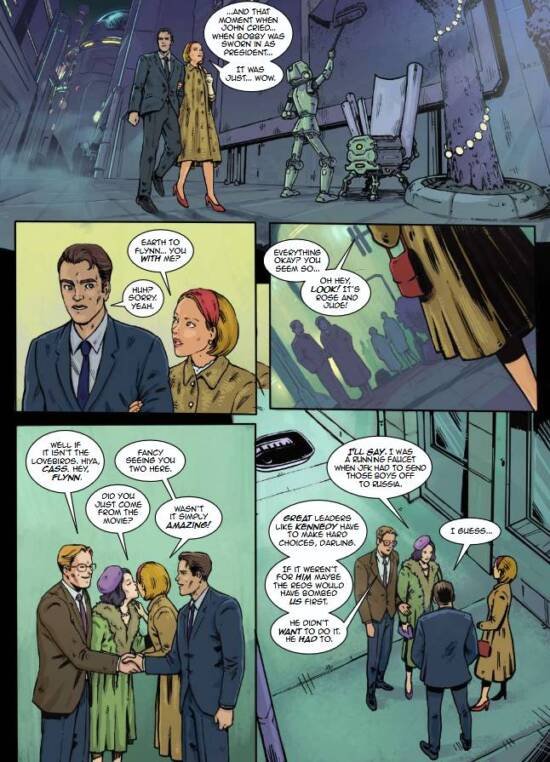
Mr Schlow’s script has an interesting way of combining familiar 20th-century nostalgia (The Matrix motion picture is a clear influence) with near-future speculative science fiction. The setting is particularly effective, presenting a version of the future that feels rooted in the anxieties and aesthetics of the past. Electric typewriters and traditional consumer storefronts coexist with personal androids and advanced robotics, while conversations about the Kennedy administration and Cold War politics provide a historical backdrop to the story’s larger conspiracy.
There’s also an interesting tension between the apparent stability of this society and the lingering resentment of those who remember its previous conflicts. The Elders may have maintained peace for decades, but Flynn’s skepticism suggests that not everyone is convinced their leadership deserves unquestioning loyalty.
The story also benefits from its central character. Flynn is not introduced as some particularly heroic or capable individual, but rather as a young man struggling with an unreliable father, an overbearing employer, and an uncertain future. His relationship with his father provides much of the emotional foundation for the opening installment. Beneath all the conspiracies and technological mysteries is a fairly familiar family drama involving abandonment, resentment, and the difficulty of rebuilding trust.
This gives the increasingly outrageous developments something personal to build upon, even when the story starts throwing military operatives, secret organizations, and experimental technology at its protagonist.
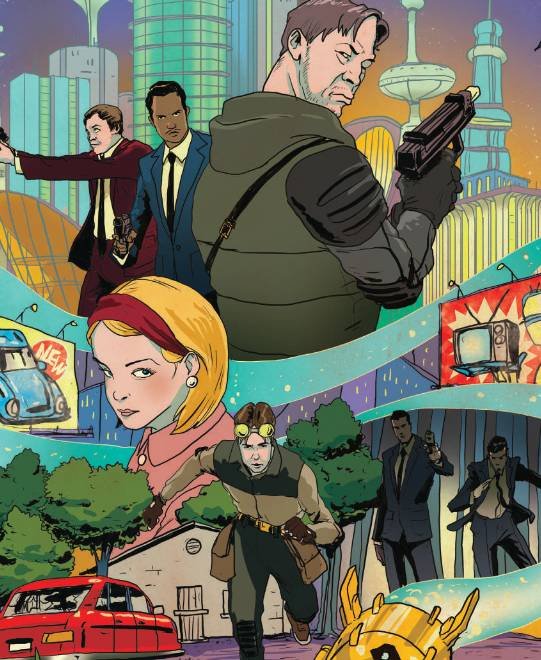
Utku Yavaşca’s artwork is another strong component. His clean, detailed linework has a grounded quality, while the colouring gives the futuristic setting a distinctive atmosphere. Rather than relying on the excessively glossy appearance often associated with science fiction comics, or even just modern comics, the book uses a more subdued palette, with plenty of muted blues, greens, purples, and earthy tones. This works particularly well in establishing the contrast between New York’s sleek architecture and the more cluttered, lived-in environments where much of the story takes place. It is also solidly 1950s: the Second Machine Age aesthetic pervades the story in the fashion, the streamlined vehicles, and the architecture.
Mr Yavaşca is particularly good at establishing a sense of place. The city feels like a functioning metropolis rather than a collection of futuristic backdrops, with its streets, shops, public spaces, and transportation systems contributing to the overall world-building. Character work is equally effective, with expressive faces and body language doing the heavy lifting during the more emotionally charged scenes. The action sequences are also handled competently, with dynamic panel compositions and changes in perspective maintaining a good sense of movement without sacrificing clarity. This becomes especially important during the later sequences, when the story begins introducing more surreal visual elements associated with Flynn’s exposure to nanotechnology.
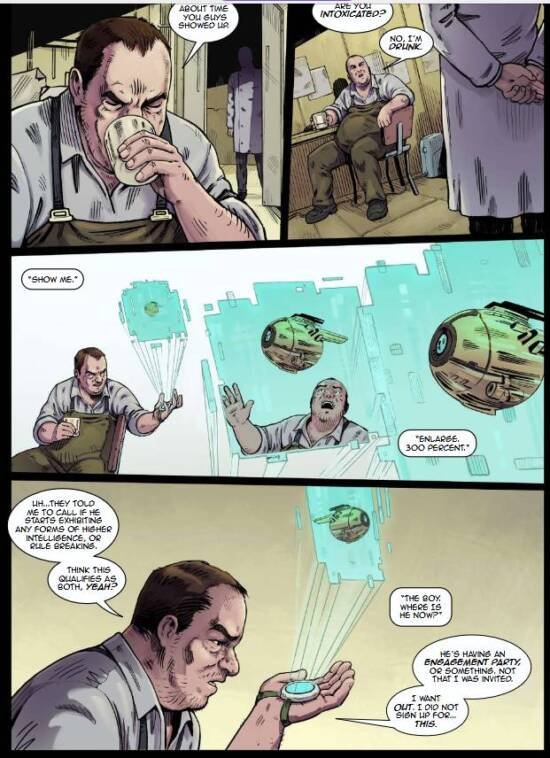
If there’s one weakness, it’s that the narrative occasionally moves too quickly through its exposition and revelations. There is a lot happening in this first instalment, and some of the larger mysteries are introduced before the reader has much opportunity to properly digest what has been laid out so far. The conspiracy surrounding Sparrow Global, the Dentokai, and the Elders is intriguing, but do we need three villainous, shadowy organisations pulling stings? The book is clearly more interested in establishing the pieces of a much larger puzzle than providing immediate answers. That’s understandable for the opening chapter of a longer story, although it does leave certain developments feeling somewhat abrupt.
Nevertheless, Jackrabbit: Book One makes for an intriguing introduction to what could become an entertaining science fiction espionage thriller. Its combination of retro-futurism, political intrigue, family drama, and technological paranoia gives it a distinct identity, while Mr Yavaşca’s artwork provides a strong visual foundation for Schlow’s increasingly elaborate narrative. Part I of “The Awakening” ends just as Flynn begins to understand the nature of the world he’s been living in, leaving plenty of questions for the next instalment to address.
The title is available for purchase from the publisher: https://www.surreylanebooks.com/jackrabbit