


Writer: Snake
Artist: Mauro De Falco
October 2026
Graphic novels that tackle systemic poverty, homelessness, and addiction often run the risk of falling into miserabilism, treating human suffering as little more than misery porn for middle-class consumption. Grinding Against the Marrow, written by British writer (and acclaimed poet) Snake and illustrated by Italian artist Mauro De Falco, manages to avoid much of that territory.
Rooted in the lived trauma of its creator and presented through an arresting combination of kinetic artwork and lyrical prose, this is less a conventional graphic novel than a bruised, jagged poem about the gravitational pull of a dying town and the difficult business of escaping it.
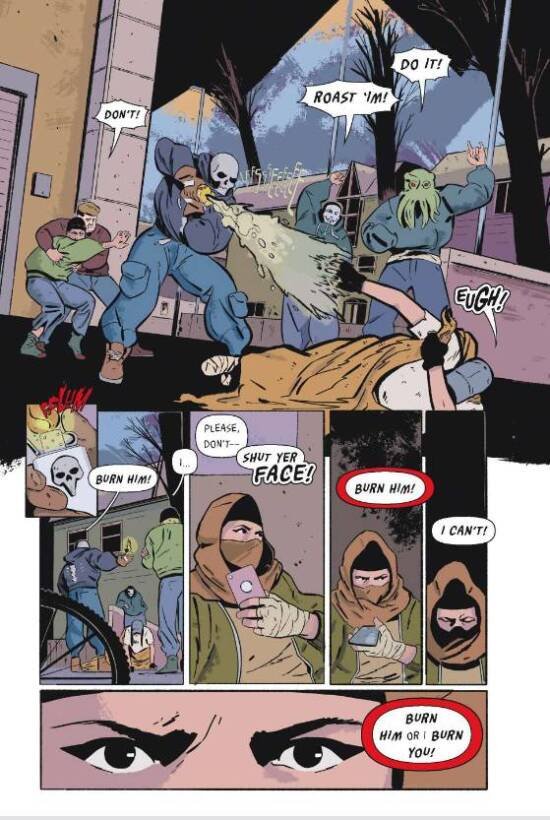
The story takes place in The Vale, an anonymous, claustrophobic suburban wasteland that seems determined to swallow everyone unfortunate enough to call it home. At its center is Soma, a hooded, scarf-obscured former drug addict now living on the streets. A woman of few words, she moves through the town almost invisibly, observing its many forms of cruelty while trying to stay one step ahead of its predators. Packs of mask-wearing youths terrorize the vulnerable, corrupt municipal authorities make an already miserable existence worse, and Soma’s response to the surrounding ugliness is often an explosive, fiercely protective violence.
Here is the promotional copy:
It’s Halloween. All the ghouls and goblins are out! We’re stuck in the small-minded malevolent town of Marrow. So get ready to survive the streets with Soma, a homeless ex-junkie Muslim. She’s all action, a woman of minimal words. Think a female Clint Eastwood cowboy, straightening out small town trouble. Soma encounters an entire cross section of the town’s seedy underbelly, including being hunted by packs of mask-wearing youths, corrupt cops, and partnering with an unlikely crew of outcast allies. However, she’s also got one particular skill that makes her formidable for this ordeal: parkour free running. But will this acrobatic ninja actually manage to escape the town’s clutches?
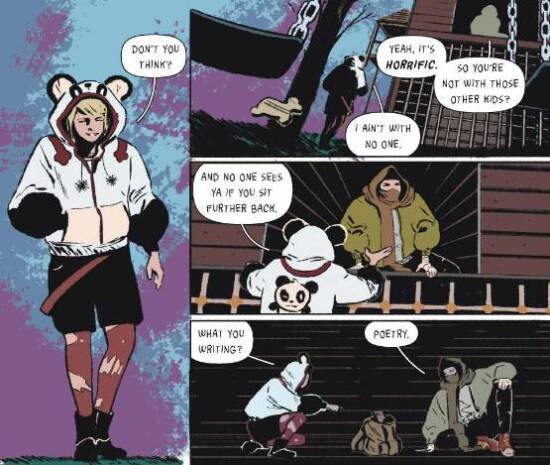
For all its brutality, however, the book isn’t consumed by despair. There are occasional moments of tenderness, particularly in Soma’s brief friendship with Juniper, a young poetry enthusiast who wears a panda hoodie and struggles with an equally suffocating home life. Their relationship provides much-needed breathing room in a plot otherwise boiling with conflict. It also gives the narrative an emotional anchor, reminding us that even among people who have been discarded by society, there remains a capacity for kindness and connection.
The story eventually takes a darker turn when Soma discovers that a local restaurant is being used as a front for human trafficking. What follows is an eruption of violence and fiery retribution, although the book’s ultimate destination is more personal than its explosive climax might suggest. Rather than offering an implausible victory over the social conditions that have made The Vale such a miserable place, Snake frames redemption as something smaller and considerably more difficult: recognizing toxic relationships and circumstances for what they are, then finding the strength to walk away.
Much of the book’s potency comes from Mauro De Falco’s artwork. His clean, almost ligne claire-inspired approach creates an interesting contrast with the sordid reality of the setting. The color palette leans heavily on muted nocturnal blues and sickly urban greens, with sudden bursts of fiery orange when violence and chaos take over. It’s a distinctive visual language that gives the book an atmosphere of constant unease without resorting to the usual grimy visual shorthand associated with stories about homelessness and urban decay.
More importantly, Mr De Falco gives his characters a convincing physical presence. Soma is particularly well-realized. Her parkour movements are rendered with an impressive sense of fluidity, whether she’s twisting through the air to evade attackers or navigating the town’s unforgiving architecture. Yet the same character can look utterly defeated when sitting alone, her posture conveying the exhaustion of someone who has spent far too long simply trying to survive. There’s a physical weight to these figures that prevents them from becoming mere symbols of social problems.
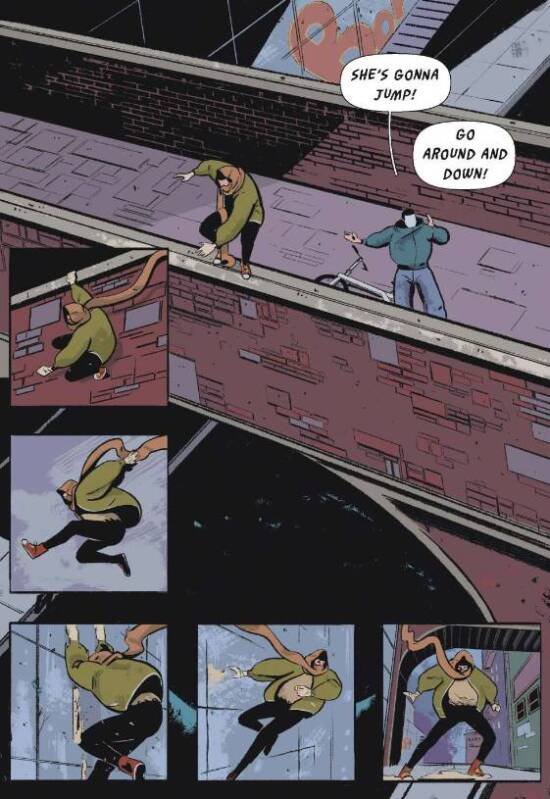
The panel compositions also deserve recognition. Mr De Falco moves between wide, lonely establishing shots of desolate council estates and tight, aggressive close-ups of antagonists hiding behind cartoonish or skull-faced masks. This shifting visual rhythm gives the book a spoken-word performance, with the artwork rising and falling alongside Snake’s text. The result is occasionally unconventional, but it suits a story that seems more interested in conveying a particular state of mind than following the familiar rhythms of a traditional narrative.
And that is perhaps the most important thing to understand about Grinding Against the Marrow. Its poetry, violence, and fragmented storytelling aren’t always comfortable companions, and the book doesn’t make much effort to accommodate readers looking for an easy or straightforward experience. But there is a purpose behind its rough edges. Snake and Mr De Falco have created something that feels deeply personal, capturing the suffocating experience of living in a place where poverty, addiction, violence, and institutional indifference have become part of the everyday landscape.
Grinding Against the Marrow is not an easy read. It is a raw examination of how easily a human being can slip through the cracks of a negligent society, and how difficult it can be to reclaim a life once those cracks have swallowed you. By marrying visceral, kinetic artwork with a lyrical exploration of trauma and survival, Snake and Mr De Falco have produced a graphic novel that lingers long after the final page.
This title is available from Booktopia: https://www.booktopia.com.au/grinding-against-the-marrow-snake/book/9781919031187.html