

Creator: Evan Adams
Independently published, February 2026
Evan Adams’ Shattered is an unusual first attempt at a graphic novel. The 2026 comic follows Ethan Timmbs through the first weeks of sixth grade at Forest Hill Middle School, where the ordinary anxieties of adolescence are compounded by the strange reality of attending school during the COVID-19 pandemic.
Mr Adams describes 6th Grade Story as being based on his own life, with characters, events, and locations drawn from his experiences around 2020. That autobiographical foundation gives the story an oddly specific quality. Rather than presenting middle school as a generic coming-of-age setting, Mr Adams focuses on the small humiliations, frustrations, social awkwardness, and institutional rules that can make the experience feel overwhelming to a child. This comic is the dark shadow of Jeff Kinney’s acclaimed children’s book series, Diary of a Wimpy Kid.
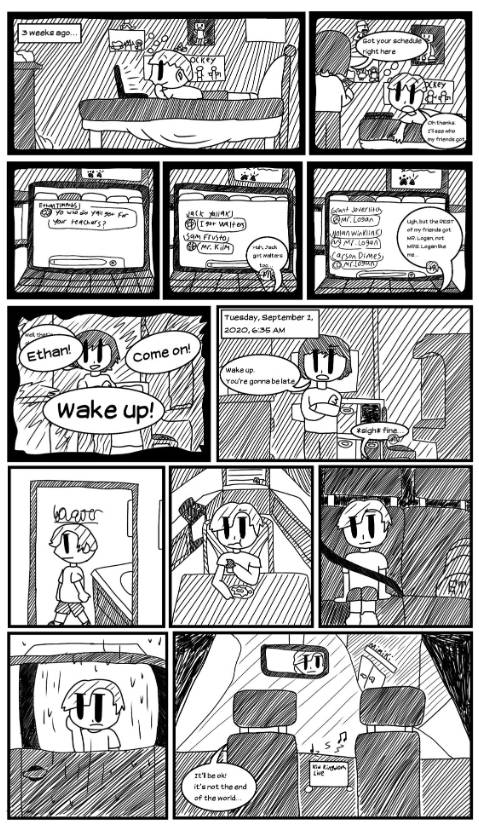
Ethan enters sixth grade already separated from many of his friends, who have ended up in different classes. Things only become more difficult from there. Assigned lunch tables, social distancing requirements, surveillance, gym class, exploratory subjects, and the general bureaucracy of middle school leave Ethan feeling increasingly isolated from the people and activities that once made school enjoyable.
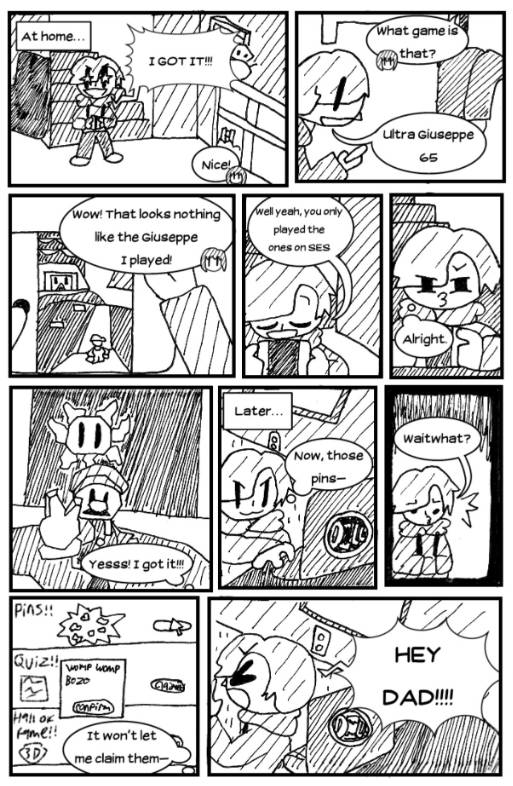
His escape comes largely through video games, including the Ultra Giuseppe series, an obvious parody of Super Mario Bros. The games provide Ethan with something that his actual environment increasingly lacks: a sense of familiarity and control. While school dictates where he can sit, where he can go, and who he can interact with, the fictional worlds of his games offer a place where the rules are at least understandable.
That distinction becomes increasingly important as Shattered moves from recognizable middle-school anxiety into psychological horror.
Ethan begins experiencing recurring nightmares involving a monstrous authority figure who confronts him about a mysterious “revolution.” The figure blames Ethan for the imprisonment of his friends, and subjects him to increasingly oppressive demands. What initially appears to be the sort of bizarre nightmare imagery that might emerge from an anxious child’s imagination gradually begins to mirror the institutional pressure Ethan experiences while awake.
The story eventually reveals that this paranoia is not entirely confined to Ethan’s dreams. His teachers, Mrs Walters and Mrs Logan, are secretly coordinating with a shadowy administrative committee that is monitoring Ethan. The two teachers fear he could follow the rebellious path of a former student named Robert. The school administration’s solution is essentially to keep Ethan under control before he can become a problem. This reminds us of Dav Pikley’s best-selling series Captain Underpants, another pre-teen absurd comedy involving a teacher with a hidden agenda – though Captain Underpants’ alter ego, the harsh principal Mr Krupps, knows it not. But Evan is far removed from Captain Underpants‘ true heroes, George and Harold, and Mr Krupps is no peer of Mrs Walters and Mrs Logan. Here, the teachers’ concern with a potential unruly student is dark.
It is an intentionally exaggerated premise. But the way Adams transforms ordinary school rules into the machinery of a dystopian thriller is compelling. From Ethan’s perspective, the distinction between an authoritarian institution and an ordinary school is thin. Being told where to sit, being watched by teachers, being separated from friends, and having adults constantly determine what you can and cannot do are not sinister experiences from an adult perspective. For a sixth-grader, they feel enormous.
The artwork reinforces that perspective. Mr Adams employs an intentionally crude visual style that looks closer to something a bored student might sketch in a notebook during class than the polished artwork associated with conventional graphic novels. Think Dogman, without the whimsy which comes from amateur hand-drawn art. Characters are simplified, expressions can be exaggerated, and the entire book has the rough, homemade quality of something created out of a young person’s imagination.
That aesthetic works surprisingly well with the material. Shattered is a story about experiencing the world through the eyes of a young adolescent, and the art feels appropriately raw and unfiltered for that story. The deliberately childish drawings also create an interesting contrast with the sterile environments surrounding Ethan. School hallways are bleak: rigid layouts, fluorescent lighting, surveillance-oriented compositions, and an almost institutional emptiness.
The warping of Ethan’s dreams is a visual representation of his inability to make sense of what is happening around him. The contrast between mundane school environments and surreal horror is one of the more effective aspects of the book. This is particularly because Mr Adams does not need to transform the school itself into a traditional haunted-house setting. The horror comes from Ethan’s perception of the institution and the possibility that the adults around him are hiding something.
There is, however, one significant problem with the presentation. Some of the early pages can be difficult to read. The dialogue balloons appear to have been added digitally, and in several instances there simply does not seem to be enough room for all of the dialogue within the available panels and balloons. The result is cramped lettering that forced this reader to squint and physically move closer to the page.
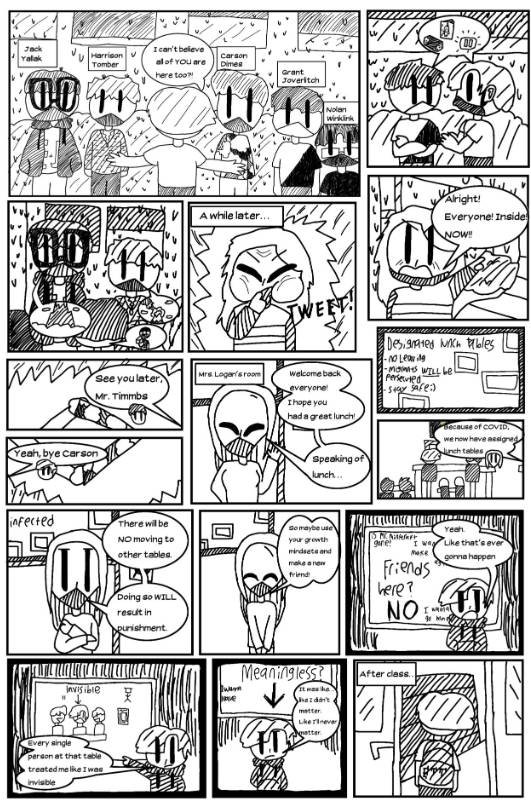
This is complicated by the book’s adolescent art. Visually, the clutter is not out of place. It looks like another extension of the comic’s homemade style. Functionally, however, it is a genuine readability issue. Readers of a physical copy may strain to make out some of the smaller text, while anyone reading digitally will find themselves reaching for the zoom function more often than they should.
That issue aside, Shattered is an interesting debut because of how specifically it captures a particular moment in adolescence. The pandemic setting is especially significant. It caused many creators to dedicate time and effort to pandemic-themed works, for example, https://worldcomicbookreview.com/2021/09/24/virtually-the-same-a-lockdown-corona-diary-review/ and which we otherwise discussed here: https://worldcomicbookreview.com/2020/05/29/fortresses-of-solitude-american-comic-books-and-their-readers-during-the-covid-19-pandemic/ For readers who went through the early stages of adolescence during the COVID-19 pandemic, the combination of school restrictions, social isolation, constantly changing rules, and the desire to maintain some sense of normality through entertainment and video games will be familiar. The Ultra Giuseppe material, the school setting, and Ethan’s increasingly bizarre interpretation of authority all contribute to a story very much rooted in the experiences of its creator and his generation.
As a first graphic novel, Shattered is rough around the edges, literally. Its artwork is crude, its pages can be difficult to read, and its story moves from recognizable autobiographical material into increasingly surreal territory. Yet those qualities gives the book its personality. The title is available for free here: https://globalcomix.com/c/6th-grade-story/r/bfc6265c-3319-44e3-95e2-6403c5e0dfa0