


Writer: Mike Carey
Artist: Dean Ormston
Vertigo Comics, February 2001
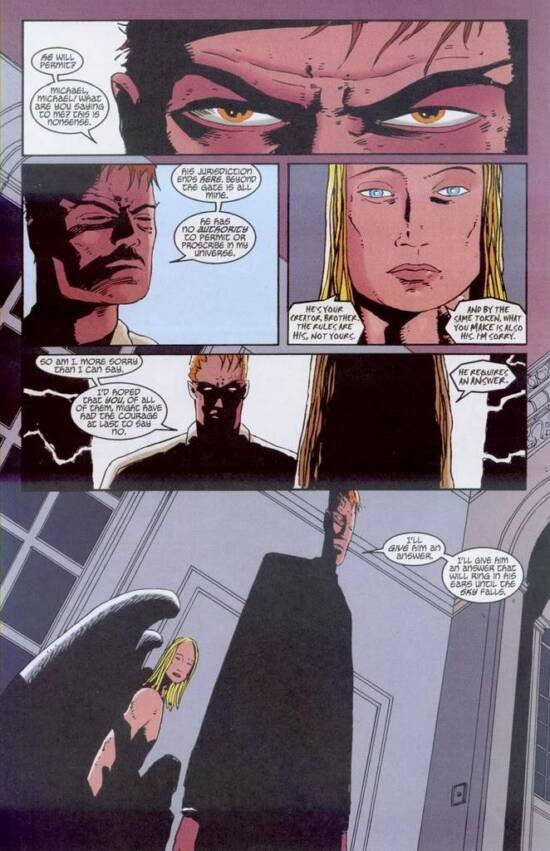
This critique is the second of a series of reviews of Mike Carey’s epic work Lucifer, which this year celebrates 25 years since inception. Our first in the series can be found on this link: https://worldcomicbookreview.com/2026/08/01/lucifer-twenty-five-years-later-part-1-children-and-monsters-prelude-issue-9-review/
Defiance of authority is the keel to epic fiction. Writer Mike Carey, for almost the entire series, spared no effort to have his readership enamoured of the cold defiance and fierce pride of his central character, Lucifer, the proudest of all of God’s creations.
Within this issue 20, Lucifer’s master plan is revealed. In the ultimate act of defiance, Lucifer has set up a universe in competition to that of God. Whoever does not enjoy God’s creation can try Lucifer’s instead. The mighty archangel Michael was an unwitting participant in the scheme, and does not comprehend what Lucifer has done until Lucifer smugly spells it to him. In a few brief panels, Mr Carey explains what it is that Lucifer had been up to for the preceding twenty issues of the title, almost two years of rapt but ponderous head-scratching by the audience: Lucifer has stuck it to his dad, the Creator, in the most offensive way possible, by way of his own Creation.
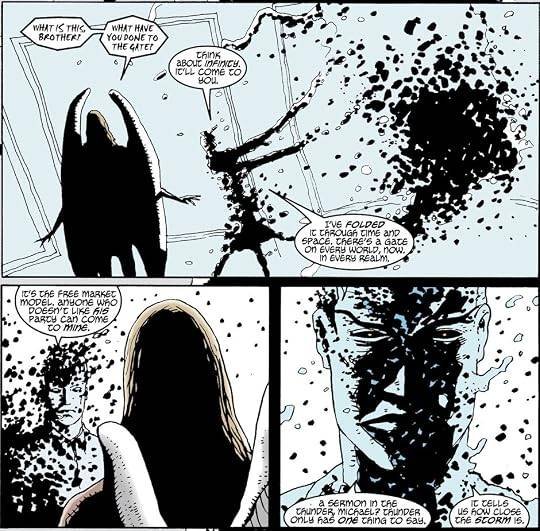
God is not happy. Michael has been told to tell Lucifer to shut it down, and notes that because God created Lucifer, what Lucifer creates is God’s.
But all this explanation of a metaphysical chain of title does is further provoke Lucifer. Lucifer will not allow his father to tell him what to do in his own space. And as an additional act of defiance, Lucifer audaciously extends the offer of refuge to anyone who might choose it, by replicating a gateway to Lucifer’s creation across God’s creation. Anyone else who is tired of God’s plan can join Lucifer’s laissez-faire alternative.
We gaped in awe at Lucifer’s effrontery and even knowing he is cold as stone, we cheer the rebel son on.
As a philosophical subtext, Mr Carey throughout the series considers the the debate between determinism and free will. It seems natural that as an embodiment of will, and as the leader of the rebellion against God, Lucifer has no truck with God’s plan, and Lucifer seems to understand that the accountability for his actions is more along the lines envisaged by St Augustine (put very briefly, that there is predestination, tempered by free will and the sin arising from free will).
But by issue 52, when Lucifer finally encounters Destiny of the Endless, Mr Carey has Lucifer moved beyond St Augustine’s philosophy. Lucifer is deliberately out to prove instead that French philosopher Jean-Paul Sartre was right – existence predates essence, and that we are – or at least Lucifer is – is completely free: Lucifer’s life is not predetermined, and he will carve out his own path.
The Endless are a creation of fellow British writer Neil Gaiman, first appearing in The Sandman. (We have talked about Mr Gaiman’s work as the source material and inspiration for Lucifer in the first critique.) Within DC Comics, The Endless embody various way points of existence, and Destiny is the physical manifestation of, well, destiny. Destiny carries about a very big book, within which is the story of the past and future of the universe.
Destiny does not like Lucifer much, it seems, and indulgences in some passive-aggression, and Lucifer does not like Destiny’s very reason for existence let alone his attitude (we sympathise – Destiny is deliberately not a likeable character). Lucifer inevitably (a pun) loses his temper with Destiny and incinerates pages of the book to ensure that Destiny is as blind to the future as the rest of us. God’s plan, Lucifer supposes, is erased into ash.
But below is the final, Calvinist page of issue 52, where determinism wins out: Destiny is capable of reading the tatters and ash and shows that the attack on his book was, like anything else, predetermined.
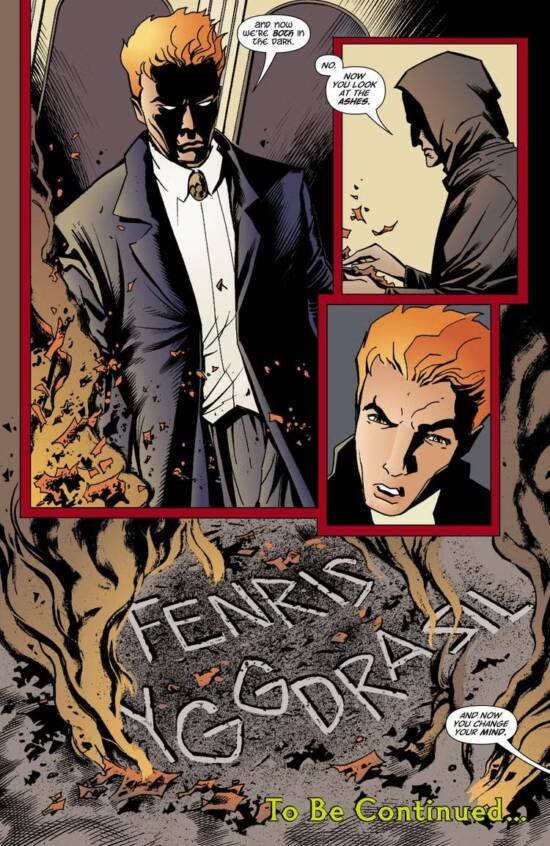
Back in issue 20, though, Lucifer is not interested in the debate of free will and determinism. The argument about free will and determinism is negated if you exit from the equation of it. Lucifer removes himself from the chess board, and allows anyone else who has equally had enough of it to also step out of the game. The audacity is completely compelling.
Issue 20 contains a trap for readers. Cosmos-shaking deeds within Lucifer are often contrasted by Mr Carey with the silly and even banal, which we see very clearly with the two cindery cherubs, Gaudium and Spera, who pop up throughout the series. Using ‘lowborn’ characters as comic relief is is a Shakespearian tactic of thematic juxtaposition.
Lucifer’s headquarters in Los Angeles was his inoffensive piano bar, called Lux. It was rebuilt by Lucifer, after a preliminary skirmish, into a mind-bending tower. Lux as by this point in the series become a beacon to those with any sort of magic in them, from genuine creatures of myth and sorcery to those who have even a glimmer of ‘sight’. The yearning attraction to Lux is a misconception by those with stunted magical ability of Lucifer’s universal invitation to decamp to his new realm.
Ewen and Sherri are two young trespassers who decide to scale Lux’s wall. It is an act of teen impetuousness. Sherri is the one who is lured in by the promise Lux holds. She is a wild, magnetic spirit and Ewen is caught in her spell. The trap for readers is to think that these two are like the gravediggers from Hamlet or Dogberry from Much Ado About Nothing and are there just to disrupt the tension.
But Lux offers no food or water to the uninivited, and they find themselves lost in a maze of dry, stone tunnels. (Ewen is a soft-hearted slacker secretly in love, and achieving what he utimately desires – sex and intimacy with Sherri – only to then miserably die of kidney failure is a deliberately poor ending to his life.)
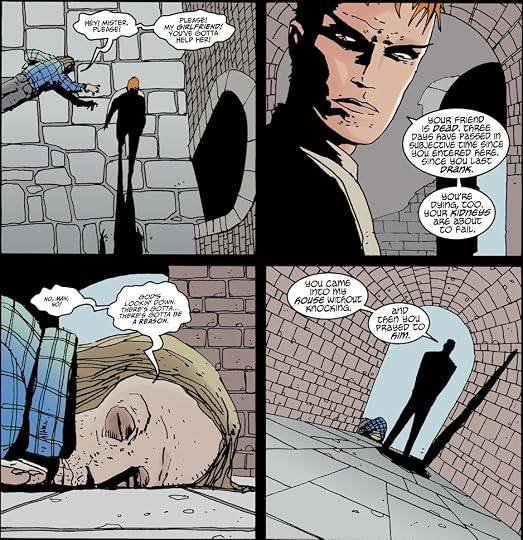
Lucifer could easily save him. He chooses not to do so, and imperiously looks down on Ewen to tell him how and why. Ewen made the mistake of asking God for help as he stumbled around in Lux’s never-ending twist and turns looking for water. Ewen does not strike us as the God-fearing type. Invoking God is a figure of speech that secular people do daily when they stub their toes or forget where they put their car keys. But for Lucifer, it is an insult.
Lucifer is responsible for many deliberate deaths throughout the series. His entry and passage into the gossamer nil-space of the Mansions of the Silence causes the deaths of billions, we are told, and we also have his murder of thousands of people in Beijing (Lucifer: Nirvana, 2002). But those deaths were at least to a purpose. Ewen’s death was indifferent and prissy.
With this story, Mr Carey reminds us that Lucifer is grand, imperious, resourceful, powerful beyond belief, and cunning. But Mr Carey reminds us that Lucifer is also inhumanly spiteful and despicable. Hubris is one thing, but pettiness is another. We are dragged back by Mr Carey in this issue to the cold fact that Lucifer is not to be admired, despite being our champion in his defiance to God. Lucifer is the villain, not the hero or anti-hero, in his own title.