

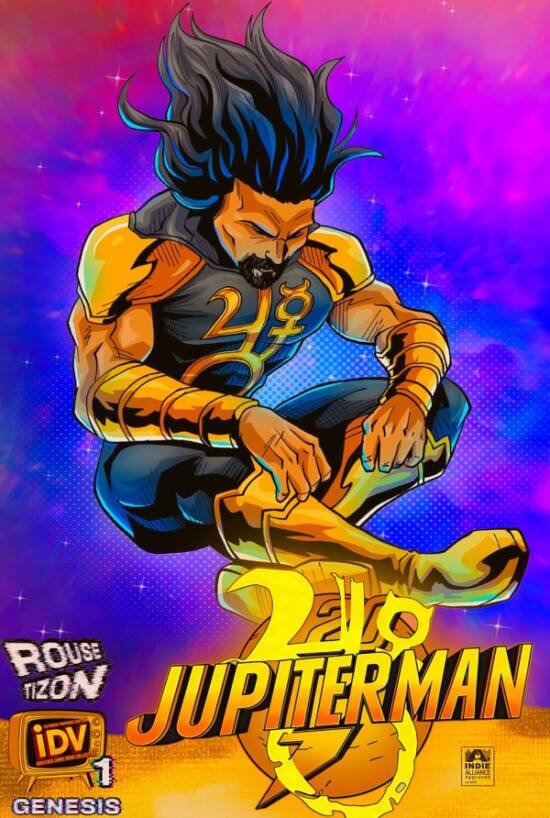

Writer: Nathan Rouse
Art: Jeffry Tizon
Idolverze Publishing Group, 2026
Created and written by Nathan Rouse, with artwork by Jeffry Tizon, The Legacy of Jupiterman is published by Idolverze Publishing Group. Its first issue is an ambitious introduction to a superhero mythology that draws from ancient gods, indigenous folklore, historical frontier drama, and extraterrestrial warfare. There is certainly no shortage of ideas although the challenge of fitting so many elements into a single issue occasionally works against the story. An editor might have de-cluttered ancillary elements, and we talk more about that below.
The series opens with the creation of the universe, or more precisely, the sacrifice that made its existence possible. A primordial pantheon of thirteen gods, led by the Roman pantheon’s father-figure, Jupiter, voluntarily gives up its physical existence to allow the universe to develop on its own. However, not everyone is willing to accept this arrangement. Roman god of death Pluto rejects the decision, setting in motion a conflict that will eventually have consequences far beyond the divine realm. Here is the promotional copy:
The Legacy of Jupiter Man is about Wohali Ishta, a Native American man whose life and identity are shaped—and manipulated—by forces far larger than himself. At its core, the story isn’t just about a superhero mantle being passed down. It’s about inheritance without consent. Wohali is selected by the U.S. government to become Jupiter Man, not because he seeks power or fame, but because he fits a profile—psychological, cultural, and symbolic. Through simulations, conditioning, and carefully curated heroic narratives, the government feeds him a version of history and destiny, blurring the line between who he is and who they need him to be.
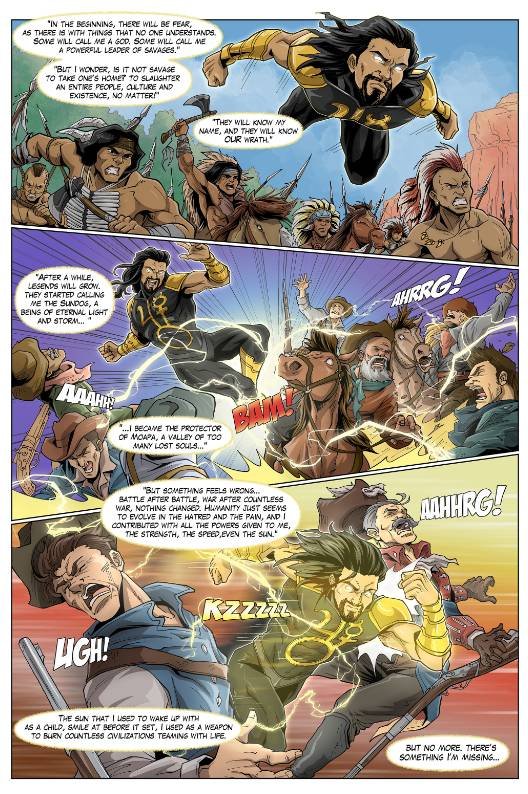
From this mythological beginning, Mr Rouse establishes two parallel origin stories. The first follows Wohali Ishta, an outcast Cherokee warrior living in 1819 Nevada. After discovering an ancient chamber, he encounters the power that transforms him into Jupiterman. It is not a straight-lined plot, that a Native American war leader might harness the power of a Roman god, and the concept of stumbling across the powers of a classical deity dates back to 1939 and Captain Marvel. But there we go.
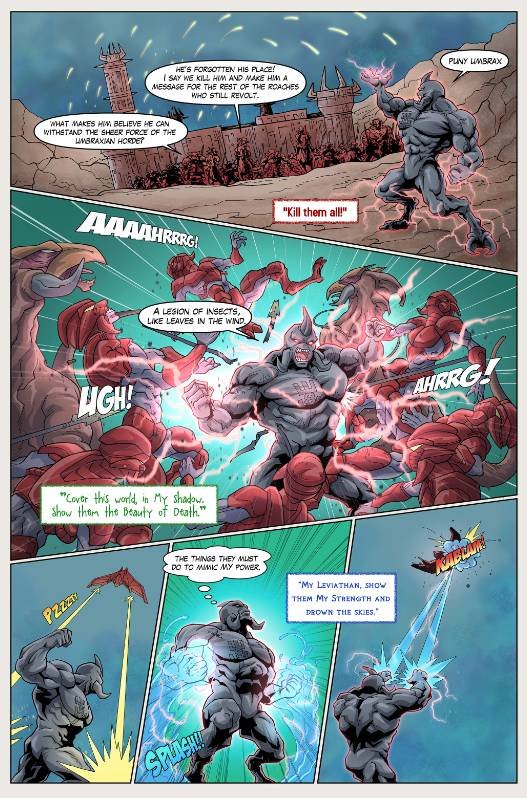
The second plot introduces Bivias, an alien chieftain from the distant planet Etisoppo. Faced with the prospect of watching his people starve, Bivias accepts the corrupted power offered by Pluto’s faction, setting him on a very different path.
Mr Rouse clearly has a considerable mythology in mind, and the first issue wastes no time introducing it. The comic establishes several different stories simultaneously. We get the creation of the universe, a nineteenth-century frontier drama, an alien civilization facing extinction, and the beginnings of a modern-day superhero conflict, all within twenty-eight pages. We admire Mr Rouse’s energy, but we barely kept up with it.
The result is a narrative that moves faster than its characters can develop. Bivias’ transition from a desperate leader trying to save his people into an instrument of cosmic vengeance, in particular, could have benefited from more room to breathe.
Still, the script has some interesting ideas beneath all the cosmic spectacle. One of the more appealing aspects of Jupiterman’s characterization is his growing disillusionment with humanity. After centuries of intervening in human conflicts, he has come to realize that his efforts have done little to change mankind’s seemingly endless appetite for war.
It’s a welcome complication of the familiar superhero archetype, giving the character a sense of exhaustion. The idea that someone capable of extraordinary feats could eventually become weary of trying to save a world that refuses to learn from its mistakes is arguably one of the book’s more interesting narrative hooks.
Mr Tizon’s artwork complements the story’s larger-than-life sensibilities with a vibrant, high-saturation digital aesthetic. There’s an unmistakable Saturday-morning cartoon quality to the title, particularly in the exaggerated character designs and colorful energy effects. Mr Tizon also does a commendable job distinguishing the different settings. The 1819 Nevada sequences make effective use of dusty, sun-baked earth tones, providing a grounded contrast to the brilliant, neon-colored energy discharges inside the 21st century Olympus Pride Cave.
The character designs are similarly bold. Jupiterman cuts an imposing figure, and his flowing hair and gold accents give him an appropriately regal appearance. Bivias, meanwhile, becomes a suitably intimidating physical counterpart after his transformation into a horned, gray-skinned powerhouse. These cliches somehow grant a sense of scale to the characters.
However, the digital presentation does have rough edges. Certain panels rely heavily on smooth gradients and relatively flat background textures. They are less substantial than they should be. This is particularly noticeable in the wider cosmic vistas and action sequences, where more texture and visual depth could have made the spectacle more convincing. The linework also needs grit, especially when depicting the brutality of frontier life or the desperation of a civilization fighting for survival. Nevertheless, Mr Tizon keeps the layouts clean and the action easy to follow. Whether the characters are fighting in a dusty Nevada alleyway or an alien battlefield, the geography of the action is clear enough.
In summary, The Legacy of Jupiterman #1 is an ambitious opening chapter that occasionally struggles under the weight of its own mythology. Mr Rouse uses the title to articulate interesting ideas about divine intervention, human nature, and the consequences of power, while Mr Tizon provides a colorful visual identity that suits the material’s superhero and science-fiction influences. The storytelling would benefit from a more measured pace, and some of the artwork would be stronger with greater textural depth. All of this suggests to us weak editorial feedback and control. ‘With regards to freelance editing, there was a long period of time of at least 10 years where creators did not recognize the value that editors would bring in. Nowadays, it’s actually changed, where more and more creators are recognizing, “Hey, maybe I need an editor…. The first step of comic editing is recognizing what works, what doesn’t work,‘ says Steve Colle in this interview: https://editorsbc.ca/2025/12/07/comics-editing-interview/ . We anticipate the series has room to grow with some prudent weeding by a patient editor, most obviously in respect of pace.
Independent comics often distinguish themselves by taking familiar genre conventions in unexpected directions, and The Legacy of Jupiterman has the beginnings of something interesting. Its combination of indigenous folklore, mythological revisionism, and cosmic superheroics gives it a distinct identity.
You can buy this title here: https://www.indyplanet.com/the-legacy-of-jupiterman-1