

Writer: David Pepose
Artist: Davide Tinto
Mad Cave Studios, May 2026
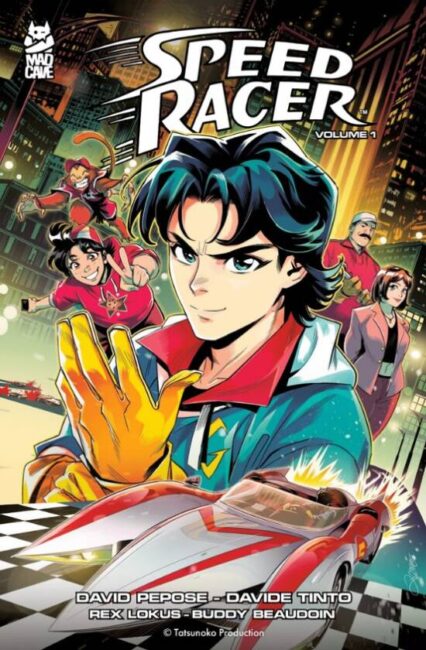
Mad Cave Studios’ take on Speed Racer has always had a tricky balance to strike. The original property is so stylistically distinct, so tied to a very specific era of animation, that any modern adaptation risks either feeling outdated or losing its identity. With Speed Racer Vol. 1 TPB, writer David Pepose and artist Davide Tinto don’t attempt a full overhaul. Instead, they tinker with the engine and recalibrate the timing.
The story remains focussed on the protagonist, named Speed. Collecting issues #0 through 5, this volume reframes Speed’s world through a contemporary lens without discarding its roots. The core premise remains recognizable: Speed, his family, the Mach 5 race car, and the looming presence of Speed’s adversary, Racer X.
But the structure surrounding those elements has shifted. Gone are the clean, commercialized races of the original anime. In their place is a grittier, high-stakes underground racing scene that feels much closer in tone to something like the Need for Speed franchise. Speed is no longer just a professional racer chasing trophies. Here, he is navigating an illegal circuit, dodging law enforcement, and racing not just for pride but survival.
That tonal shift is the most immediate and potentially divisive aspect of the book. For longtime fans, this reinterpretation is a departure from the spirit of the original. The bright, almost optimistic simplicity of the 1960s series is replaced with something more kinetic and tense. It begs the question: do we need a 1990s grim and gritty version of Speed Racer? The notorious 1990s tone of American superhero comics is less akin to progression and more like burning rubber circle-work in a mall car park.
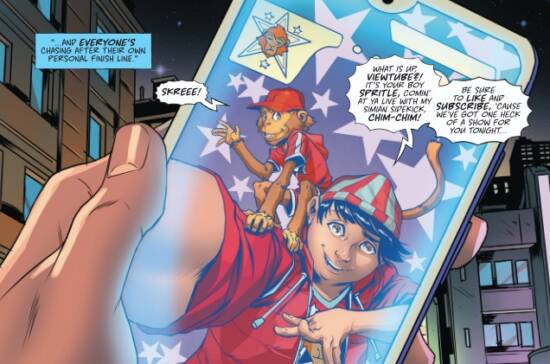
However, the creative team shows a clear awareness of that risk. The result is less a rejection of the source material and more an attempt to translate it into a modern storytelling language. And the modernization extends beyond the races themselves. Characters are subtly reworked to reflect contemporary culture. Trixie is no longer just a supporting figure but a racing team owner with agency. Another minor character named Spritle has a change in role and is now a livestreamer, which integrates influencer culture into the narrative wit. These changes could have easily come off as gimmicky, but they are handled with enough restraint to feel like natural evolutions rather than desperate attempts to stay relevant.
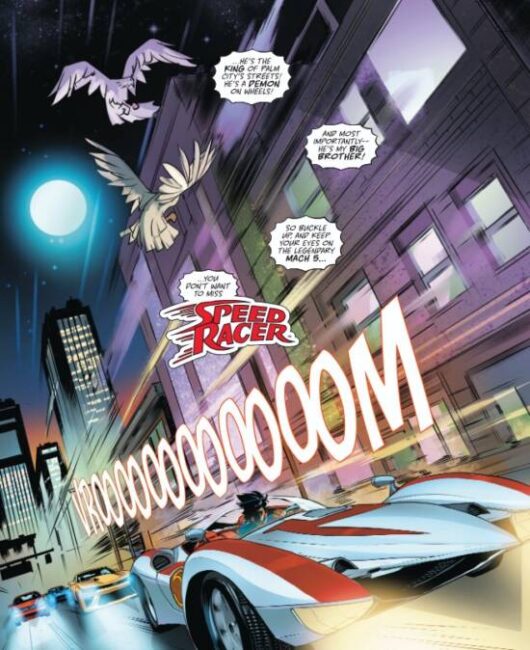
Where the book consistently excels is in its visual storytelling. Tinto’s artwork carries much of the narrative weight, especially during the racing sequences. The layouts are designed to emphasize speed and motion, often stretching panels and using sharp angles to create a sense of forward momentum. This is critical for a property like Speed Racer, where the spectacle of racing is the main draw. The rendition of the Mach 5 itself is a standout. It has been modernized in its detailing, but not to the point where it loses its instantly recognizable silhouette. That balance mirrors the book’s overall approach.
From a structural standpoint, the trade paperback functions as a complete arc, but only to a degree. There is a clear beginning, middle, and escalation, with the central conflict involving Pops going through a life-threatening incident providing a strong throughline.
However, the volume deliberately ends on a cliffhanger, along with a reveal that will likely resonate more strongly with readers unfamiliar with the original lore. (Most collected works of comics contain a hook to entice readers to buy the next issue.) Nonetheless, it gives enough resolution to feel substantial, while still pushing readers toward the next instalment.
As an entry point, this collection works well. New readers do not need prior knowledge of the franchise to follow the story, while longtime fans will recognize the foundational elements being reinterpreted. But to reiterate, enjoyment may hinge on how open Speed Racer aficionados are to the tonal shift. If the expectation is a faithful recreation of the original series’ atmosphere, this version will feel off. But, from our perspective, if the goal is to see how Speed Racer can function in a modern comic landscape, the book largely succeeds.
Overall, Speed Racer Vol. 1 TPB is less about reinvention and more about adjustment. It updates the franchise’s framework to fit contemporary sensibilities while preserving its core identity. The result is a fast-paced, visually engaging read that understands what makes Speed Racer iconic, even if the acceleration is in a different gear.