


Writer: Henry Chebaane
Artist: Stephen Baskerville
Independent, Summer, 2023
There is something to the human condition that compels us to know what is behind the curtain. Here we see familiar historical and the suggestion that something much stranger has been hiding underneath it all along. The Panharmonion Vol. 1: Times of London, written by Henry Chebaane with art by Stephen Baskerville, takes Victorian Britain, blending historical mystery, science fiction, horror, and corporate conspiracy into an alternative-history story that stretches across centuries and continents.
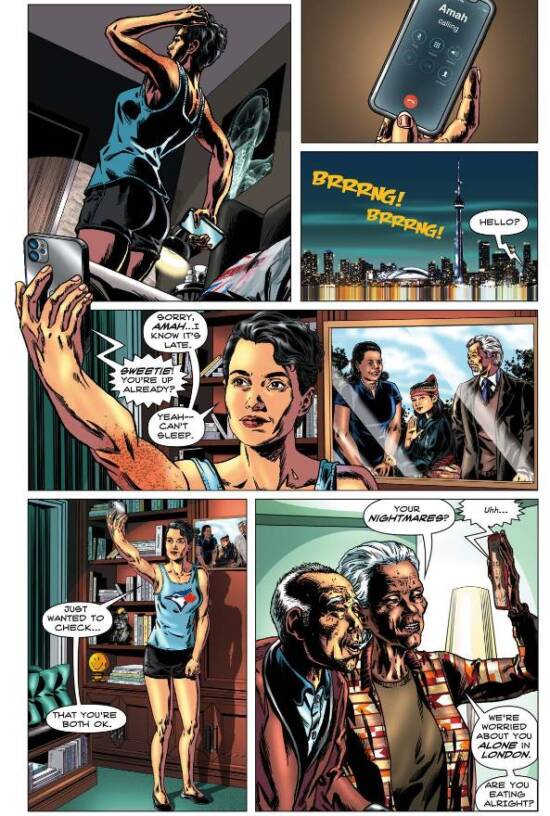
The story follows Alex Campbell, a music producer and composer who has spent much of her life carrying the psychological scars of a traumatic residential fire in Montreal in 1994 that claimed the lives of her family. Raised in Toronto by her protective grandparents, Alex unexpectedly inherits a long-abandoned 19th-century property in London’s King’s Cross after their sudden deaths. What initially looks like a probate headache soon becomes something considerably more disturbing.
Construction delays begin piling up. Tools mysteriously disappear. Strange things are happening around the property, prompting Alex to bring in her cousin Ravi to help secure the site. From there, the story begins digging into a hidden history involving 19th-century researchers and military engineers who were experimenting with harmonic energy and entropic sound forces beneath the St Pancras gasworks. The inevitable revelation is that Alex’s ancestors were involved in these experiments.
Mr Chebaane handles the multiple timelines particularly well. The narrative moves between Victorian history and modern-day London without making the reader feel as though they are tackling two separate stories. Instead, the historical sequences provide threads of a mystery that Alex is trying to unpick in the present. The result is a conspiracy that feels increasingly global and personal as the two timelines begin to converge.
That personal connection is important. The Panharmonion has a lot of material to juggle. There are multiple centuries of history, secret societies, strange scientific principles, military experimentation, corporate interests, and harmonic physics all competing for the reader’s attention. It would have been easy for the story to become buried beneath its own mythology. Instead, Mr Chebaane generally keeps the plot anchored to Alex, and the consequences these discoveries have on her life.
That also keeps the exposition from becoming too cumbersome. Details about corporate harassment, historical experiments, and the mysterious forces beneath London emerge as shards of the larger mystery rather than lengthy information dumps. The reader learns about this strange world alongside Alex.
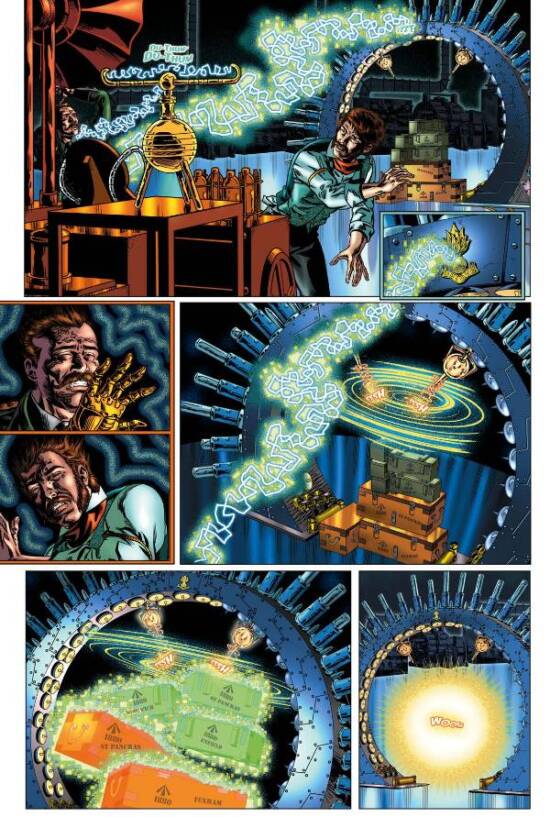
Stephen Baskerville’s artwork is the engine to the comic. It is obvious to create a strong visual distinction between the grimy subterranean spaces beneath the property and the more polished, yet equally oppressive, modern London above them. The underground vaults and tunnels have an appropriately aged and claustrophobic quality, giving locations such as the 1941 bomb shelter a convincing sense of history.
But with the science fiction elements, Mr Baskerville does not overload the pages with complicated machinery or excessive technological detail. Instead, atmosphere and lighting do much of the work. This restraint allows elements of the story to remain mysterious rather than turning every supernatural or scientific development into clockwork fuzziness.
The characters’ appearances benefit from Mr Baskerville’s attention to expression and physical detail. Alex’s psychological state is especially important to the story: Mr Baskerville shows the physical toll that stress, trauma, and sensory overload take on her.
In summary, then, The Panharmonion Vol. 1: Times of London succeeds because its sprawling mythology never completely loses sight of its central character. The story gives the reader a reason to care about uncovering those secrets. The combination of alternative history, subterranean mystery, harmonic science, and corporate greed is a particularly interesting melange. Mr Baskerville’s atmospheric artwork provides the right visual foundation for it.
You can find more information about this title, including volume 2, which is to be released this year, on this website: https://www.panharmonion.com/