

Writer: Justin Heggs
Artist: Cam Hayden
Black Panel Press, April 2026
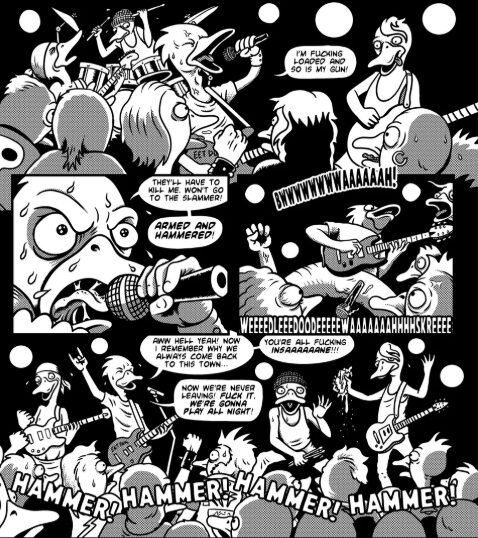
Death Metal Duck, from Canadian duo Justin Heggs and Cam Hayden, took a long time to hatch. From https://www.geeknerdnet.com/blog/2026/4/13/2026-year-of-the-death-metal-duck-justin-hegg-cam-hayden
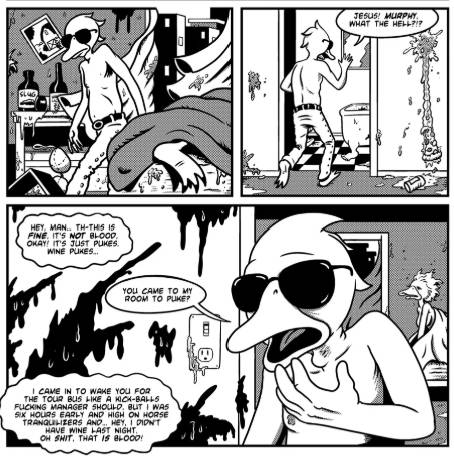
A decade has gone by since Heggs first wrote the opening of the series, and he credits that time away to making now the perfect time to come back to the story and its characters for finishing the story… Heggs shares a story (from spring 2024) of his kids reading his earlier comics (Wolf Hands, with art by Nick Johnson) which lit the spark to get him back into writing comics again. For Hayden, revisiting the series after a decade’s worth of work under his belt with various co-creator, as well as creator-owned projects (which you can find on his Patreon), he completely redrew the original first issue, which is now woven into this graphic novel. He talks about the ways in which he drew the ducks to be part duck and part humanoid shape. It’s the expressions in the faces which really pushed him, having to work with a large duck bill and the fact they don’t have eyebrows to convey emotion in a scene.
The stark black-and-white art and the cast of anthropomorphic ducks suggest something light, maybe even absurdist. The running gag about the ridiculous name of Curt’s old thrash metal band, “Puke Hammer”, is a throwaway piece of silliness that lands well. However, the comic’s real heart is far more grounded than the title suggests. Here is the promotional copy:
Once the snarling frontman of thrash metal legends Puke Hammer, Curtis Paul is now more dad than demon, trading mosh pits for parent-teacher meetings. But when a chance to reunite the band arises, Curtis finds himself torn between diapers and distortion pedals, family dinners and filthy riffs.
Told with sharp humor and raw heart, Death Metal Duck is a time-hopping, 70-page graphic novel that dives deep into the chaos of parenthood, the passion of playing music, and the messiness of second chances. Featuring real music by a local Alberta band reimagined as Puke Hammer’s discography, this book is a raucous, reverent ode to creativity, comics, and the enduring power of loud guitars.
For fans of slice-of-life stories with a metal edge—this one’s for you.
The story centers on Curt, a middle-aged former musician now living a quiet life as a househusband. Once part of a moderately successful band, he is now navigating family responsibilities and the creeping realization that his glory days are firmly in the rearview mirror. It is a familiar setup, but the execution gives it real weight. Curt is not framed as a tragic figure or a “washed-up” stereotype; he comes across as someone in transition, caught between who he was and who he has to be now.
If the book has a hurdle, it is the structure. The narrative jumps across Curt’s life—from childhood to peak fame to the band’s eventual decline, often without clear visual markers. While this non-linear approach adds texture, it can be disorienting. There are moments where we found ourselves flipping back a page just to confirm a time jump wasn’t missed. This interrupts the flow, though once the reader adjusts to the rhythm, the emotional throughline remains strong.
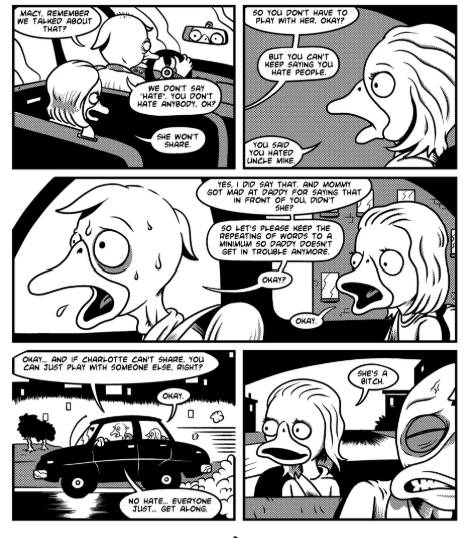
What makes Death Metal Duck work is how sincere it feels beneath the stylization. The “duck” aspect of the presentation never undermines the drama. If anything, the character designs fade into the background as Curt’s life takes center-stage. The world-building is consistent enough to be believable, with only one real exception: a scene where Curt is confronted by his daughter’s principal about his past. It feels overly staged, a brief break in the illusion that doesn’t quite fit the realism established elsewhere.
Visually, the book is a standout. The sharp monochrome art carries detail and clarity. Even in chaotic concert scenes, the action is sharp, which is no small feat in black and white. There is something impressive about seeing an art style that could easily belong to a gag strip being stretched to support a full-length, emotionally driven story. That contrast between style and substance is one of the book’s greatest strengths.
Ultimately, Death Metal Duck is less about its quirky premise and more about the uncomfortable, quiet process of aging. While it stumbles on narrative clarity at times, it more than compensates with sharp characterization and striking visuals.
This title is available from Black Panel Press’ website: https://blackpanelpress.com/products/death-metal-duck