


Writer: Bragi Schut
Artist: Renzo Podesta
Mythos Comics, 2026
Magick #1 from Mythos Comics brings together writer Bragi Schut and artist Renzo Podesta, a pairing that already proved effective on another comic, Samaritan. That connection is worth exploration. Mr Schut didn’t just work on the film version. He also wrote the screenplay for the 2022 movie. The film is a rare case where the original comic creator carried his own concept across mediums, instead of creative control being huijacked by a producer or director. That depth of experience shows here, as Magick feels shaped by someone who understands both serialized comics and cinematic pacing.
Magick is a fugitive story centered on Jim Bishop, a man clearly carrying knowledge that others would kill to control. The narrative doesn’t rush to explain him, and that restraint works in its favor. What is revealed carries weight: Jim understands an ancient language capable of bending reality, and he’s being pursued by a powerful, shadowy organization with enough reach so as to deploy federal authorities. That combination alone gives the book a strong hook, but Mr Schut avoids overloading the reader, choosing instead to let tension build through implication rather than exposition.
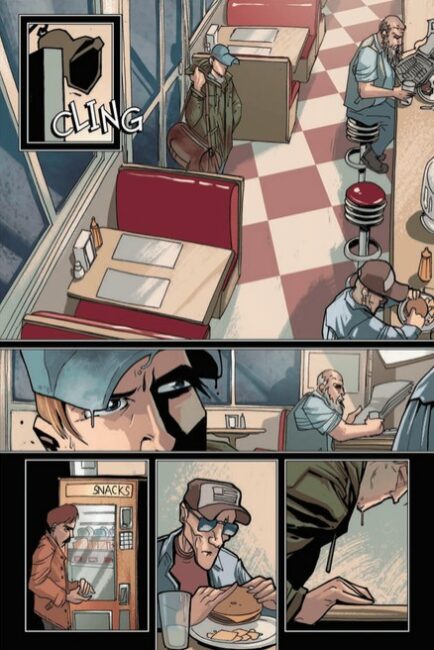
The structure of the issue leans into recognizable genre beats, particularly the “drifter passing through” setup (first used in comic books, as far as we know, in Marvel Comics’ The Incredible Hulk). Jim’s encounter with local law enforcement plays out in a way that initially feels predictable, but the characterization quickly shifts expectations. He isn’t framed as a brawler or a defiant anti-hero. Instead, he comes across as tired, cautious, and almost disarmingly cooperative. That choice subtly reshapes the dynamic. When he does escape, it isn’t through brute force or clever trickery in the traditional sense, but through something far stranger and more unsettling. The use of the ancient language to reshape reality, especially in something as mundane as a jail cell, lands with quiet impact because of how understated Jim has been up to that point.
There’s also an effective sense of looming danger introduced through the antagonist, Agent Sarling. Even with limited page time, Sarling establishes the stakes through decisive, ruthless action. The implication is clear: others like Jim are already silenced. That tension hangs over the entire issue, giving even slower moments a sense of urgency.
Mr Podesta’s artwork complements that tone well. His style leans toward a rough, shadow-heavy realism that prioritizes atmosphere over polish. The heavy use of blacks and contrast creates unease, as if the visual landscape is closing in on the characters. Faces are expressive but worn, particularly Jim’s, reinforcing the idea that this is someone who has been running for a long time. When the supernatural elements come into play, the visuals shift just enough to feel disorienting without becoming confusing. Panels stretch and warp, reflecting the instability of reality under the influence of the language, but the storytelling remains clear. Mr Podesta handles this unorthodox visual story-telling confidently.
Our only critique of the comic is also tied to its strengths. Because the issue withholds so much information, readers looking for immediate clarity or deeper world-building may feel like they’re only getting fragments. Whether that restraint pays off will depend heavily on future issues.
Overall, Magick #1 is a controlled and atmospheric opening that prioritizes tone and intrigue over instant answers. The title distinguishes itself through character choices and visual mood, backed by a creative team that has already proven it can translate ideas across both comics and film.