

Writer: David Pepose
Artist: Jonathan Lau
Dynamite Entertainment, May 2026
Over the course of its run, David Pepose’s Space Ghost has consistently earned praise for successfully modernizing a franchise that, in its original incarnation, was aimed primarily at children. Beyond that, its most famous revival, Space Ghost Coast to Coast, reimagined the character as part of an absurdist satire. Mr Pepose’s interpretation takes a different but well-travelled approach, transforming the property into a contemporary superhero, and nowhere is that transformation more apparent than in Space Ghost #11.
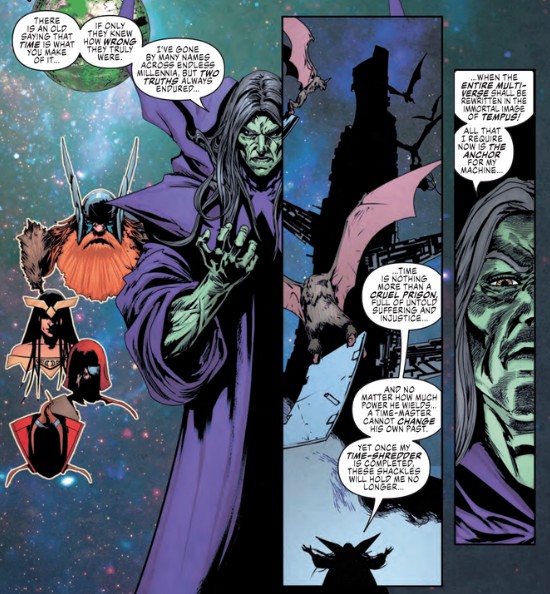
This issue is vehicle for the reinvention of the classic Space Ghost villain Tempus. Readers familiar with the original cartoon will remember Tempus as a straightforward time-manipulating antagonist. Mr Pepose elevates the character, recasting him as an immortal, multiversal threat. Readers who watched Space Ghost as children might recognize Tempus as a villain from a publication of around the same era, The Legion of Superheroes‘ foe called The Time Trapper. Time-meddling immortals with purple hooded cloaks cannot be that common.
It is however an update that longtime fans may find refreshing, preserving the spirit of the original while raising the stakes to match the series’ modern superhero sensibilities.
Here is Dynamite Entertainment’s promotional copy:
“Tempus the Time-Master” Part Two! Enter… the Time Tyrants! With Space Ghost trapped alone in the prehistoric jungle, he finds himself hunted by Tempus the Time-Master’s enforcers: Toymaker, Tarko the Terrible, Barbos the Time-Pirate, and the Sorceress! Meanwhile, Jan and Jace must survive a dystopian future ruled by the Rock Robots! In order to survive this doomed timeline, they’ll have to team up with a future from the past… as Space Spectre makes his triumphant return!
The issue also highlights how Mr Pepose has structured the series from the beginning. What initially appeared to be a largely episodic “monster of the week” adventure has gradually revealed itself to be something far more ambitious. Earlier issues quietly seeded elements and character developments that have steadily built toward this plot climax. As the penultimate chapter of the series, Space Ghost #11 begins cashing in on that long-term setup.
The narrative embraces many of the familiar hallmarks of mainstream superhero storytelling. Space Ghost finds himself stranded in the distant past. Villains he has previously defeated return to join forces against him. Time-travel complications create unexpected revelations, including a twist involving a future version of a familiar ally that is best left unspoiled for readers who are not yet caught up. Meanwhile, a war unfolds simultaneously across multiple points in history.
It is messy. But it is the kind of messiness that comes from an ambitious story pulling together numerous plot threads at once. Readers who have followed the series month-to-month will find the payoff rewarding, though the dense plotting may read better when collected in trade format.
Artist Jonathan Lau’s art is very contemporary. One day, critics will look back on this period of time in comic book art and decide that Jim Lee, Bryan Hitch, and Michael Turner created a type of artistic rendition for superheroes which has been pervasive for the past 30 years. It consists of fine detail, dynamism, heavy shadowing, and a sort of faux-photorealism. Mr Lau follows in that tradition, again underscoring that fundamentally this is a superhero comic.
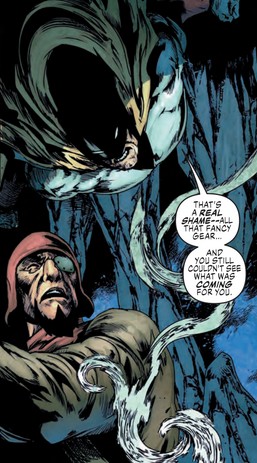
The action remains one of the book’s strongest assets. Once again, comparisons to Batman are unavoidable. Stranded in prehistoric times and facing opponents who are physically superior, Space Ghost relies on strategy, resourcefulness, and environmental advantages rather than mere brute force. The result is a series of entertaining encounters that each showcase this more grounded superhero framework. In this panel below, Space Ghost sounds very much like Batman, or Batman’s more earnest doppelganger, The Midnighter.
Meanwhile, in the parallel plot line, the future-front conflict provides a more straightforward but enjoyable grand spectacle. Jace, Jan, and the reformed Space Spectre battle through an army of robots as they desperately search for a way to reunite with Space Ghost before it is too late.
The issue concludes with a effective cliffhanger. After spending much of the storyline building anticipation for his arrival, Tempus finally steps onto the battlefield and immediately demonstrates why he is a significant threat. Space Ghost is overwhelmed, while Jace, Jan, and Space Spectre race toward the conflict. It is the kind of ending that leaves genre readers eager for the finale and serves as a strong setup for what promises to be an explosive conclusion.
It is not innovative. But it gives its audience what they want. Space Ghost #11 delivers on months of careful buildup while embracing the grand, time-bending excesses of modern superhero comics. The story may be crowded with plot twists, returning villains, and temporal warfare, but the excitement generated by those elements far outweighs the occasional narrative clutter. As the series heads into its final chapter, Mr Pepose has positioned his heroes and villains for a finale that feels every bit as epic as the journey that led there.