

Writer: Joseph Jasionowski
Artist: Elton Thomasi
Colosseum Comics, September 2026
There is something inherently fun about a story that throws a Roman warrior, a samurai, a weapons dealer, a werewolf-like hellhound, and Satan into the same adventure and simply lets them start beating the hell out of each other. That is essentially the premise of Julius: The Werehound #1, an independently published dark fantasy comic written by Joseph Jasionowski with art by Elton Thomasi, which is being released through a Kickstarter campaign.
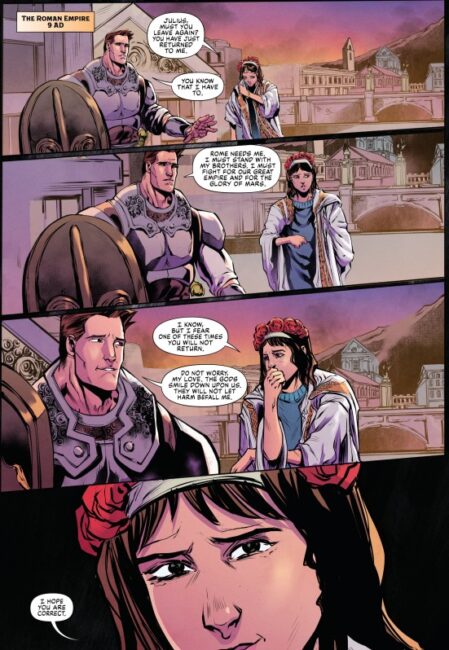
The official premise describes Julius as “a man out of time,” a warrior transformed into a monster and cursed to exist somewhere between heaven and hell. After becoming a werehound through Satan’s machinations, Julius eventually encounters Tomoe, a samurai, and Jack, a weapons dealer. Both have their own reasons for wanting revenge against the Devil, and the three form an unlikely alliance with an ambitious goal: kill Satan.
That premise makes Julius: The Werehound sound like it might be a particularly grim and sophisticated piece of dark fantasy. The combination of Satan, demonic forces, supernatural curses, and a protagonist who looks like a particularly angry werewolf certainly suggests something with plenty of thematic meat. The comic’s copious amounts of gore, including severed hands and slit throats, might buttress that impression.
The actual experience is considerably more straightforward.
Strip away the blood, Satanic imagery, and the occasional gruesome death, and Julius: The Werehound #1 could almost pass for a Saturday morning cartoon, or a teenage Dungeons & Dragons plot, about a group of supernatural heroes on an adventure. The dialogue is rudimentary, functioning primarily to establish characters, explain what is happening, and get everyone to the next fight. There is little interest in lengthy philosophical discussions about damnation, morality, or what it means to be a monster. Julius is angry, Satan is evil, and the heroes want revenge. That’s pretty much all the motivation the story needs.
That isn’t a criticism. The comic’s creators understands the flavor of entertainment they want to provide. Julius: The Werehound is built around kinetic action, and it wastes little time getting its characters into situations where they can demonstrate what they can do.
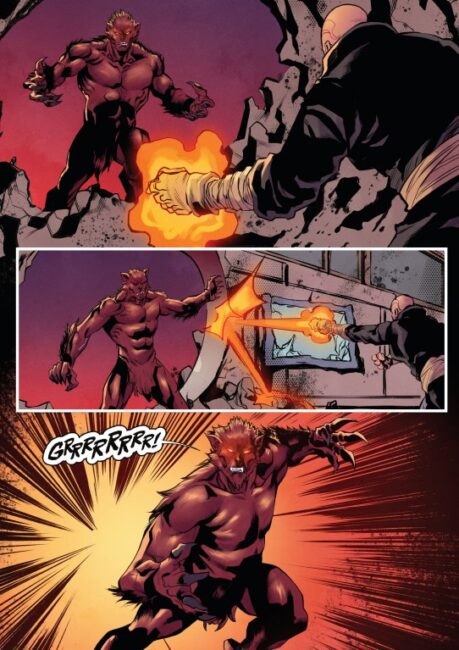
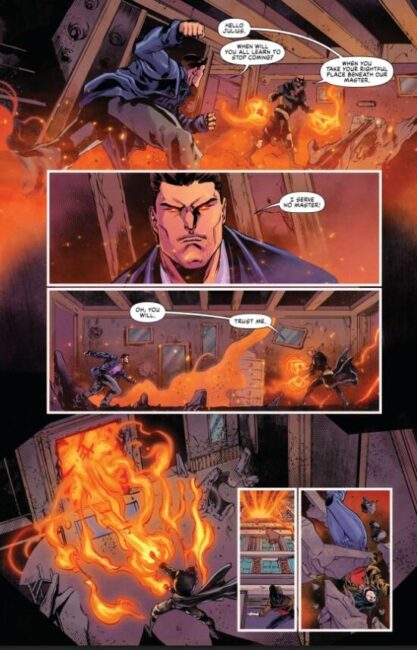
Julius is particularly well suited to this approach. As a werehound, he possesses enhanced strength, durability, and physical abilities, along with the ability to wield hellfire. His allies provide their own specialized forms of mayhem. Tomoe brings the expected samurai swordsmanship, while Jack provides the firearms and other weaponry. Between them, the eclectic trio cover just about every conceivable method of causing physical damage, from blunt-force trauma and sword strikes to good old-fashioned artillery.
Consequently, the action sequences are the attraction. The comic doesn’t spend much time worrying about whether its protagonists are overpowered or whether their abilities need complicated explanations. It simply puts them in front of enemies and lets them loose. For readers looking for a fast-moving supernatural action comic, that approach works.
It is the artwork, however, that really makes Julius: The Werehound #1 stand out.
Mr Thomasi’s artwork has a classic, bold superhero-comic aesthetic. The heavy line work gives the characters plenty of weight, while the strong contrast and vibrant colors make the action immediately noticeable. Characters have exaggerated, imposing features, with chiseled jaws and rugged expressions during quieter moments and more exaggerated, creature-like proportions once the fighting begins.
The coloring deserves particular attention. Fiery oranges, deep reds, and moody purples give the book an appropriately hellish atmosphere without making the pages difficult to read. The panels remain clean and easy to follow, even when characters are throwing punches, swinging swords, firing weapons, or unleashing supernatural abilities. There is a sense of movement throughout the book that suits the material extremely well.
Most importantly, the art has personality. Julius: The Werehound doesn’t look like it is trying to imitate the subdued visual language of modern prestige comics. It embraces a louder, more exaggerated aesthetic, and that makes the book feel like a deliberate throwback to the era when superhero and fantasy comics weren’t afraid to simply look cool.
The biggest caveat is that readers expecting the premise to lead into a deeply layered exploration of Satan, damnation, monstrosity, or revenge may find the actual story somewhat lightweight. The concept has considerably more complexity than the first issue’s writing attempts to explore. There is plenty of room for the mythology to develop, but this opening chapter is not the place for it. The creators are interested in establishing the characters and getting them into fights.
As a result, Julius: The Werehound #1 should be approached as a pulpy supernatural action comic rather than a particularly cerebral dark-fantasy story. This is bourbon, not grenache. Its writing provides the framework, while Mr Thomasi’s artwork supplies most of the personality and spectacle.
There is nothing wrong with that. Sometimes the appeal of a comic is watching a werewolf-like Roman warrior covered in hellfire team up with a samurai and a guy carrying an arsenal, then go looking for Satan. Julius: The Werehound #1 knows that is a pretty damn entertaining idea, and it gets on with it.
Here is a link to the Kickstarter page: https://www.kickstarter.com/projects/colosseumcomics/julius-the-werehound-issue-1