

Writer: Styles Pacheco
Artist: Nicky C.
Lucky Devil Comics, June 2026
The Plague #1 is the first issue of a new ongoing comic book series from Canadian independent publisher Lucky Devil Comics. Created by writer Styles Pacheco in collaboration with artist and co-creator Nicky C, the series follows Diego Diaz, a low-level corporate employee who is betrayed and left for dead after uncovering a deadly conspiracy. Resurrected by dark forces, Diego returns as The Plague, determined to wage war against the forces responsible for his downfall.
As is often the case with the first issue of an ongoing series, The Plague #1 is largely concerned with establishing its world, characters, and central conflict. Fortunately, it handles that job quite well.
The story takes place in New Orleans in 2030 AD, a date that initially sounds comfortably futuristic until you remember that it is only a few years away. The world of The Plague certainly looks like a post-industrial dystopian future, with a massive corporation sitting at the top of society and using its influence and monopoly over pharmaceuticals to squeeze the public. Meanwhile, widespread discontent has led to mass protests, while the government is more interested in protecting corporate interests than addressing the grievances of ordinary people.
The comic has all the ingredients of a traditional science-fiction dystopia, yet some of its ideas are beginning to bear a striking resemblance to reality. What might have once felt like an exaggerated vision of the future now feels considerably closer to home.
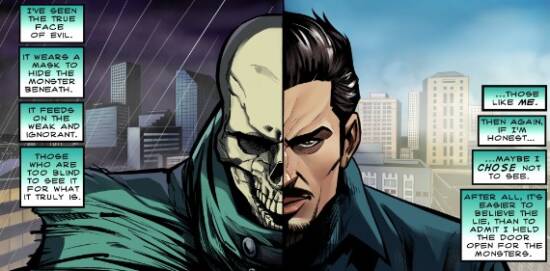
At the center of this is Diego Diaz, an unassuming employee of the pharmaceutical giant Inquigenex who is assigned to provide security for one of the company’s scientists. Diego soon becomes involved in the scientist’s attempt to expose Inquigenex’s dirty dealings, including the particularly sinister revelation that the corporation developed a virus capable of causing a pandemic and then manufactured and sold the cure for it. There are hints that the conspiracy goes even deeper, although the creators wisely leave some of those details for later.
Things go badly for Diego after his involvement is discovered. He is reassigned to a mission alongside a group of mercenaries, only to be betrayed along the way. His romantic partner, Nina, and the journalist who was supposed to help expose Inquigenex are also assassinated. Left dying, Diego encounters a mysterious cloaked woman named Fausta. Appropriately, given her name, she offers him the opportunity to return from the dead so that he can protect the woman he loves. Unfortunately, Nina is apparently already dead by this point – somewhat unfortunate timing.
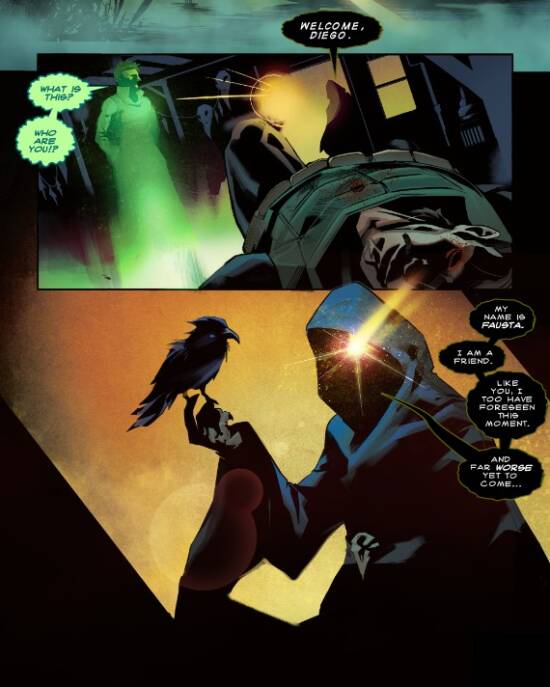
Diego nevertheless accepts the offer, returning to the world as something far removed from his former human self. With mysterious new powers and a grudge against Inquigenex, he sets out for revenge.
This comic wears its 1990s influences proudly. There is a strong visual resemblance to the sharp, high contrast style associated with Image Comics during the 90s. But the artwork also has a slightly raw, contemporary edge that keeps it from feeling like a simple throwback. Readers familiar with 1990s comics may notice some similarities between The Plague and Spawn, particularly in the broad beats of its protagonist’s origin. That comparison is hardly surprising given that Mr Pacheco is very open about the series’ strong 1980s and 1990s influences. The similarities are primarily thematic, however. The Plague is clearly trying to establish its own identity rather than simply reproduce an existing story.
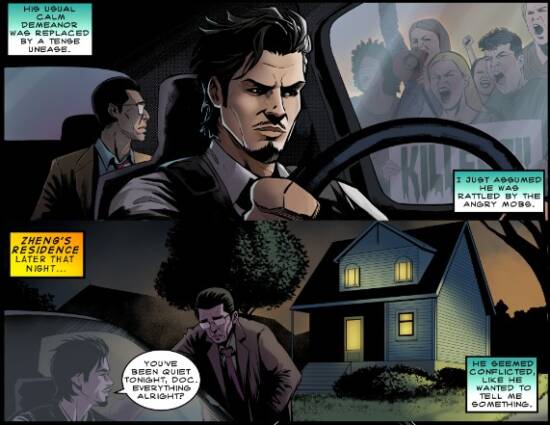
One weakness is the comic’s reliance on internal monologue captions during its early sections. it is garbled. The narration jumps between different character perspectives, while also introducing an omniscient narrator. The color-coded caption boxes help distinguish the voices visually, but the similar tone and style of the narration makes these transitions disorienting.
A lighter touch with the internal dialogue, combined with more distinctive narrative voices for each character, would give the artwork more room to breathe and make the shifts in perspective easier to follow. Thankfully, this becomes much less of an issue around the midpoint of the book, when the story finds its footing and the action and dialogue to carry more of the narrative.
Where The Plague #1 really shines, however, is its artwork. Nicky C delivers an extremely polished visual style that embraces the dramatic, high-energy aesthetic that works so well for a dark supernatural comic. Heavy lighting, deep shadows, and digital effects give virtually every page a cinematic quality. The glowing moon, flashes of lightning, and fiery muzzle flashes all contribute to an appropriately moody atmosphere.
Diego has barely had an opportunity to demonstrate what he can actually do as The Plague. It is therefore far too early to judge where the character or the story will ultimately go. The Plague #1 has a promising start to what could become an interesting supernatural revenge story. This first issue has plenty of setup to get through, but the world it establishes is compelling, its central conspiracy provides plenty of room for future developments, and the artwork gives the book a strong visual identity.
This title is available from the Lucky Devil website: https://luckydevilstore.com/