



Writer and Illustrator: Anthony Falleroni
Independent, August 2026
Anthony Falleroni’s Planet of the Pets is a 30-page graphic novella that takes a deceptively simple premise and uses it to deliver a surprisingly sharp satire of consumerism, corporate greed, and humanity’s seemingly endless desire to buy, sell, and own everything.
The story centers on the Fuzzos, a new species of genetically engineered animals created by a corporation as luxury pets for the mega-rich. Designed to be irresistibly cute and cuddly, the Fuzzos become an overnight cultural phenomenon, with consumers predictably rushing to get their hands on the latest must-have creature.
Things eventually go horribly wrong. The Fuzzos have instincts of their own, humanity’s attempts to control its creations backfire spectacularly, and before long, human civilization is facing the consequences of its own stupidity.
The basic trajectory is deliberately reminiscent of Planet of the Apes, and the title makes that connection impossible to miss. Human hubris and greed ultimately pave the way for another species to inherit the world, but Mr Falleroni avoids retelling the same story with cute animals. A late twist gives the story a different direction, providing an appropriately strange conclusion to the Fuzzos’ journey.
The book’s thesis is not just about humanity’s treatment of animals. Planet of the Pets takes aim at modern consumer culture, particularly the tendency to embrace whatever happens to be new, fashionable, and commercially available without stopping to consider the consequences. In order, the Fuzzos are first a product, and only second, living creatures. Their existence is justified by market demand, their appeal is carefully engineered, and their popularity becomes its own justification for producing even more of them.
There are also moments when the satire becomes almost uncomfortably accurate. Some of the corporations’ behavior and the consumers’ willingness to embrace the latest absurd product are exaggerated for comedic effect, but not always by very much of a margin. A few of the book’s satirical ideas land so close to real-world behavior that we wonder whether they are properly characterised as satire. Outside of the fiction in this title, humanity has already demonstrated a remarkable ability to turn increasingly ridiculous things into desirable consumer products, so the Fuzzos’ meteoric rise is not as implausible as it should be. In that respect, Planet of the Pets occasionally achieves a particularly effective kind of satire: the kind where reality itself has already done most of the work.
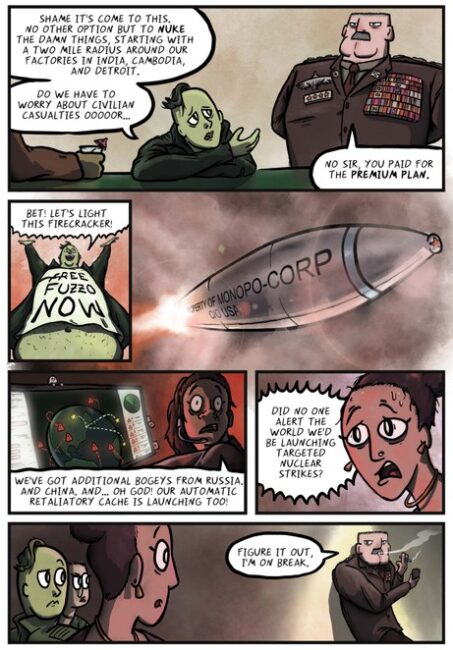
Mr Falleroni pushes the logic of consumerism to its absurd endpoint, where corporations exploit anything that can be monetized and consumers happily participate as long as the product is sufficiently desirable. The resulting apocalypse feels less like a random disaster than the inevitable conclusion to a system that treats everything as a commodity.
The artwork is particularly well suited to this approach. Mr Falleroni uses clean, bold cartoon outlines to give the Fuzzos a soft, almost children’s-book simplicity. Their egg-shaped bodies and fuzzy appearances make them look absurdly harmless, which makes the sudden eruptions of violence all the more jarring. Bloodshed, crucifixions, battlefield carnage, and other grim imagery appear alongside characters that look like they could have wandered out of a children’s television show.
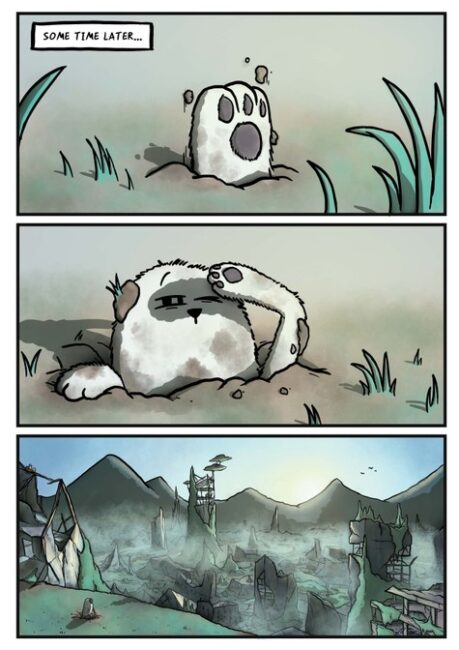
There is a strong Perry Bible Fellowship-style sensibility to the presentation, with the cute and approachable artwork constantly working against the book’s increasingly bleak subject matter. Soft digital gradients and atmospheric lighting also give the pages considerably more visual depth than the simple character designs might initially suggest. Sickly green skies and ominous red horizons signal the increasingly apocalyptic atmosphere, while background signage and environmental details frequently contain additional jokes or satirical observations. That contrast between adorable imagery and grotesque consequences is arguably the book’s greatest artistic strength.
Planet of the Pets is not subtle in its message. This is broad, dark comedy. At only 30 pages, Planet of the Pets is a quick read, but Mr Falleroni manages to pack plenty into that relatively small space. Beneath the cute creatures and cartoon violence is a fairly cynical examination of consumerism, corporate exploitation, and the human tendency to embrace the latest shiny thing without asking whether we should.
Following a successful Kickstarter campaign, the title is available for purchase here: https://planetofthepets.store/