


Writers: Greg Pak and Fred Van Lente
Artist: Milena Ciccarello
Publisher: Dynamite Entertainment, March 2026
Disney’s Villains line from Dynamite Comics has steadily carved out a niche for readers who want something a little darker and more introspective than the animated films that inspired it. Launched in 2023, the series takes classic Disney antagonists and gives them standalone stories that expand their lore without abandoning the accessibility of the source material. Disney Villains: Gaston #1, written by Greg Pak and Fred Van Lente, with art by Milena Ciccarello, may be the line’s most intriguing premise yet.
This because Gaston occupies a unique place in Disney canon. Unlike Maleficent, Ursula, or the Evil Queen, Gaston is not a character inherited from folklore. He did not appear in the original Beauty and the Beast fairy tale, nor in the major French literary versions by Gabrielle-Suzanne Barbot de Villeneuve (1740) and Jeanne-Marie Leprince de Beaumont (1756). Those stories featured Belle’s vain and wicked sisters as the primary antagonists. Disney’s 1991 animated film was the birthplace of Gaston, creating a villain who acts as a dark mirror to the Beast and a corruption of the Prince Charming archetype.
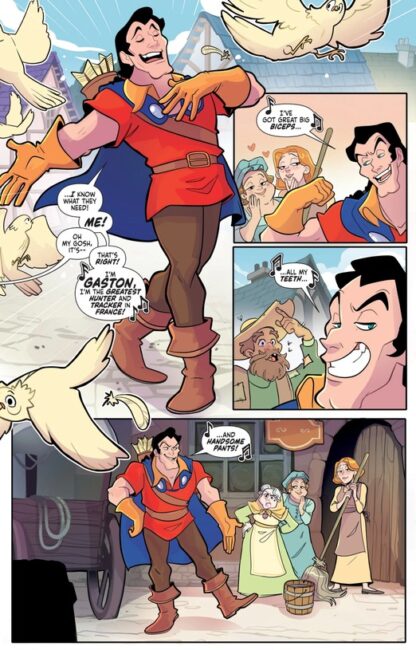
That gives Messrs Pak and Van Lente fertile ground to explore. This first issue keeps its timeline deliberately vague. The only thing that is certain is that it takes place before the events of the animated film (given Gaston’s eventual fate in that story). The plot follows him as his vanity and hunger for admiration lead him into trouble. While attempting to track a missing horse in the royal hunting grounds, where poaching is forbidden, he ends up arrested. A mysterious figure offers to have the charges dropped if Gaston agrees to hunt down an alchemist and retrieve a magical artefact.
True to character, Gaston accepts not out of obedience but because he believes he can outsmart everyone involved and walk away on his own terms. That arrogance once again becomes his undoing. The mission spirals into disaster when he is tricked into drinking a potion that transforms him into a squirrel, a particularly dangerous predicament given that he is trapped in a forest filled with hunters. The issue closes on this unexpectedly funny and ominous cliffhanger.
What makes Gaston compelling is not simply that he is arrogant. He functions as a subversion of Disney’s traditional heroic shorthand. The character’s visual design takes the indicia of the studio’s classic princes and twists them into something altogether too charming. Broad shoulders, a barrel chest, a square jaw, and confident posture are traits that fairy tales usually associate with the defender archetype, resplendent with moral virtue. Gaston is different. His lantern jaw and oversized musculature are not attractive; they are signs of a man who consumes every room he enters and demands constant attention.
Importantly, in a visual medium, Gaston’s costume participates in the peacock display. The bright reds, warm yellows, and leather accents are the colors of a protagonist, not a villain. Disney deliberately dresses him like the sort of character who would ride into the forest to slay a monster and rescue the maiden. The audience, however, knows that the Beast is compassionate beneath his frightening exterior, which turns Gaston’s “heroic” crusade into an act driven by envy, prejudice, and ego.
This issue only begins to scratch the surface of those ideas, but the potential is obvious.
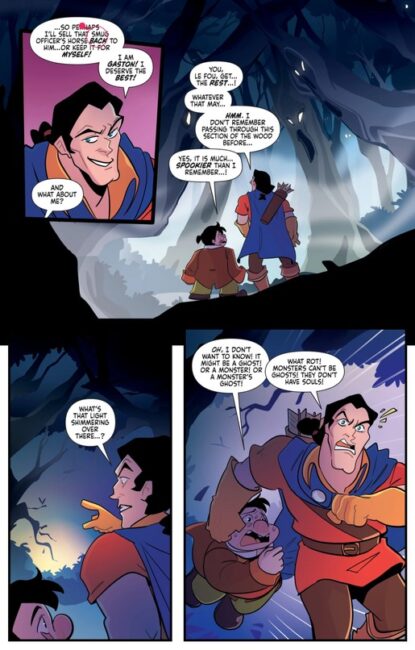
Ms Ciccarello’s artwork is a strong fit for the material. The comic embraces a clean, modern Saturday-morning-cartoon aesthetic that remains extremely faithful to Disney’s established design language. Gaston’s smug expressions, theatrical poses, and exaggerated body language communicate the character instantly. The linework is crisp, the panel flow is effortless, and the colors do much of the storytelling. Warm village pastels give way to eerie purples and deep blues as the story moves into the haunted woods, creating a noticeable shift in atmosphere without overwhelming the page with excessive detail.
The book is also remarkably easy to read. Ms Ciccarello prioritizes character acting over dense rendering, which suits a fast-paced adventure built around comedy, vanity, and magical misfortune.
As a first issue, Disney Villains: Gaston #1 is more entertaining than profound. It spends page time setting up Gaston’s humiliation rather than fully exploring the psychological themes that make the character fascinating. Still, the creative team clearly understands that Gaston is not just a buffoonish hunter. He is a counterfeit fairy-tale hero, a man who looks exactly like the prince of the story while lacking the compassion that would make him worthy of the role.
It has been ten years since we last looked at a Disney title (see https://worldcomicbookreview.com/2016/08/05/frozen-1/ ). This issue suggests we are well overdue for this revisitation. If future issues lean harder into the title character’s flaws, this could become one of the most interesting entries in Dynamite’s Villains line. For now, the debut delivers sharp character work, expressive art, and a delightfully ironic cliffhanger that leaves Disney’s most self-important hunter becoming prey.