


Creator: James Turner
There are graphic novels that tell stories, graphic novels that experiment with the medium, and then there is Omwo, a Bauhaus, metafictional sojourn which regards the very concept of storytelling as something that needs to be taken apart and examined under a microscope.
Written and illustrated by James Turner, Omwo begins with a deceptively simple premise: Omwo is a doodle born during an interminably long office meeting. Like many creations scribbled in the margins of a notebook, we suppose, he soon develops an inconvenient desire to understand why he exists. From there, Omwo finds himself wandering through an unstable cosmos populated by strange companions, living concepts, bizarre societies, and competing interpretations of reality. Here is the promotional copy:
Born from a doodle during an impossibly long meeting, Dopol Omwo enters existence with one urgent need: purpose. His search leads him through a strange and unstable cosmos filled with odd companions, living ideas, bizarre societies, and clashing visions of reality. Joined by Fyra Opal, Omwo navigates a visually inventive black-and-white world where narrative, philosophy, satire, and adventure collide. Written and illustrated by James Turner, Omwo is a singular graphic novel for readers seeking bold, unconventional comics from the independent tradition.
Calling this a conventional graphic novel would be misleading. Omwo operates more like a chaotic philosophical dissertation that happens to have been drawn in the margins of an office notebook and which has evolved into a Modernist exploration. Mr Turner uses the comic medium itself as part of the joke, repeatedly breaking the fourth wall and making the characters acutely aware that they are ink marks trapped on a page.
Here is an extract from another review ,https://artboutiki.com/blogs/news/omwo-a-new-graphic-novel-from-slg-publishing-now-on-kickstarter which provides a summary no better than we could:
“OMWO is filled with bold design, surreal humor, strange beings, impossible logic, and a world that feels both absurd, and deeply human. This is a book by someone who has truly sat through too many meetings.”
The book also takes considerable pleasure in dismantling familiar narrative conventions. The “Chosen One” archetype, for instance, is treated less as a glorious destiny than as an absurd existential burden. Omwo’s attempt to rescue the kidnapped Fyra Opal initially appears to be setting up the kind of heroic adventure readers have seen countless times before. Mr Turner instead takes the story somewhere considerably darker and more ridiculous, ultimately discarding in a clever loop that takes readers back to where it all started.
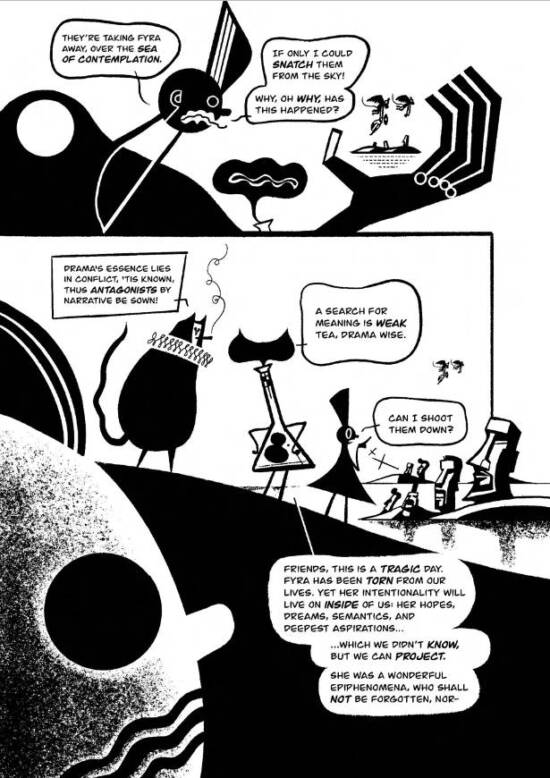
Beneath all the absurdity, though, Omwo has considerably more on its mind than simply making fun of comics.
The encounter with the tyrant Ceoking Shizz and his forced-labor canal project is a particularly effective example. What initially appears to be another bizarre detour gradually develops into a discussion of predatory capitalism, the ruling class’ entitlement, exploitation of the working class, and competing ideas about what a functional society should look like. Bauhaus is currently under attack by the far right in Germany – see https://apnews.com/article/germany-far-right-afd-bauhaus-school-election-e98d278a30dbed6fb9848e824e1b37e7 and https://theconversation.com/why-germanys-far-right-hates-the-bauhaus-movement-250416 and Mr Turner’s discussion of these topics is not accident. Mr Turner is clearly interested in political and philosophical questions, but he approaches these weighty concerns through deliberate absurdity rather than presenting them as conventional political commentary.
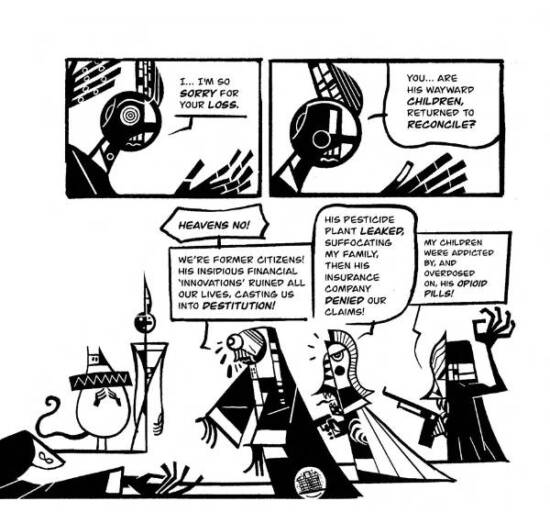
Omwo is difficult to categorize. It is satire, science fiction, philosophical comedy, adventure, avant-garde, and metafiction, often within the same sequence. Mr Turner is comfortable abandoning one narrative direction in favor of an entirely different intellectual tangent, if doing so provides Mr Turner with an opportunity to explore another idea.
The Bauhaus artwork is equally unconventional. We have struggled to find another comic, or even an animation, which uses Bauhasu conventions in such a novel way.
Omwo looks exactly like what its premise suggests it should look like: frantic margin doodles created by someone desperately trying to survive an agonizingly long meeting. There is no digital colouring, nor glossy illustrations. Instead, Mr Turner fills the pages with complex Modernist shapes that seem almost deliberately allergic to conventional comic-book aesthetics.
For some readers, this will be the biggest obstacle. The constantly shifting designs, dense doodle-filled backgrounds, and deliberately chaotic compositions are visually confronting, particularly during the busier sequences. There are moments when it is genuinely difficult to determine exactly what you are looking at.
The simplistic Modernist appearance of the characters also creates an empathy barrier. How do you self-identify with a squiggle, not matter how lucid and philosophical? When your protagonists look like random geometric shapes, it is difficult to form an attachment that a reader might develop toward conventionally rendered characters. (Our editor’s young children had a similar issue with Mac Barnett’s and Jon Klassen’s clever Circle, Square and Triangle books, despite the thoughtfulness of each story.)
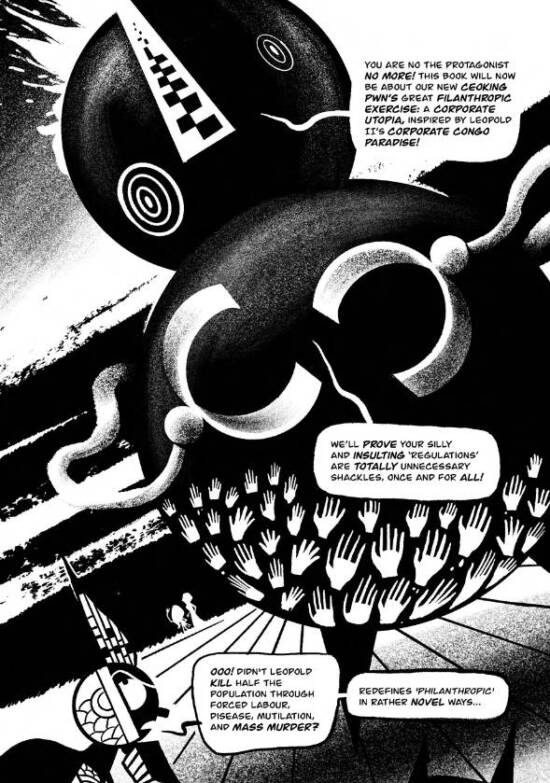
Yet Mr Turner’s line work is remarkably crisp and controlled. The drawings may resemble random Modernist shapes and forms, but the apparent lack of order and structure is therefore part of the artistic strategy: it is the point. The contrast between the intentionally chaotic visuals and the density of the ideas is one of the book’s defining characteristics.
Omwo is best approached with the same expectations one might bring to an experimental film or an aggressively unconventional novel. Readers looking for a straightforward adventure with clearly defined characters and a conventional visual style may find themselves frustrated. The book is far more interested in asking questions than providing comfortable answers, and it frequently seems to be having fun making the reader wonder where the story is going to next.
This title is available as an eBook on Booktopia – https://www.booktopia.com.au/omwo-james-turner/ebook/9780943151427.html