

Short Cuts:
Writer: Matt Fraction
Artist: Javi Fernandez
Cut Short:
Writer: Scott Snyder
Artist: Nick Derrington
DC Comics, November 2026
The title of this new series is a homage to Gardner Fox’s and Carmen Infantino’s classic story in The Flash 123, published by DC Comics in September 1961. This issue was the beginning of DC Comics’ sometimes elaborate Multiverse, pruned in 1985’s Crisis on Infinite Earths but which has flourished again. A recent extension of this is the Ultimate universe, featuring a hulking version of Batman, whose adventures we have previously reviewed.
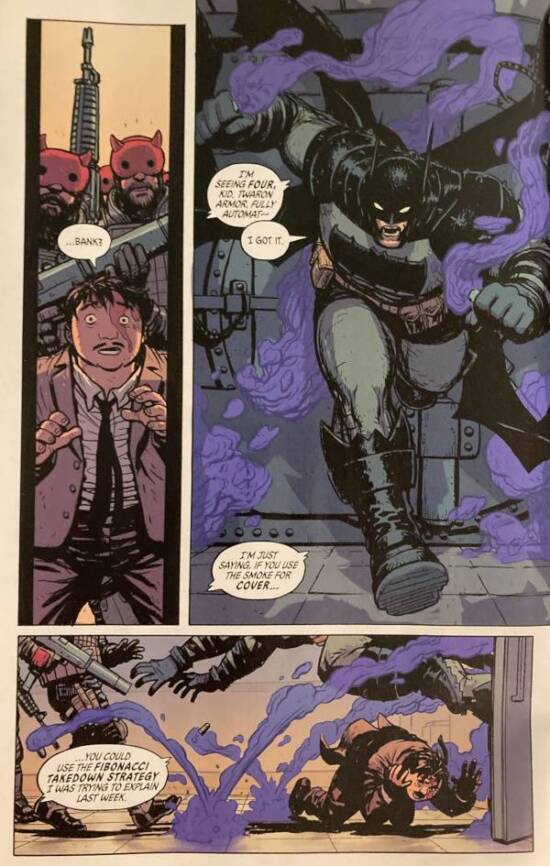
This first issue consists of two twinned stories, both eight pages each, the first dealing with standard continuity’s Batman chasing the thieves of a short-range teleportation device, and the second dealing with Ultimate Batman’s foiling of a robbery. Here is DC Comics’ promotional copy:
Two worlds. One legendary hero. Batman of Two Worlds features an all-new Batman story by writer Matt Fraction and artist Javi Fernández, with colors by Tomeu Morey and letters by Clayton Cowles, alongside an all-new Absolute Batman story by writer Scott Snyder and artist Nick Derington, with colors by Frank Martin and letters by Tom Napolitano, celebrating the versatility of the World’s Greatest Detective. From the streets of Gotham City to the bold new landscape of the Absolute Universe, each story offers a unique perspective on Batman’s unwavering pursuit of justice.
Some online reviews of this title have been critical:
‘…it suffers a little bit from Scott Snyder’s trademark overwriting, and the fact that Snyder doesn’t give Derington and co. a big, original moment to illustrate. If you’ve been reading Absolute Batman and expected the trademark “WTF?!” moment that series delivers each month, the moment that makes you pump your fist or takes your breath away, you won’t quite find it here.‘ (Matt Reads Comics – https://mattreadscomics.com/2026/09/22/batman-of-two-worlds/ )
‘...it is not peak Snyder, and it isn’t the best way to show somebody what Absolute Batman can do.‘ (Nostalgia Nest Egg – https://nostalgicnestegg.com/batman-of-two-worlds/ )
‘Oh boy, that was disappointing.’ (League of Comic Geeks – https://leagueofcomicgeeks.com/community/thread/68956684 )
We expect that any disappointment arising from the title is because of the expectation that the two characters would meet. They do not. DC Comics’ cover, and the very title of this issue, actively misleads potential buyers of the title (as it did your reviewer) into thinking that the two characters would have some sort of 1961-type crossover. (When standard Batman seizes the teleportation devices, we wondered if these were a plot device which would generate an interdimensional portal into the Ultimate Batman’s universe. But they do not, and we suppose they will end up in the Batcave trophy cabinet. )
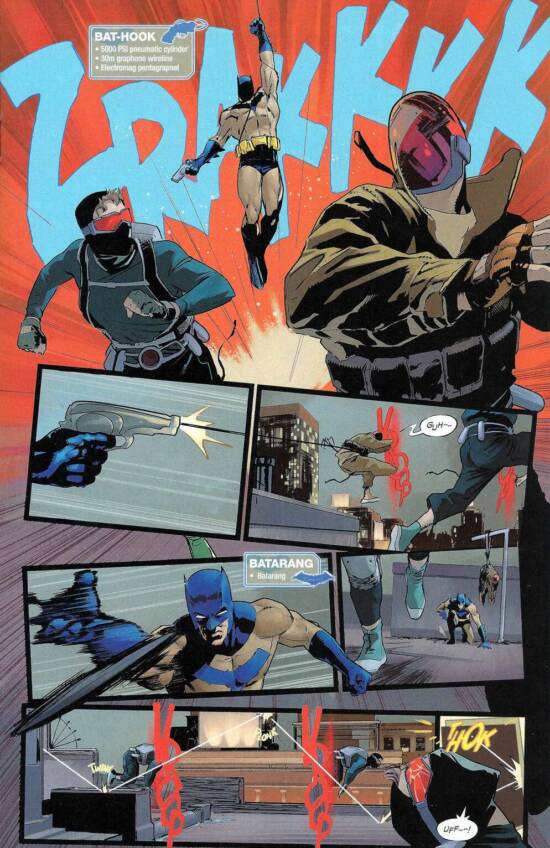
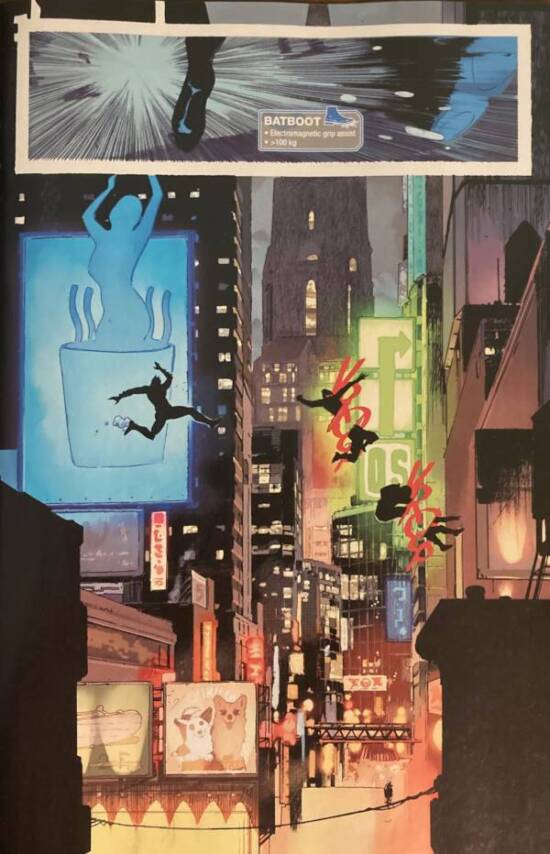
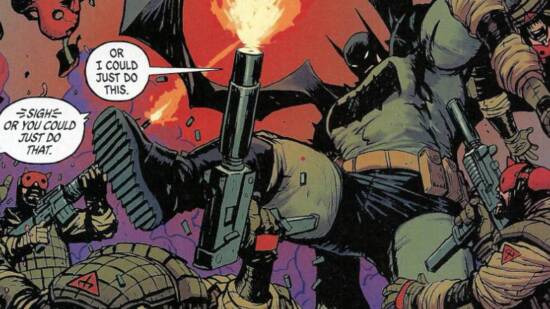
Rather than a team-up, the issue is a study in contrasts. Standard issue Batman is a lithe, fast, relentless detective armed with various hi-tech gadgets. This story, embellished by the very clean lines of artist Javier Fernandez, reminded us how science fiction Batman can be, with his electromagnetic boots and his wire grappler. Absolute Batman, on the other hand, uses his trademark bulk and lack of restraint to smack around a gang called The Red Devils, using his axe, his strange-molecule cape, and some purple smoke. Mr Snyder, writing this second story, uses Batman’s coach (for want of a better term) Alfred Pennyworth in narrative exposition. In Mr Fraction’s story, Alfred Pennyworth is dead, and without the Pennyworth monologue this first of the twinned stories is as a consequence not as text-heavy as Mr Snyder’s story.
The publication of this story happens to coincide with the award of a Nobel Prize in chemistry to Henri Kagan of Paris-Sud University and Kenso Soai of the Tokyo University of Science. Life tends to develop with mirrored halves: we are born with molecular symmetry in our bodies, as are all animals. In the skull of most animals, such as humans, we have mirrored eyes and ears and nostrils, and so on. This extends all the way down our bodies, and the bodies of all animals. Yet we have a preference called chirality, which manifests as right-handedness, or left-handedness, and for creatures like snails, how shells spiral to one side rather than the other. The two Nobel Prize-winning academics have discovered a tricky way of skewing chirality, using mixed catalysts to create asymmetric amplification. How apt for this title of mirrored halves. It prompts us to ask, in relation to standard continuity Batman as written by Mr Fraction, and Ultimate Batman written by Mr Snyder, which is the favoured half in the symmetry? Both are very entertaining, but which is the preference?
My Snyder is not a Nobel Prize winner in chemistry. He does offer an oblique explanation within this title, to those in the know, as to the origins of this mirroring Ultimate universe. Bruce Wayne is a construction worker in the Ultimate continuity, and there are a series of panels where he is discussing with his boss, Lucius Fox, the the flaws in a new high-rise building. ‘The integrity here has somehow been compromised…can you find the Source?’ Later in the issue, Bruce responds to Lucius: ‘The problem wasn’t in the affected parts… it was here. A crack in the piling. The whole foundation was corrupt’. This is an extended reference to the Ultimate universe being a by-product of the insidious essence of Darkseid, DC Comics’ go-to cosmic villain, at the universe’s creation in a story called Absolute Power. (The Source is a reference to the force which sits behind Darkseid and his kinfolk, the New Gods.) No chemical catalysts and amino acids here.
This issue was an appropriate introduction to the two iterations of DC Comics’ most popular chiral property. For the purposes of the Comic Book Round-Up’s score card system, we give it 3.5/5.