


Created by Nick Green / Link Nexus (Detroit)
Story / screenplay: Elias Mercer
Independently published, 10 November 2026
Every grand engineering project rests on an article of faith: that the machines will keep running long after their builders are gone. In Nexian Universe #1, that faith is put to the test when an otherwise stable energy network begins showing signs of trouble. Set in a world of crystal nodes, flying whales, and transit pods hovering over crowded streets, the opening chapter introduces a sprawling technological infrastructure that is considerably more fragile than its operators would like to believe. And when the central system begins to fail, the question quickly becomes one of priorities: who gets sacrificed to keep it running?
Here is the promotional copy:
Nine minutes. That’s how long Nexus Prime has when its Heart starts to fail.
Sera Venn is a maintenance technician who hears the Heart Nexus’s rhythm go wrong through the machinery — before any instrument flags it. She whispers one word in Nexian: A-N-S-RA — world.
Against orders, she goes to the Heart to save a dark district, and pays for it. Around her, an older warning reaches the Council of Twelve, a rescue specialist holds collapsing machinery together by hand, a Keeper guards sealed archives from a war he survived, and a solo salvage worker follows a route to a gate sealed for generations. When the old network wakes, nothing stays sealed.
This is Issue #1 of the Nexian Universe: a complete 22-page story (plus cover) that opens a larger universe.
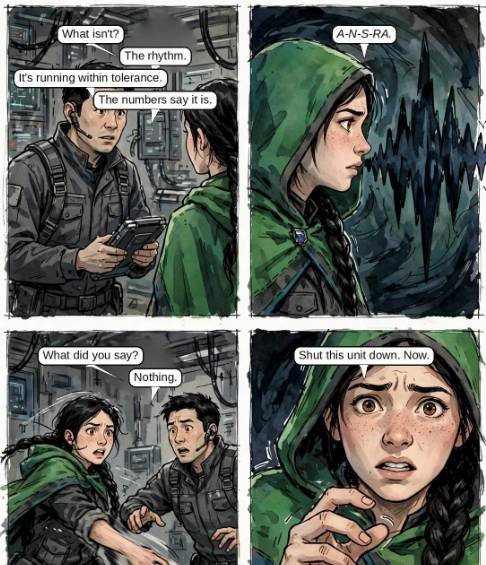
The story unfolds across a series of timed checkpoints, from “The First Minute” to “The Ninth Minute”. Sera, a field technician wearing a green cloak and goggles, notices an irregularity in the machinery’s rhythm. The numbers say everything is within acceptable parameters, but her instincts tell her otherwise.
Meanwhile, councils debate whether to cut power to the outer districts to protect the capital, a hooded figure guards sealed historical records, and a worker named Kade struggles to stay alive at a volcanic site. When Sera attempts to stabilize the grid by rerouting energy through an older, unmapped pathway, her solution comes with consequences of its own. The network survives, but not without damaged hearing, fractured systems and the unsettling possibility that something much bigger has just been awakened.
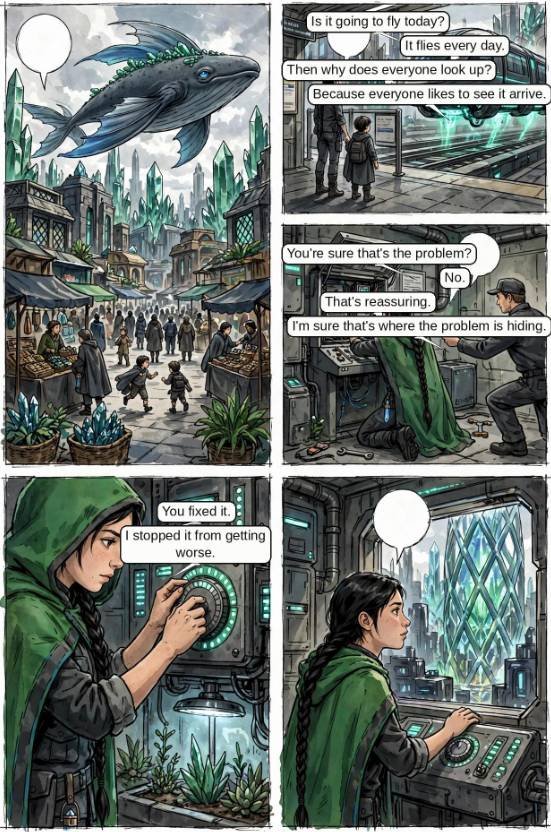
There’s an interesting thread running through the story concerning institutional complacency and the dangers of withholding information. Officials are more concerned with following established procedures than addressing the warnings flashing in front of them. (We do not often see organisational psychology so well fleshed out in a comic book.) Meanwhile, the guardians of historical knowledge have become so afraid of repeating past mistakes that they would rather keep potentially useful information locked away. Unfortunately, that leaves everyone else with little understanding of what they’re dealing with when things go wrong.
The script does a decent job of maintaining tension through clipped dialogue and frequent changes in location, although the constant jumping between characters and events occasionally makes it difficult to settle into any one storyline.
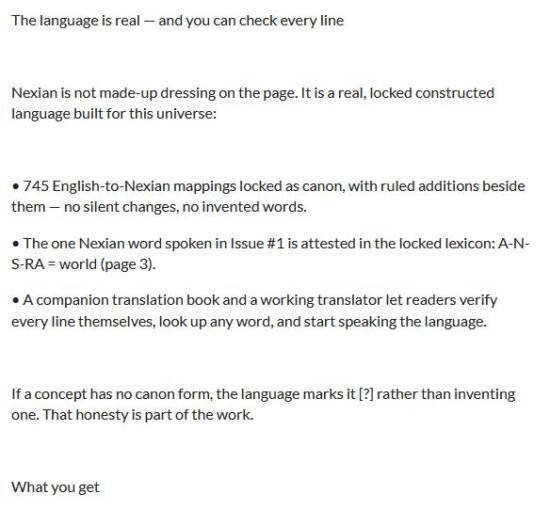
The creators have also put considerable effort into the world’s linguistic foundations. Nexian comes with its own constructed language, reportedly supported by a 745-word canonical lexicon, a system of glyphs and even a standalone online translator. Conlangs in mainstream comics reached a high point with Jonathan Hickman’s work on X-Men for Marvel Comics from 2019-2024 – the mutants’ secret written language was more a cypher than a conlang, but it was fun to follow.
It’s certainly an ambitious addition to this project, although its practical relevance to this first issue is limited. The comic is written in English and features just one Nexian word, A-N-S-RA, meaning “world”. Readers can follow the entire story without having to consult any of the supplementary material. Those with an interest in constructed languages might appreciate the extra work, but for everyone else, it’s an optional curiosity rather than an essential part of the reading experience. We assume the creators went for ‘accessible’ as a virtue rather than ‘time-consuming and challenging’.
The artwork does the heavy lifting in establishing the setting’s atmosphere. Ink-heavy linework is paired with moody, watercolour-like washes of slate grey, mossy green, amber and electric blue. Crystal formations, glowing conduits and imposing industrial panels give the technology a tangible presence, while the contrast between geometric machinery and crumbling stonework helps sell the idea of an advanced civilization built on increasingly unstable foundations. (Ruins in science fiction are always appealing – our present is their ancient history, demonstrated by familiar landscapes badly deteriorated.)
The characters are also reasonably expressive, with wide eyes, clenched jaws and strained hands helping communicate the urgency of events when the situation gets particularly chaotic.
Unfortunately, the visual presentation has noticeable problems. The artwork, which the creator has disclosed to have been produced using AI-assisted roughs followed by human finishing, has moments where the end result simply doesn’t feel complete. Blank speech balloons, clipped or overlapping dialogue, blurred patches and inconsistent lettering make several pages look more like unfinished proofs than a properly prepared comic.
Character continuity is another issue, with Sera’s goggles and hood occasionally appearing and disappearing between scenes. These aren’t deal-breakers, but they do make the reading experience unpolished and disappointing. There’s also the ever present “Thousand Yard Stare” issue common among rough Gen AI artwork.
We are generally open-minded to the use of AI in comic book creation, but this is sloppy. We are loathed to say this, but why should we care to read a comic if the creators cannot care enough to finish it properly?
Despite these shortcomings, Nexian Universe #1 has an interesting premise and enough narrative momentum to make its opening chapter worth a look. Its strongest ideas concern the vulnerabilities of complex systems and the people who are expected to keep them running, particularly when those in positions of authority would rather protect established arrangements than confront uncomfortable problems. The world-building is ambitious, perhaps more so than this first issue can comfortably accommodate, but there’s worthy potential. Whether the series can develop its sprawling setting, characters and elaborate linguistic framework into something more cohesive is something our editor, at least, doubts, because of the lack of care in issue 1 as a finished product. Hopefully the creative team can prove him wrong.
For now, though, the title establishes a reasonably compelling crisis.
You can read this title for free via this link: https://linknexus313.itch.io/nexian-universe-issue-1-nine-minutes-without-a-heart