

Writer: Pornsak Picheshote
Artist: Rafael Albuquerque
DC Comics, August 2026
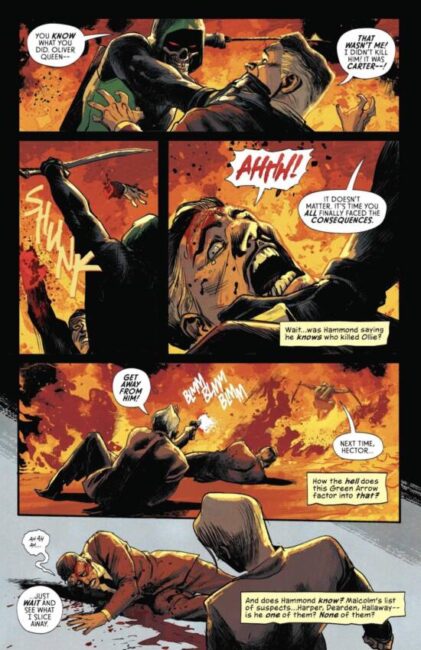
Some people will be pleased by Green Arrow being rendered as a vengeance-fuelled ghoul, firing arrows tipped with a fast-working biological agent that causes the target’s skin to bubble and boil. Green Arrow in this alternate universe created by DC Comics, fouled by evergreen menace Darkseid’s influence from inception, looks a little like Taskmaster from Marvel Comics, or the Enforcer skin from Fortnite. The titular character, along with the supporting cast of mostly dead or infected thugs, is drawn with great skill by artist Rafael Albuquerque. Mr Albuquerque’s style reminds us of English artist Jock (a significant compliment), with its heavy shadowing and furrowed, lined facial expressions.
Here is a section of DC Comics’ editorial warbling on the title – see https://www.dc.com/blog/2026-05-22/absolute-green-arrow-is-a-slasher-comic-that-will-shock-you-to-your-core :
I feel like there will be so much more to unpack, debate and theorize on as the series continues, but for now, suffice it to say that Absolute Green Arrow is one of the most intense comics you’ll read this year. It’s not a superhero book. It’s a horror slasher that thrills while asking some pretty provocative and timely questions. In other words, a perfect addition to the Absolute Universe.
The slasher theme explains the font of the title, which has a very 1990s “graffiti drawn in blood” vibe. But if DC Comics’ editorial team was hoping for thoughtful provocation, then they have missed something quintessential about horror. Horror is rarely thoughtful, and especially slasher horror.
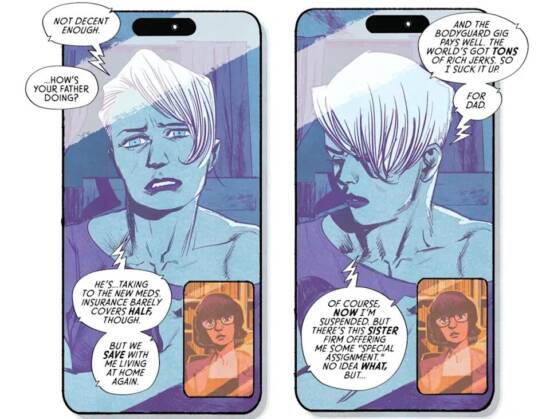
Dinah Lance, a former mixed martial arts fighter and now bodyguard, is our guide through this story. This initial arc is called “The Longbow Killer”, a nod to the Eisner-nominated 1987 Green Arrow story “The Longbow Hunters”, by Mike Grell. High water mark in the development of Green Arrow it might have been, but the depiction of Dinah within Mr Grell’s story, as a bound and tortured victim, was gratuitous and disturbing. Dinah here is a different type of victim. Dinah’s father is very sick, and medical insurance does not cover the invoices for his medication. Darkseid has not provided universal healthcare for Americans in this fictional universe, either.
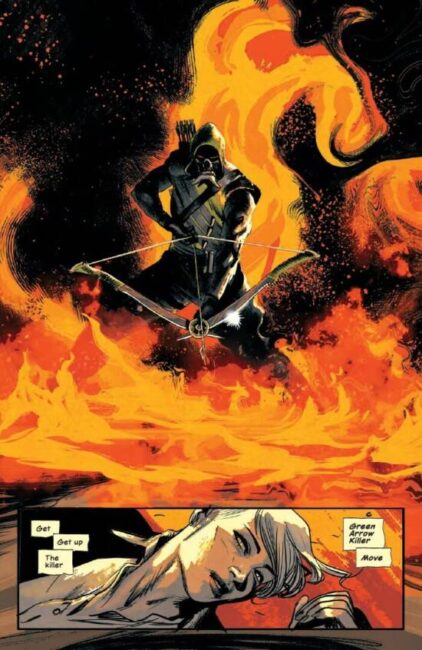
There are plenty of action scenes. We witness Jubal Slade’s horrible murder in the first few pages, which includes torture and genital mutilation. And in the image above, we see Green Arrow framed like a demon in the inferno, undeterred by fire around and behind him in an eight page action sequence.
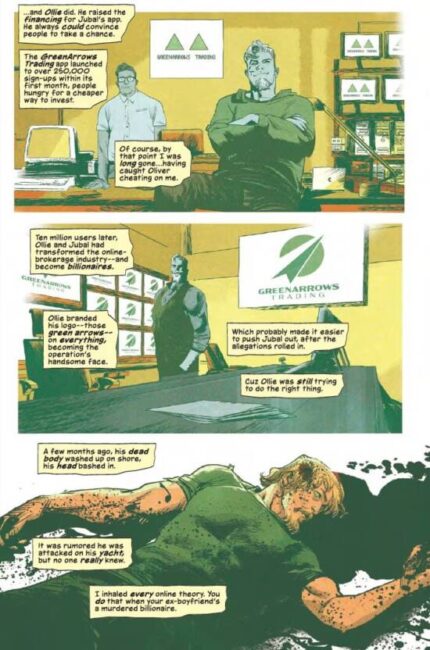
But in the middle of the story, we are confronted with six pages of text-heavy exposition, half of them masked as a video psychologist session, and the other half as a flashback. This is an enormous speed bump.
In The Dark Knight Returns (1986), Frank Miller introduces us to an Oliver Queen who is missing his right arm. There is in two light brushes – two word balloons – the background that Queen has his arm removed in a failed attempt by Superman to shut down the archer’s subversion.
In stark contrast, there is no nuanced suggestion of background in Absolute Green Arrow #1 – we are spoon-fed, in big chunks, Dinah’s father’s illness, Dinah’s anger management issues, Dinah’s failed relationship with Oliver Queen, and Oliver Queen’s rise to wealth as a techbro. Some of this is communicated in a monologue written in narrative boxes resembling scraps of paper, as if it is a series of diary extracts. Wading through this is tough going. Writer Pornsak Picheshote is very concerned about the delivery of his action sequences, and the price to pay for this is a background which is designed to educate the reader as to the differences between the Absolute Oliver and Dinah compared to the main-continuity Oliver and Dinah.
It is not subtle, in any sense. But then again, slasher horror never is.