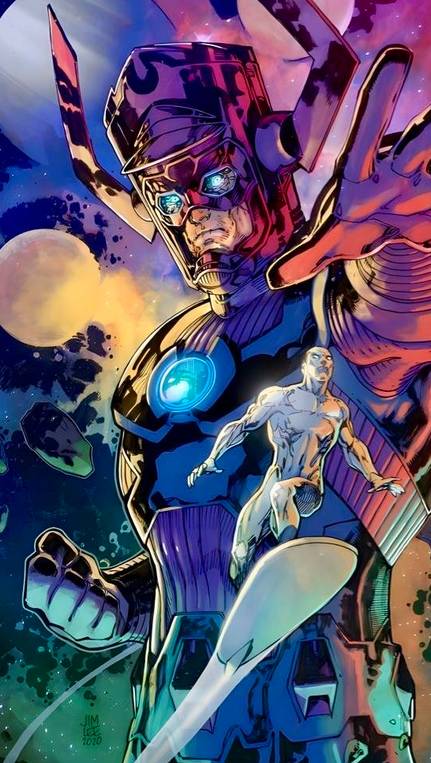
Created by Jack Kirby and Stan Lee
Marvel Comics, 1966
The American superhero genre of comic books is rife with conquerors, petty criminals, and megalomaniacs obsessed with political power. One of the most enduring threats that has plagued Marvel Comics’ over-crowded roster of superheroes is one that can’t be classified as evil. He does not care about ruling the cosmos, amassing wealth, or satiating his ego. When Galactus appears in a comic, he (usually) has one simple motivation: like the teenage boys who were his initial audience, he is always hungry.
Galactus first stomped into the pages of comic books in 1966, along with his herald Silver Surfer, in Fantastic Four #48. A creation of American comic book luminaries Jack Kirby and Stan Lee, this colossal creature represented something far grander than standard costumed villainy. With a giant letter G on his chest, this was, for teen readers, the inscrutable face of God, rendered in purple and blue. They could not get enough of him.
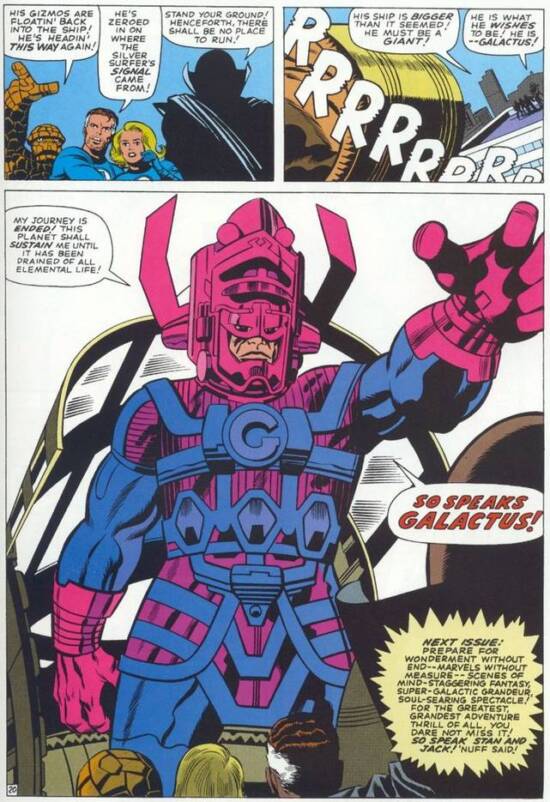
Galactus is not simply an individual who possesses malice and ambition. He is an extinction-level catastrophe with a face, driven by biological necessity. He does not destroy worlds out of hatred or cruelty. Galactus is an indifferent god, the worst of all types of gods. Wikipedia quotes Stan Lee on his creative vision for Galactus:
Galactus was simply another in a long line of super-villains whom we loved creating. …[W]e felt the only way to top ourselves was to come up with an evil-doer who had almost godlike powers. Therefore, the natural choice was sort of a demi-god, but now what would we do with him? We didn’t want to use the tired old cliche about him wanting to conquer the world. There were enough would-be world conquerors in the Marvel Universe and in all the other comic book galaxies. That was when inspiration struck. Why not have him not be a really evil person? After all, a demi-god should be beyond mere good and evil. He’d just be (don’t laugh!) hungry. And the nourishment he’d require is the life force and energy from living planets!
Jack Kirby’s perspective was, typically, more thoughtful than Stan Lee’s cliche-dodging:
My inspirations were the fact that I had to make sales and come up with characters that were no longer stereotypes. In other words, I couldn’t depend on gangsters. I had to get something new. For some reason, I went to the Bible and I came up with Galactus. And there I was in front of this tremendous figure, who I knew very well because I’ve always felt him. I certainly couldn’t treat him in the same way I could any ordinary mortal. And I remember in my first story, I had to back away from him to resolve that story. The Silver Surfer is, of course, the fallen angel. When Galactus relegated him to Earth, he stayed on Earth, and that was the beginning of his adventures. They were figures that had never been used before in comics. They were above mythic figures. And of course they were the first gods.
As long as Galactus exists, the threat of another world being consumed remains. His stories can therefore explore the limits of heroism, particularly when the lives of entire civilizations are at stake. As comic book publishers continually escalated stakes over the decades, introducing reality-warping entities, multiversal threats, and universe-ending villains, Galactus retained his relevance through sheer simplicity. For a planetary threat who does not need to justify his hunger to anyone, however, Galactus does like to indulge in some extended monologue.
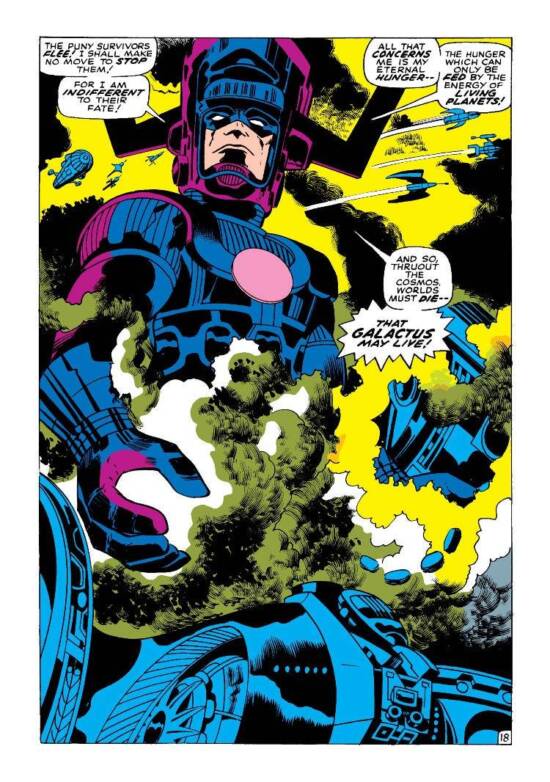
Jack Kirby understood that superhero comics excel when making abstract concepts physically imposing. Sclae was important to Mr Kirby. By drawing Galactus as an enormous figure dwarfing the hhuamn figures in panel, the artwork immediately established a sense of insignificance. Gods are, after all, tall. Aphrodite in The Aenas was so tall that her head brushed the beams of a ceiling, and in Ovid’s Metamorphoses, Artemis is head and shoulders taller than her companions. Thor and Hercules have swaggered around the Marvel universe for decades with bulk and height aplenty, but Messrs Kirby and Lee decided to scale Galactus up another level again. As the herald tasked with finding worlds for consumption, the Silver Surfer provided a human-scale perspective to both Galactus’ mind-boggling size as well as an incomprehensible cosmic process.
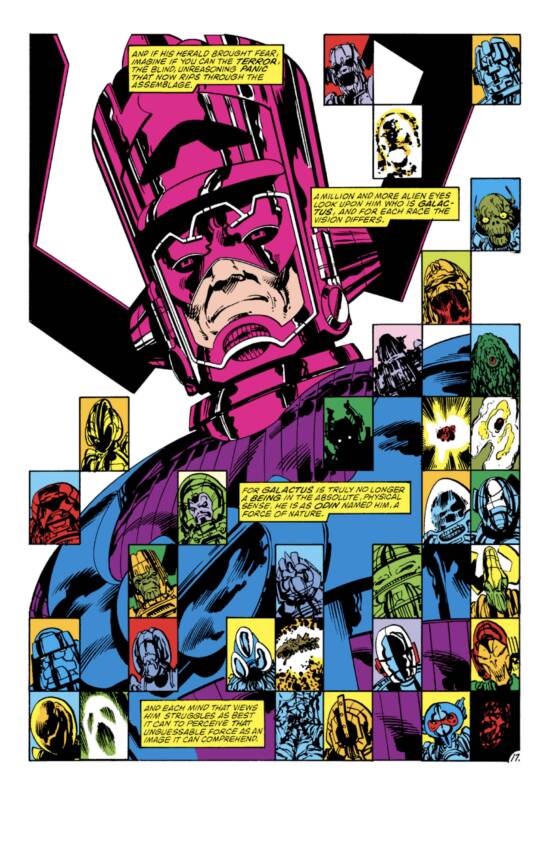
Why is this god in the shape of a man? John Byrne in Fantastic Four issue 262 (1984) provided a fascinating answer to this. Galactus as a cosmic entity is hard for mere mortals’ brains to process. As a result, he is perceived by the observer within a structure they can comprehend. For humans, he looks human. For other species, he looks like something else. This page below explains how it works, and how it looks:
Galactus’ longevity can also be attributed to the fact that Marvel Comics’ editors has found ways to use him beyond his original function as a cosmic threat. His immense power makes him a natural candidate for stories involving the fate of the universe, but his role in Marvel’s mythology has also allowed writers to explore the nature of his existence and the purpose he serves. Galactus has to that end been a catalyst for change within Marvel’s continuity, most notably in Fantastic Four #257 (1983) by John Byrne when he consumed the home world of Marvel Comics’ most persistent alien villains, the Skrulls.
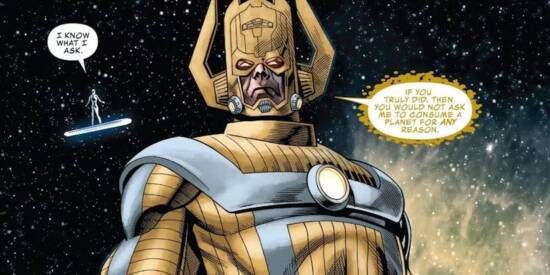
And then, an inspiration. In 2016 Galactus was transformed into the Lifebringer. Rather than consuming planets to sustain himself, he gained the ability to restore life to worlds. The change offered a different perspective on a character whose identity had long been associated with destruction. The purple and blue hues were switched out for gold and white. This was no longer an indifferent god: it was a god of life.
Such a transformation carries its own risks. Galactus is an iconic character partly because of the dread his arrival inspires. Turning him into a force for creation challenges that established identity, but it also demonstrates that there is more to explore than another story about a planet facing imminent consumption.
This was a phase we personally enjoyed (we wrote about it in October 2016 – see https://worldcomicbookreview.com/2016/11/05/civil-war-ii-ultimates-12-review/ ). But Galactus as Lifebringer only lasted two and a half years: The Ultimates (vol. 2) #1 published in January 2016, ending in Infinity Countdown issue 4 (June 2018).
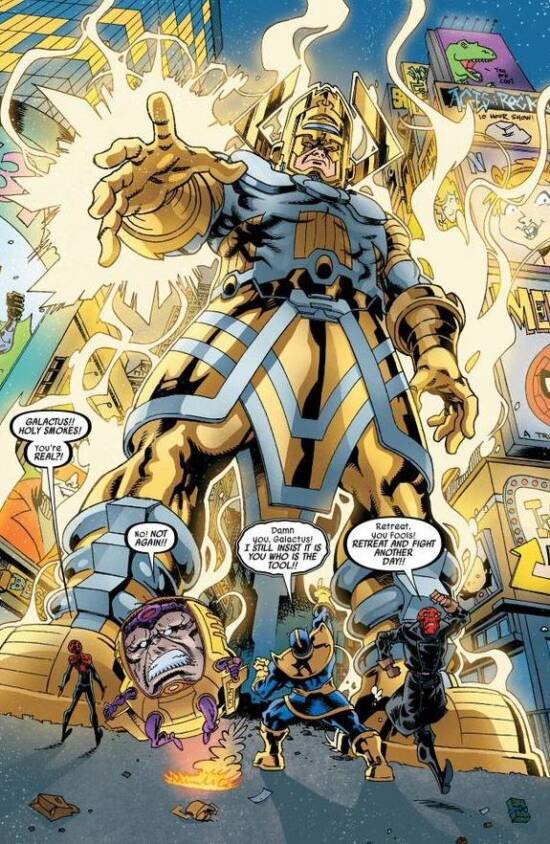
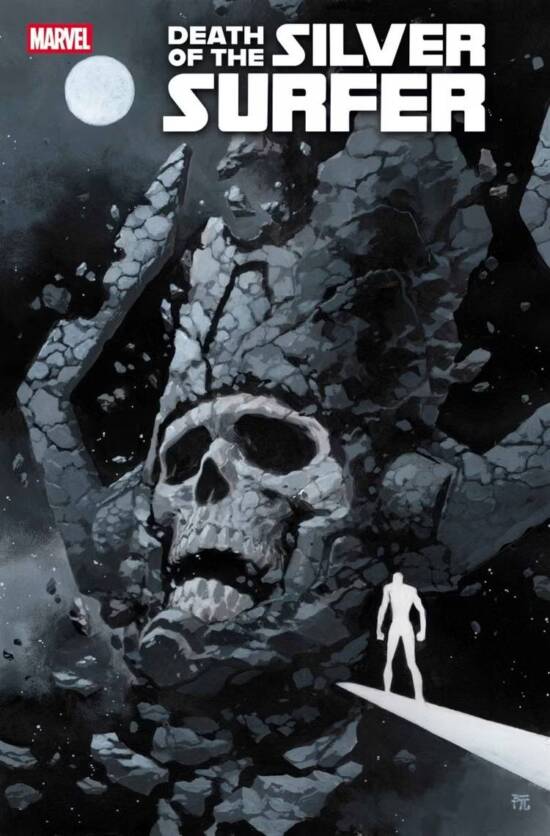
Galactus has also been a dead god. In fact, for a cosmic being, Galactus has been dead an unseemly number of times. This website counts the many deaths of Galactus: https://www.comicbasics.com/all-times-galactus-died-in-the-comics-explained/ , some within continuity, some not. But like all proper gods, and indeed all respectable characters in superhero comics, resurrection is part of the deal.
The character has had an impact beyond pop culture. In 2013, an astronomical software tool for the modelling of hydrogen in galaxies was called Galactus. That strikes us as completely appropriate.
But, back to the comics. Sixty years after his debut, the World-Eater remains effective because his stories can accommodate both the spectacle of cosmic destruction and the moral dilemmas that follow in its wake. Marvel’s universe may have grown considerably more complicated since Galactus first appeared, but the central problem he presents is, yet again, remarkably simple. and relatable: hunger. Happy 60th birthday, Galactus.