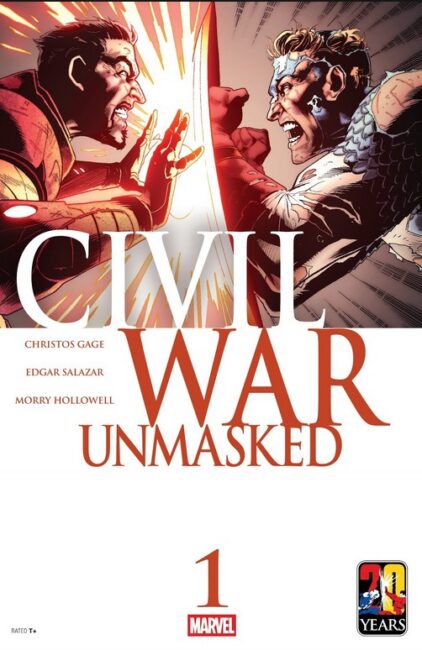
Writer: Christos Gage
Artist: Edgar Salazar
Marvel Comics, May 2026
The first question many readers will probably ask when they see Civil War: Unmasked is simple: why?
The original Civil War crossover ran for seven issues from July 2006 to February 2007. Its central conflict ended long ago, and most of its fallout has already been overtaken by later Marvel-wide events. Even Civil War II, which ran for eight issues in 2016, has largely faded from readers’ memories, with most of its continuity impact either forgotten or quietly ignored. That sense of distance is probably even stronger now that Marvel’s more widely seen cinematic universe has staged its own version of Civil War, which is likely what many fans think of first when the title comes up.
That said, Civil War: Unmasked #1 is not a pointless revisit.
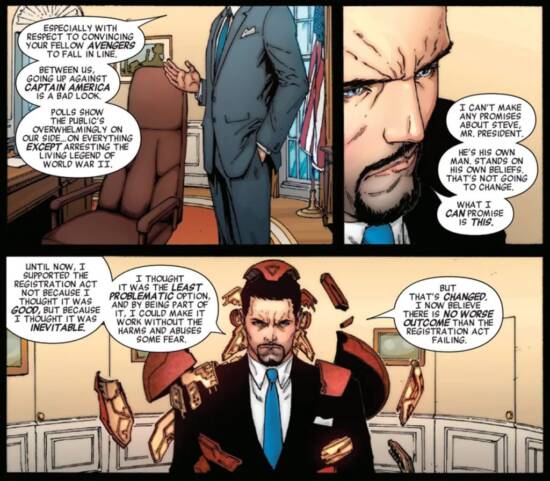
In fact, it works surprisingly well as a companion piece to the original event. One of the biggest criticisms of the 2006 storyline was Tony Stark’s seemingly extreme commitment to the Superhuman Registration Act, even when it meant turning against friends, teammates, and longtime allies. Unmasked sets out to address that question directly.
The issue drops readers into a familiar moment from the original Civil War: Tony Stark’s attempt to recruit Emma Frost to the pro-registration side. Emma refuses, insisting that what little remains of mutantkind must stay neutral. Readers of the original story already know this scene, but Unmasked expands it by revealing an unseen layer behind the meeting.
After approaching Emma, Tony is contacted by Bishop, a time-traveling mutant from the future. Bishop shows him a grim timeline in which the failure of the Superhuman Registration Act pushes the U.S. government toward a far more extreme response. That future eventually leads to the near-eradication of mutantkind, and the enslavement of the surviving human population.
That revelation forms the heart of the issue, rendered with palpable intensity by artist Edgar Salazar.
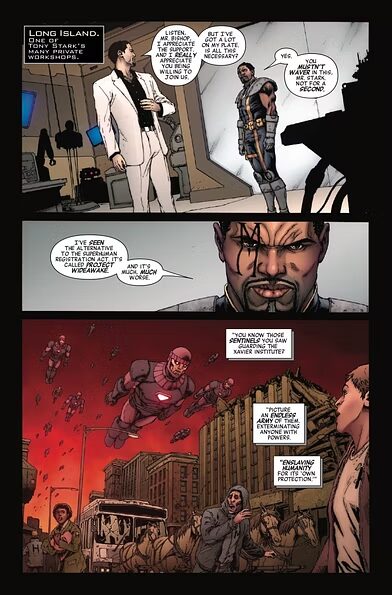
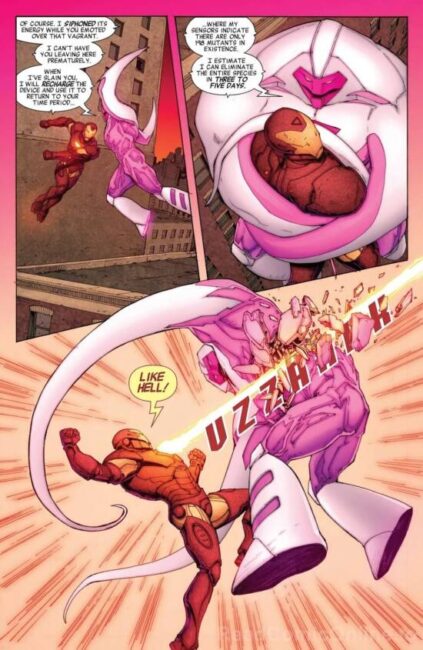
Mr Salazar’s kills extend into the rendition of a dystopian New York City, with buildings crumpled and buses drawn by horses. Tony and Bishop cloak themselves so they can observe this future without interfering, but things quickly go wrong when they are detected by Nimrod, the most advanced Sentinel model ever created. Nimrod’s ability to constantly adapt to its opponents’ powers makes him an immediate threat, and the inevitable action sequence follows. While the fight itself is solid, the real tension comes from the possibility of Nimrod following them back to the present. The issue handles this well, with a clever bit of strategy that prevents that from happening.
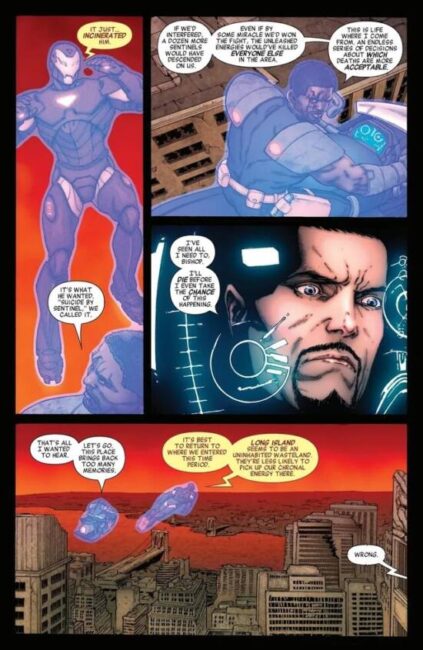
Once Tony has seen that future with his own eyes, his determination suddenly makes far more sense. His support for registration is no longer framed simply as political arrogance, control-freak behavior, or ideological stubbornness. It becomes an act of desperation. He is not merely trying to win an argument with Captain America. He is trying to prevent a future apocalypse.
That does not necessarily excuse Tony’s actions in the original Civil War, but it does make them more understandable, and that alone gives Civil War: Unmasked #1 real value.
Despite the initial skepticism surrounding the project, revisiting a crossover that no longer has much relevance to present-day continuity and has largely faded from mainstream reader attention, this first issue turns out to be a worthwhile read. It fills in some of the gaps left by the original event and adds a layer of motivation that arguably should have been there from the beginning.
On its own, Civil War: Unmasked may feel like an unusual release. But as part of a future omnibus or complete Civil War collection, it makes a lot of sense. For readers who enjoyed the original event and wanted a little more substance behind one of its most controversial character turns, this is a strong and genuinely useful supplement.
WCBR Score: 4/5