Creator: Lando
Breakdown Press and and Gosh! Comics, March 2026 (Third Edition)
As we have previously explained, we are usually very reluctant to review anthologies, because it is hard to give what we regard as adequate attention to each of the stories in the collection. For Gardens of Glass, however, we make an exception.
Here is the promotional copy:
Gardens of Glass is a retrospective collection of comics by Lando, bringing together the very best of his short works produced over the last five years for Decadence Comics, the influential publishing collective he co-founded with Stathis Tsemberlidis.
Blending Ballardian contemplation of the near future with the aesthetics of early European sci-fi comics, Lando’s incredibly meticulous, impossibly fine pen line describes the deserted world that follows the Anthropocene epoch, where warfare, class division and ecological collapse dominate the landscape.
Gardens of Glass contains the stories “Olympic Games”, “Last Drink”, “H.A.A.R.P.”, “Pyramid Scheme”, “Flood Tablet” and “The Marble Man”.
Gardens of Glass is a book which we picked up in May 2026 on a trip to London. This title explores cities which are dead, landscapes littered with the debris of civilisation. In 2014, The Comics Journal described https://www.tcj.com/two-intersecting-visions-decadence/ the creator of this anthology, Lando, as ‘[an] apocalyptic futurist, dealing with the nuts and bolts of worlds in strife and the realities of survival in far off lands’. Most of the stories in this anthology are concerned with life in a post-apocalyptic world when humanity is in its last gasps. Things are not looking so good for us at all. Your reviewer once watched an interview with sculptor Sir Antony Gormley, who casually noted how humans were likely to be extinct in around 200 years. These stories, on that timeline, are set perhaps in the last decade of humanity.
Ruins have a certain allure, and for centuries the stones of dead cities have been tourist attractions across the world. But Lando’s wastelands are bereft of charm, and their shattered monuments are instead only a potential place to hide. Humans are like cockroaches and the continuation of the species beyond the generation featured in the stories seems very unlikely. And the tales often feature warring between the remnants of humans, which seems to us to be an inevitable consequence of basic resources which have diminished to almost nil. This is a collection of the worst of dystopias.
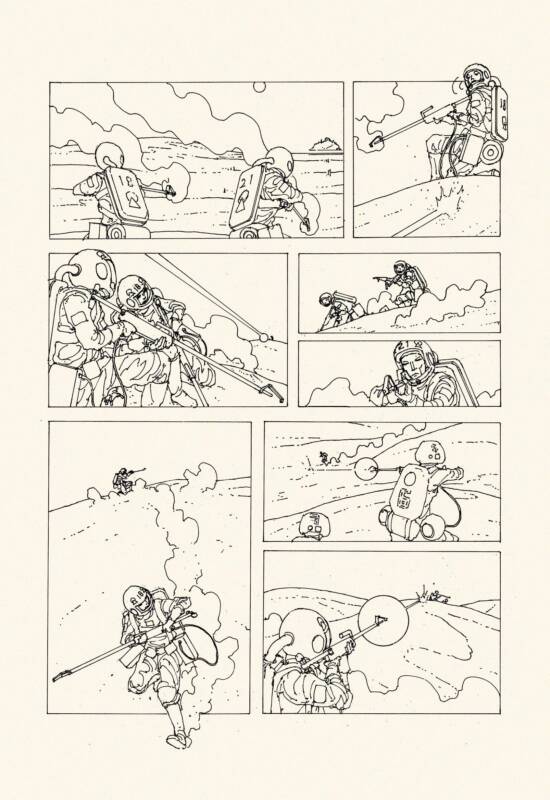
Lando’s art is fine line, inevitably drawing comparisons to Moebius both because of the style and the science fiction themes. It is spidery at times, even in Lando’s depiction of grand landscapes. Barely perceptible clouds of smoke waft from the burned bodies of those exposed to sunlight, which smashes like the fist through parting clouds, in the story ‘H.A.A.R.P’. It is wispy and ephemeral, and makes every panel look bleached as a bone.
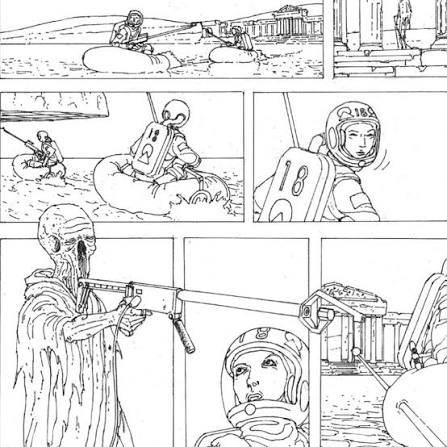
The two exceptions to grubby dystopia are unpleasant in their own way. The first is the lead story, ‘Olympic Games’. This story involves vacuum-suited fighters, armed with rifles, in a race across a brittle landscape towards a hypocritical Valhalla. It is a thematic cousin of The Hunger Games but bleaker, and somehow more cynical. The second, entitled ‘Pyramid Scheme’, is a callous assessment of the destructive power of science, presented as allegory: a man, a woman and a child in a silent world of floating platforms, dressed as Olympian deities, whereby the man is distracted by abstract forms, leading to the literally collapse of their home. (We are spared a direct scene of the mother and her child falling to their deaths, each substituted by a chair and a giant teddy bear.) It is not especially subtle.
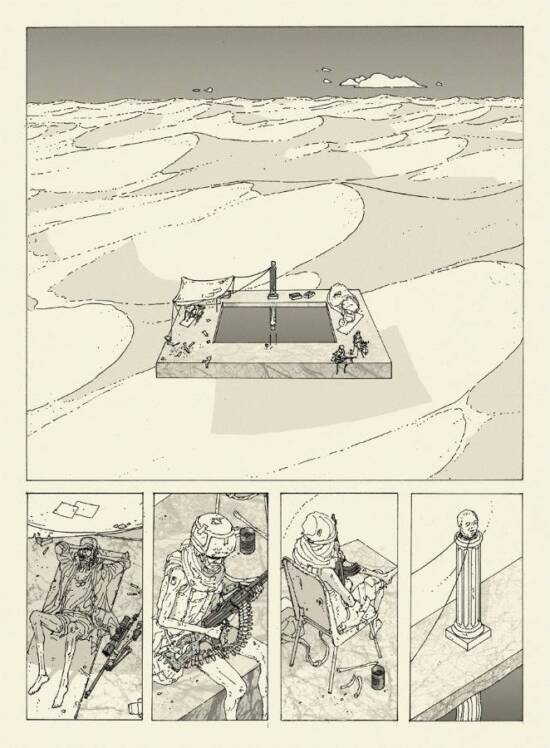
The story which we found most compelling was the forty-page closer, ‘The Marble Man’. (It is also the only story in the anthology with dialogue.) Perhaps we are all feeling jittery about artificial intelligence at the moment, but this post-apocalyptic story about inhuman decision-making and human sacrifice was frightening. It features an animated bust shaped like a Roman emperor, tethered with little more than a string, which guides a scrappy group of fighters towards battle with other undernourished humans. The bust and its human catspaws float about on a silent rectangular monolith, flat and thick, and with a large square pool in the centre, and a ragged beach umbrella and a temporary tarpaulin for shade. The dead are placed in the pool, for reasons which aren’t clear but which assists the animated head towards its liberation. The bodies float in the pool like sausages in a broth. The head lies about possible threats, encourages violence, gives false solace when one of the few survivors is seriously injured, and then murders her when no one is looking. With each death, it advances in its appearance, developing a chest, youthful features, arms and legs. Eventually, it shrugs off the thin yoke. Science fiction should not be so prescient.
Andy Oliver, writing for Broken Frontier in 2025 https://www.brokenfrontier.com/gardens-of-glass-landos-socio-political-sci-fi-collected-by-breakdown-press/, prosaically notes:
‘All of Lando’s strips here, then, are uncompromising in delivery, tone and aim. This is not work created to entertain in the leisurely sense but, rather, socio-political commentary wrapped up in the traditional standards of the science fiction form. The message is simple. These are not worlds for the reader to escape into. These are worlds for the reader to avoid. This isn’t about “What if?” it’s about “What will be!” if the inherently flawed values of contemporary civilisation go unchecked. For anyone with even a passing interest in the major boundary-pushing players in UK self-publishing over the last decade-plus Gardens of Glass is an essential acquisition. Oblique but hypnotic, these dystopian parables are a savage indictment of a society doomed by its own inexorable moral devolution.’
What we see instead are a collection of stories about the absence of hope. The only story which left us scratching our heads, ‘Flood Tablet’, which endeavours to draw a parallel between a Visa Card lost in a flooded glass mall and the Rosetta Stone. It is bleak – the story begins with the image of a hanged man – but delphic in its rendition of a human being transformed through some sort of DNA-driven science into a snake.
The title is available for purchase here: https://www.breakdownpress.com/store/gardens-of-glass . Or, if you are in the UK and wish to support Oxfam, there is a secondhand copy here: https://onlineshop.oxfam.org.uk/gardens-of-glass/product/HD_304157384?sku=HD_304157384 . (Outside of this title, Lando and his long-standing collaborator Mr Tsemberlidis are presently working on an intriguing video game. Like fashion house Hermes’ “L’appel du large” digital works, it is hand-drawn, which in an age of artificial intelligence saturation is a mesmerizing concept: https://www.killscreen.com/decadence-comics-rhizomatic-compound/ .)