

Writer: Lavender Vroman
Artist: Joshua Kemble
Turner Publishing, September 2026
Not Death, But Love: The Strange, Supernatural Story of Elizabeth Barrett Browning, written by Lavender Vroman and illustrated by Joshua Kemble, takes one of Victorian literature’s most famous romances and places it in the unsettling world of 19th-century spiritualism. Published by Nashville-based Turner Publishing, the graphic novel blends historical drama, gothic romance, and supernatural intrigue while exploring the real-life relationship between poets Elizabeth Barrett Browning and Robert Browning.
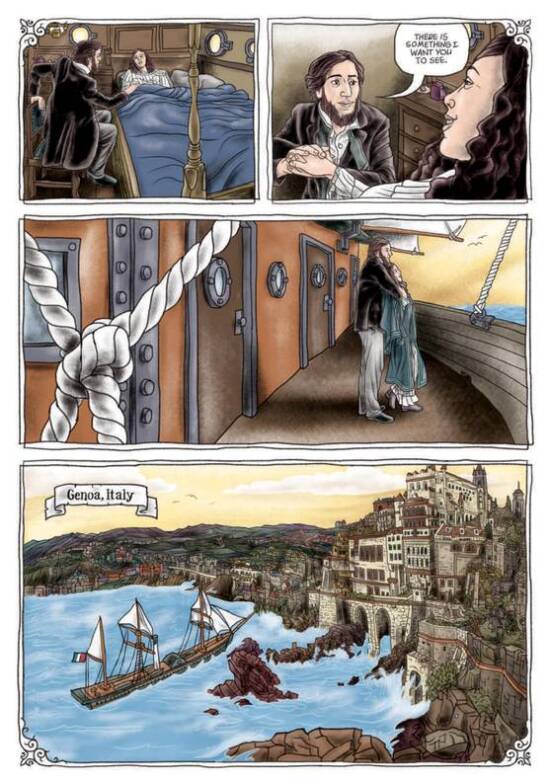
Set in the mid-19th century, the story follows Elizabeth after she escapes the oppressive household of her tyrannical father. She elopes with Robert, eventually settling in Florence, Italy. The warmer climate offers hope for Elizabeth’s chronic health problems, but physical distance from England does little to ease the grief surrounding the tragic drowning of her brother, Edward. Already physically vulnerable and reliant on laudanum to manage her pain, Elizabeth becomes increasingly fascinated by the era’s growing obsession with spiritualism and the possibility of communicating with the dead. This is where Sophie Eckley enters the picture.
An enigmatic American woman, Sophie quickly becomes a close companion to Elizabeth, claiming an ability to channel messages from the afterlife. Elizabeth finds considerable emotional comfort in these supposed communications, while Robert remains deeply skeptical. He views mediums as charlatans and becomes increasingly protective of his wife as Sophie’s influence over her grows.
The resulting conflict gives Not Death, But Love much of its dramatic power. Rather than presenting Elizabeth as merely gullible, the story establishes the emotional circumstances that make her susceptible to manipulation. Her grief, physical suffering, dependence on opiates, and a longing to reconnect with her dead brother create a convincing psychological foundation for her attraction to spiritualism. The supernatural elements consequently feel less like an arbitrary horror device and more like an extension of Elizabeth’s emotional vulnerability.
Here is the promotional copy, taken from the author’s website https://lavendervroman.com/books/:
Deeply researched and strikingly illustrated in Victorian style, Not Death, But Love puts an eerie, romantic twist on the true story of the poet who wrote the iconic Sonnet 43, which famously begins “How do I love thee? Let me count the ways.”

An invalid since childhood, poet Elizabeth Barrett is famous throughout Victorian England, despite a hermit-like existence in the household of her tyrannical father. Opium makes the pain of her mysterious illness more bearable, but she lives in constant expectation of death. To her surprise, she instead finds love with dashing fellow poet Robert Browning, who whisks her away to freedom in Florence, Italy. Captivated by her new home and the revolutionary spirit of the Italian Risorgimento, Elizabeth basks in the glow of a happy marriage and reinvigorated health.
Haunted by lingering griefs, however, Elizabeth is drawn into a shadowy world of séances and mediums as the supernatural craze known as spiritualism spreads from America to Europe. On a
visit to London, she witnesses the otherworldly feats of celebrated medium Daniel Dunglas Home, who claims to conjure the spirits of dearly departed relatives. While Robert takes an immediate dislike to Home, sparking a bitter rivalry, Elizabeth falls under the spell of enchanting Boston heiress Sophie Eckley. The two women embark on a series of spiritual experiments that threaten Elizabeth and Robert’s status as soulmates. Laced with hints of the supernatural, this graphic novel retells Barrett Browning’s story while exploring the timeless tensions between passion and repression, faith and skepticism, hope and despair.
The story becomes particularly effective once Sophie’s motivations begin to emerge. What initially looks like an unusual friendship gradually develops into something far more obsessive. Sophie’s desire for Elizabeth’s affection threatening to drive a wedge between the married poets. Robert’s attempts to uncover the truth therefore become more than an investigation into fraudulent supernatural phenomena. They become an attempt to protect his marriage and rescue Elizabeth from the exploitation of her grief.
The confrontations in the latter portion of the book are consequently among its strongest moments. The tension that has been building around Sophie, Elizabeth, and Robert finally erupts into an emotionally charged struggle over trust, deception, and possessiveness. The conflict is no longer about whether ghosts are real, but about how far someone can go when they become convinced that another person’s affection belongs exclusively to them.
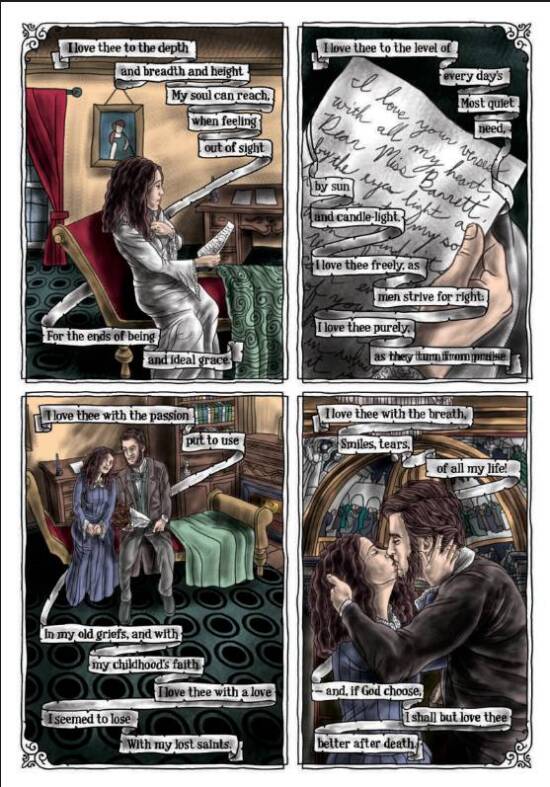
The historical grounding also gives the narrative considerable texture. Ms Vroman incorporates authentic elements of Elizabeth’s life. This clever melange includes her poetry, health problems, relationship with Robert, and grief over Edward’s death. Actual Victorian poetry is woven into the story, helping connect Elizabeth’s creative life to the emotional events unfolding around her. At times the lengthy poetic excerpts interrupt the narrative momentum. The transition from conventional dialogue into extended verses can make certain sequences feel slower than the surrounding story. But the result, overall, is that the reader is watching some sort of avant garde cinema.
Daniel Dunglas Home, however, is a weakest component of the cast. While his presence is important to the plot, he often comes across as straightforwardly villainous, functioning more as a mechanism for advancing the story than as a character with particularly complicated motivations of his own. This is jarring, because it contrasts with the more psychologically nuanced treatment given to Elizabeth and Sophie.
Mr Kemble’s artwork is one of the book’s major strengths. The visual style combines hand-sketched illustrations with mixed-media digital rendering, creating something that feels closer to an illustrated Victorian storybook than a conventional glossy comic. Fine-liner pens, ink, and dark graphite pencil establish the foundation, with visible cross-hatching, organic variations in line weight, and hand-drawn panel borders giving the pages a tactile quality. Soft digital shading and airbrushing are then layered over this traditional artwork, producing smooth gradients, subtle highlights, and a slightly three-dimensional appearance.
It is an especially appropriate aesthetic for this story. The artwork feels old-fashioned without looking artificially antiquated, and the combination of traditional linework and digital rendering gives the Victorian setting an appropriately atmospheric quality.
Mr Kemble also does an excellent job with facial expressions and body language. Elizabeth’s physical fragility and profound sadness are apparent without requiring constant exposition. Robert’s protective personality is equally readable, particularly in his sharper expressions and more forceful poses. Sophie receives perhaps the most interesting visual progression. She initially appears as an enthusiastic and seemingly innocent companion, but her demeanor changes noticeably when she is alone with the medium Daniel Dunglas Home. The artwork gradually exposes the desperation and obsession underneath her outwardly pleasant persona.
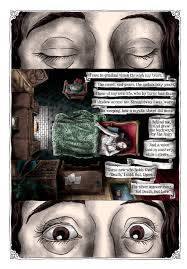
There is one visual drawback that contemporary readers may find challenging. The pages containing lengthy poetic passages are dense. Compared with the more open illustrated pages, these sections can feel visually crowded. That is difficult to criticize too harshly, however, because the presentation is clearly part of the book’s overall aesthetic. (In addition, our editor’s view has always been that comics are a mixed medium, where in recent times text-heavy content has given away to sleek, computer-enhanced art. But that is a rant for him on another occasion.) Replacing the approach with a cleaner more contemporary visual element would certainly make the poetry easier to read, but it would also undermine the Victorian visual identity that the book is deliberately establishing. It is therefore less a flaw in execution than a trade-off created by the material and artistic approach. Readers simply have to accept that some pages demand more effort than others.
Not Death, But Love succeeds because its supernatural premise is rooted in palpable grief. Elizabeth is not portrayed as a foolish woman who suddenly believes in ghosts. She is a brilliant but physically and emotionally vulnerable person desperately searching for some way to reconnect with someone she has lost. That distinction gives the story emotional weight.
The graphic novel’s creators also understand that its central love story works best when contrasted against the destructive forms of devotion surrounding it. Sophie’s obsession and Elizabeth’s grief provide the darker elements, while Robert’s determination to protect his wife provides the emotional counterweight. The supernatural mystery consequently becomes a vehicle for examining trust, possession, manipulation, and the difference between genuine love and the desire to control another person.
Despite some secondary characters being somewhat one-dimensional and the occasional slowdown caused by extended poetry excerpts, the book builds toward satisfying and emotionally charged confrontations. Its combination of historical detail, gothic atmosphere, expressive artwork, and psychological drama makes it an engaging exploration of a lesser-known chapter in Elizabeth Barrett Browning’s life.
The title is available here: https://turnerpublishing.com/products/not-death-but-love